Duckweed Wastewater Treatment: What It Actually Removes
Duckweed removes nitrogen and phosphorus from wastewater, but published numbers hide their conditions. What a duckweed system does, and where it stops.
Search duckweed wastewater treatment and you will be handed a removal percentage within about ten seconds. Ninety-nine percent nitrogen. Ninety percent phosphorus. The figures are real and they come from real studies. They are also conditional on a loading rate, a retention time, a water temperature and a harvest interval, and almost none of that survives the trip from the paper to the page you are reading.
That gap matters if you have a discharge consent to meet. This article gives the numbers with their conditions attached, names the point where the mechanism stops being the plant, and is explicit about the two things the literature is quietest on: winter, and what you are allowed to do with the biomass.
What a duckweed system is, in treatment terms
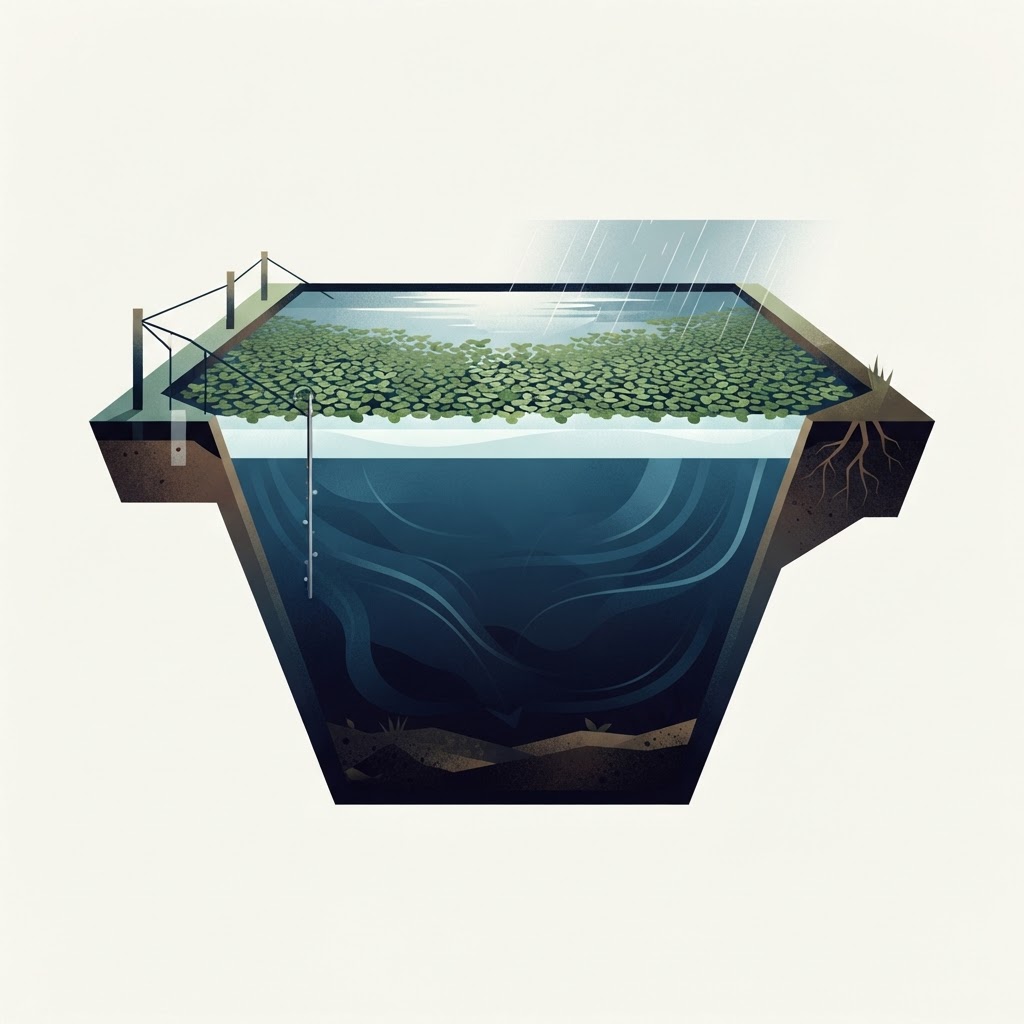
A duckweed treatment pond is a shallow basin with a floating mat of Lemnaceae over it, running as secondary or tertiary treatment. Physically it resembles a facultative lagoon. Functionally it does the opposite of one.
A conventional lagoon works by encouraging algae. A duckweed pond works by suppressing them. The mat outshades planktonic algae, including toxic cyanobacteria, which changes where the nutrients end up. Nutrients held in phytoplankton are difficult to harvest and largely get released again. Nutrients held in duckweed float on the surface and can be lifted out. Suppressing algae also flattens the diurnal pH swing that makes lagoon effluent quality erratic.
The plants are one component, not the process
The same design report is careful about something most summaries skip. Heterotrophic bacteria do the first job, breaking organic matter down into the ammonia and orthophosphate the plants can actually take up. Under the mat, roughly the top 10 centimetres stays aerobic through oxygen transferred by the roots, while the mid and lower water column turns anoxic and then anaerobic, giving denitrifying bacteria their zone. The roots and fronds add biofilm surface area.
So a duckweed system is a plant, a bacterial community and a mat that manages light and oxygen. Which of the three is doing the removal on any given day is not a fixed answer, and the rest of this article is largely about that.
What it removes, with the conditions attached
Two pilot studies make the point better than any average would.
A four-unit pilot using Lemna gibba on domestic wastewater under tropical ambient conditions of 30 to 36 degrees reported maximum removal of 84 percent COD, 88 percent BOD5, 68 percent ammonia nitrogen, 58 percent total nitrogen and 87 percent suspended solids. Those maxima arrived at a specific operating point: 10 days hydraulic retention, an organic loading rate of 50 kg COD per hectare per day, and a stocking density of 0.5 kg per square metre. The nitrogen uptake rate by the duckweed itself was 0.62 grams of nitrogen per square metre per day.
A second pilot put an anaerobic UASB reactor in front of three duckweed ponds in series, 15 days total retention. In the warm season it removed 93 percent COD, 96 percent BOD and 91 percent suspended solids, with 98 percent of ammonia, 85 percent of TKN and 78 percent of total phosphorus. Residuals were 0.41 mg N/L ammonia, 4.4 mg N/L TKN and 1.11 mg P/L. Faecal coliform removal reached 99.998 percent, leaving 4 x 10^3 cfu per 100 ml.
Total nitrogen removal in those two systems is 58 percent and 85 percent. Same plant, same broad process. The difference is pre-treatment, retention time and loading. A removal percentage describes a configuration, not a species.
The number that decides everything: how much of it is the plant
Here is the question an operator actually needs answered, and the one the review literature almost never separates out. If the mat is what carries nutrients off site, how much of the measured removal is mat?
The cleanest answer comes from work on duckweed-covered sewage lagoons. At a nitrogen surface loading of 183 kg N per hectare, total nitrogen removal could be attributed entirely to duckweed uptake. Above roughly 300 kg N per hectare, which corresponded to high ammonium concentrations, uptake fell to less than half of total removal. Relative growth rate dropped from 0.19 to 0.05 per day as ammonium nitrogen rose from 25 to 96 mg/L.
Read that as a design threshold. Load the pond lightly and you have a harvest-driven nutrient sink. Load it heavily and you have a lagoon with a lid, where ammonia stripping and nitrification and denitrification are doing the work, the plant is inhibited, and the harvest no longer exports much nitrogen. Both systems can report good removal. Only one of them behaves the way the brochure describes.
The low-strength case confirms it from the other side. In a pilot comparing three genera in monoculture and polyculture on eutrophic water, total nitrogen and phosphorus fell from 6.0 and 0.56 mg/L to below 0.5 and 0.1 mg/L, with best-case removal of 99.1 percent nitrogen and 90.8 percent phosphorus in the polyculture, and plant uptake accounting for above 70 percent of it. That is the 99 percent headline you keep meeting. It belongs to water an order of magnitude weaker than municipal effluent.
This is also why duckweed growth rate and nutrient removal are not interchangeable numbers, and why picking Lemna minor because the papers used it is a smaller decision than matching the loading to the plant.
Phosphorus saturates, and it saturates first
Nitrogen and phosphorus do not come out on the same schedule, which quietly breaks systems designed around a single retention time.
In flow-through duckweed reactors, nitrogen removal climbed toward roughly 100 percent by day 9 to 10 and then declined. Phosphorus removal peaked at about day 5, then fell, approaching zero between day 12 and day 20. Removal efficiency also fell as water got deeper and rose with the ratio of surface area to depth, which is a reminder that this is a surface process wearing a pond’s shape.
The operational consequence is direct. Harvest interval is a phosphorus control before it is a yield decision, and the study’s own recommendation was harvesting at 5-day intervals to hold productivity. Any business case that treats harvesting equipment as an optional add-on has misunderstood which part of the process is load-bearing.
Winter is the failure mode nobody quotes
The UASB-duckweed pilot ran through a full year, and the winter result is more useful than the warm-season one.
Through winter the system stayed efficient at removing COD, BOD and suspended solids. It was not efficient at removing nutrients. Faecal coliforms in the final effluent rose to 4.7 x 10^5 cfu per 100 ml, against 4 x 10^3 in the warm season, a difference of roughly two orders of magnitude in the same system.
That is the shape of the risk. The organics keep coming out, so a plant reading BOD alone looks fine, while the two parameters a consent is most likely to be written around, nutrients and pathogens, are the ones that go. Any duckweed step carrying a year-round nutrient obligation needs a stated winter answer: a polishing backup, seasonal discharge terms, or storage. The season is not a detail attached to the number. In temperate outdoor conditions it is the number.
Sizing questions the literature will not answer for you
The design parameters that do exist are worth having, provided they are read as starting points rather than specifications.
Retention and depth. For municipal sewage, around 20 days hydraulic retention is offered as a minimum guideline to reach acceptable discharge standards and pathogen reduction, at depths between 0.6 and 1.5 metres for large systems, with plug-flow velocity kept to about 0.1 m/s so the mat is not disturbed. Plug flow also creates two zones by design: a farming zone where nutrients are plentiful, and a nutrient-starved polishing zone downstream.
Loading and dilution. On anaerobic baffled reactor effluent, nitrogen removal exceeded 79 percent across nearly every treatment tested, with a 1:1 effluent-to-water dilution at 600 grams per square metre of duckweed the best combination, bringing ammonium nitrogen below 3 mg/L within 14 days. Dilution is a real lever, and it costs freshwater.
Wastewater type changes everything. On meat processing wastewater that had already had primary and secondary treatment, three days was enough to meet discharge requirements, while cultivation beyond six days ran into salinity problems. Three days in one stream, twenty in another. There is no universal retention time, and this is exactly why designing a cultivation system around the water you actually have is not a luxury step.
The harvested biomass, and the line we do not cross
Almost every article on this topic ends with the same flourish: and then you feed the biomass to livestock. We do not write that sentence, and the sources give the reason rather than leaving it as a house rule.
The meat processing study states plainly that wastewater-grown biomass intended for feed has to be assessed for toxic metals, pesticides, pharmaceuticals and pathogens, a test SERAPH never has to run because that biomass is never offered as feed in the first place. The effluent study above documents E. coli accumulating in the biomass and calls for sterilisation research before it is used even as an organic fertiliser. And the design report notes that in the nutrient-starved polishing zone, duckweed scavenging for what it lacks will take up toxins and heavy metals if they are present. The polishing zone is the part of the pond that produces the cleanest water and the least trustworthy biomass.
At SERAPH this is settled policy rather than a case-by-case judgement. Remediation biomass is never sold or blended as food or feed, and the two streams are separated from the first sensor reading. Duckweed grown on wastewater, manure or contaminated water is remediation-grade, permanently. The production-grade stream is a different system on different water, which is the only context in which we discuss duckweed as animal feed. Where the contaminated stream leads instead is phytoremediation, and the question of what to do with metal-loaded biomass afterwards.
Where SERAPH is on this
We are at TRL 3, proof of concept, with outdoor field validation still ahead. Nothing in this article is our own performance data, because we do not have field performance data to publish yet, and saying so is cheaper than the alternative.
What we do have is the measurement layer. A knowledge base of 256 indexed duckweed papers mapped across 31 research areas in 5 domains tells us where the evidence is thick and where two papers are carrying a whole claim. The vision work reads canopy continuously rather than by occasional destructive sampling. Both exist for the reason this article documents: the numbers in the literature are conditional, the conditions are mostly indoor, and you cannot close that gap by sampling a pond every fortnight.
FAQ
How much land does a duckweed treatment system need?
Less than a conventional lagoon treating the same flow, because outshading algae raises the nutrient removal a given area achieves. That is the comparison the design literature makes, and it is not a comparison with a mechanical plant. The sizing driver is the surface-area-to-depth ratio: efficiency rises with it, so a shallower pond does more per cubic metre and less per hectare.
Does duckweed treatment remove pathogens?
Seasonally. The UASB-duckweed pilot reached 99.998 percent faecal coliform removal in the warm season and fell to effluent of 4.7 x 10^5 cfu per 100 ml in winter. Treat pathogen removal as a warm-season capability unless your own data says otherwise.
Can duckweed replace a conventional treatment plant?
Not on its own in the studies that work best. The strongest reported results pair duckweed with pre-treatment, either anaerobic as in a UASB reactor or conventional primary and secondary stages, and use the ponds as the nutrient and polishing step. Positioned as a whole-works replacement it inherits every winter and loading limit above with nothing behind it.
Why do published duckweed removal figures disagree so much?
Because they are measurements of different systems. Influent strength decides whether the plant or the bacteria dominate, retention time decides whether phosphorus is still being removed or released, depth changes efficiency independently, and season changes all of it. Two studies reporting 58 and 99 percent nitrogen removal can both be right.
How is duckweed physically removed from a treatment pond?
Because it floats, by netting or scooping from the surface, or by pushing the mat over a spillway into a collecting pan using booms or a self-propelled craft. Netting suits narrow plug-flow ponds reachable from the bank; broad ponds need the mechanical route. Plan for water weight either way: duckweed is about 92 percent water, and reported drainage trials lose up to half of that in the first two days out of the pond.