Duckweed Harvesting Equipment: What Works at Pond Scale
Most duckweed harvesting equipment is built to clear a nuisance, not to crop a standing biomass. The four machine types, and the spec that decides.
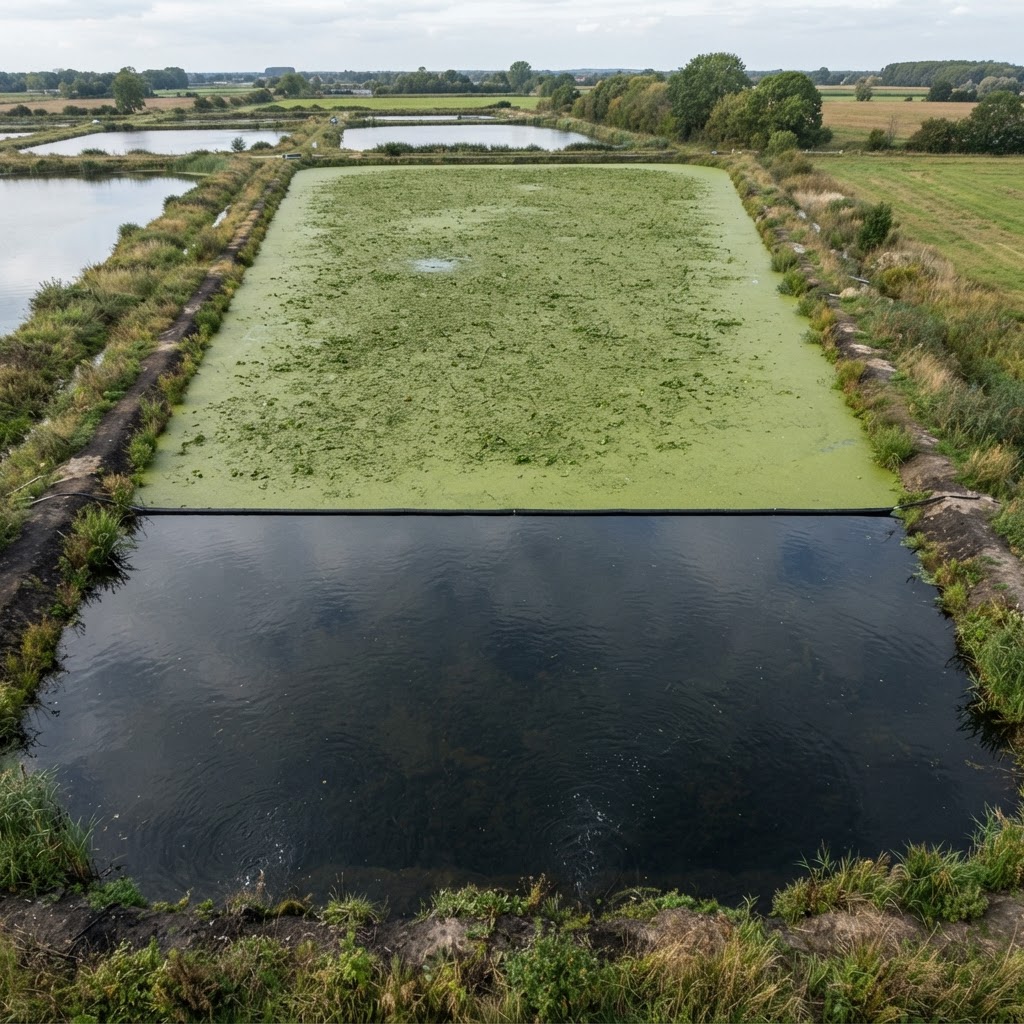
Search for duckweed harvesting equipment and you will be shown machines built to make duckweed go away. Weir skimmers, weed-cutting boats, remote-controlled pond skimmers. They are real products with honest specifications, and most of them are the wrong tool, because they were designed for a different job: clearing a nuisance once, judged on how quickly the water looks clean.
Cropping a pond is the opposite operation. You take a fraction of the mat on a schedule and you care about what stays behind. Get that distinction wrong and the specification you buy against is wrong from the first line.
Removal equipment and harvesting equipment are not the same machine
Two products make the split visible.
The Elastec DUCK weir skimmer is a self-adjusting floating weir. It has no pump of its own: the DUCK 100 connects by a 4 inch camlock to an external suction pump or vacuum truck, and its skimming depth increases with whatever flow rate that pump provides. It is a good piece of hardware and it is one component of a harvest train, not a harvester.
The Conver MC106 lists duckweed among its target species. It also weighs 14,500 kg, carries a 2.5 m mowing unit that works to 1.93 m depth, and needs a machinist plus an assistant. Mowing depth is a rooted-plant specification. Duckweed floats. A machine sold on how deep it cuts is being sold for waterweed and floating debris in canals, which is what that class of machine is for.
At the small end the honesty is better. The WaterBeetle states a 29.5 inch harvesting width, a 250 lb payload and operation in under 4 inches of water, and it notes that a brush attachment is needed on the intake conveyor because duckweed does not fall off the belt on its own. That last detail is the most useful sentence on any vendor page in this category, and we will come back to it.
Decide the harvest regime first, because the regime picks the machine
The equipment question is downstream of a question almost nobody asks first: how often, and down to what.
The residual density is the setting
Duckweed productivity is a bell curve against mat density, not a straight line. Under controlled conditions, Lemna minor reached a maximal biomass growth rate of 88 g dry per m2 at an optimal initial mat density of 45 g dry per m2, which is 750 g wet per m2, with nitrogen and phosphorus removal of 483 mg N and 128 mg P per m2 per day at that point. Thinner than that and you are wasting surface. Thicker and the mat shades itself.
Harvest interval and residual density are locked together. A model combining density and light intensity finds that the optimum density to leave behind falls as the harvest interval lengthens, and that a continuous regime holds density at the optimum and produces the maximum average daily yield. Stretch the interval and the population spends part of every cycle below the optimum and part above it. Yield drops both ways.
What the frequency evidence says
Field trials land in the same place from the practical side. On biodigester effluent, yield was maximised at a two-day harvest interval at 92 g per m2 per day, with little reduction at three days at 88, and the optimum density to return as inoculum was 200 to 300 g per m2.
A treatment-lagoon pilot reached the same conclusion and then made the compromise out loud: daily harvesting of incremental growth is theoretically ideal but impractical on labour and cost, biomass doubled on average every 5.7 days from a 1 kg per m2 base, and weekly scheduled harvests were the workable balance.
So the buying question is not “which harvester”. It is “which harvester for a two-day cycle, or for a weekly one”. A machine that clears a hectare in a day is oversized for the first and correctly sized for the second, and the two cost very different money. The underlying doubling behaviour, and how much it moves with weather, is the duckweed growth rate problem, and it sets the interval before any machine does.
Four machine classes, and where each one stops
Nets and scoops. Netting and scooping is labour intensive and suits smaller operations, or plug-flow ponds narrow enough that the whole crop is reachable from the bank. It has no minimum capital and no ceiling problem until labour becomes the binding constraint, which it does quickly.
Skimmer, pump and screen. The configuration used at pilot scale is a skimmer feeding a pump that discharges into a sieve bend, with two practical notes attached: the pump must handle debris up to 11 mm because the plant passes through the impeller, and outdoors the skimmer belongs in the corner where wind piles the mat, or a paddle wheel drives circulation toward it instead.
The full engineering version of this train was patented in 1991 by Lemna Corporation. An adjustable feed head sits just below the surface on removable weights so its depth can be matched to mat thickness, feeding a non-collapsible suction hose and a trash pump, then a land-based screen dewatering station, and then a return hose that puts the separated water back in the pond. That return hose is the design decision worth stealing.
Spillway and gravity. The cheapest mechanism is no machine. Duckweed can be pushed over a spillway with a sliding gate onto a sealed collecting pan where it stands for a day or two and begins to dewater. The lagoon pilot above specified two spillways precisely so the crop had less distance to travel, and treated the spillway as more cost effective than lifting.
Self-propelled harvesters. The same report describes an aluminium twin-hull machine with 3.2 m hulls, 1.8 m width, a 5.5 hp petrol engine, venturi propulsion instead of propellers so it can ride over floating barriers, and remote control, estimated at four to six hours to harvest a 5000 m2 pond. Note the deliberate absence of propellers. Note also that the reviewed literature now lists robotic surface skimmers and conveyor-belt extraction as the mechanised options in current duckweed cultivation practice, alongside the dip nets and drainage traps that came before them.
The binding spec is dewatering, not sweep width
Duckweed is 92 percent water, and it loses up to half of that in the first two days out of the pond. Every kilogram a machine lifts is roughly 920 grams of pond water you are paying to move, hold and transport.
This is why every serious configuration separates on site and sends the water back: the patent returns screened water through a dedicated hose, the skimmer setup discharges into a sieve bend, the spillway design lets the collecting pan drain by gravity. Sizing the receiving vessel, the trailer or the transport leg on wet mass without a dewatering step is the most expensive ordinary mistake in this category, and it is invisible on a spec sheet because no vendor sells you the pond water.
Reading a vendor sheet without getting caught
Four traps, all of them checkable.
- Mowing depth. A floating-plant harvest has no depth dimension. If the headline spec is cutting depth, the machine is aimed at rooted vegetation.
- Adhesion. Duckweed sticks. That is why intake conveyors need brushes and why disc-and-scraper designs exist at all. Ask what releases the crop from the collection surface, not just what picks it up.
- Solids handling, not just flow. A pump rated on gallons per minute tells you nothing about whether the plant survives the impeller or whether the impeller survives the debris.
- Density units. Optimum cover appears in the literature as 400 to 800 g wet per m2, as 1600 g wet per m2, as 9 to 26 g dry per m2 and as 65 to 75 g dry per m2, in different studies with different regimes. A figure quoted without its unit and basis cannot be compared with anything, including the one in the next brochure.
Two streams means two sets of equipment
One rule sits above all of this, and it is SERAPH’s published policy rather than an inference. Biomass grown on wastewater, manure or contaminated water is never sold or blended as food or feed. The two streams are separated from the first sensor reading.
For an equipment buyer that is not a paperwork clause, it is a plumbing constraint. Shared skimmers, pumps, hoses, screens and collecting pans are a physical path from one stream to the other. If a site runs both a remediation pond and a production pond, the harvest train has to be duplicated or the separation is only asserted. Design it in at purchase, because retrofitting a firewall onto a shared pump is not a thing that can be done convincingly. The same logic shapes how a duckweed wastewater treatment step is laid out in the first place.
You cannot run a schedule you cannot see
Everything above defines a target residual density. Hitting it repeatedly means knowing the standing density now, which is exactly why the review literature argues for expressing cover as a percentage of surface area: that is the unit an optical system can read, and optical reading is what makes automated harvesting possible rather than merely mechanical.
This is the part SERAPH works on. Our vision system reconstructs a cultivation tray in 3D from a single capture, drawing 170,000 surface points from 5.9 million captured, computes canopy volume, and tells duckweed species apart in a live frame. Growth and stress reading are still in development.
We should be equally plain about the limit. SERAPH is at TRL 3, proof of concept, with outdoor field validation still ahead. Nothing here is a validated recommendation of any machine named above, and we have not run them. What this article contains is the published evidence, assembled in the order an operator has to make the decisions.
A checklist to take to a vendor
- Pond area, geometry and bank access, including whether the crop is reachable from the perimeter.
- Target harvest interval, and the residual density you intend to leave, stated with its unit and wet or dry basis.
- Expected wet mass per harvest event, derived from your own interval rather than from a brochure.
- Where dewatering happens, and where the separated water goes.
- Pump solids handling, not just flow rate.
- Which stream this machine belongs to, and whether it will ever touch the other one.
- How standing density gets measured between harvests, and by whom.
Answer those seven before asking for a quote and the equipment shortlist usually collapses to one class. The remaining question is what a duckweed system costs to run, and the harvest interval you chose in point 2 is the single biggest input to it, which is also why how duckweed is harvested deserves settling before what harvests it.
FAQ
Can a standard aquatic weed harvester be used for duckweed?
It will pick duckweed up, but it is built for another job. Weed harvesters are mowers, specified on cutting width and depth for rooted vegetation and floating debris in waterways, and they run to many tonnes of machine. A floating mat needs skimming rather than cutting, and duckweed is sticky enough that intake belts need a brush to clear it.
Does harvested duckweed need to dewater before transport?
Yes, and the arithmetic is stark. The crop is 92 percent water and sheds up to half of it in the first two days out of the pond, so undewatered biomass is mostly freight you are paying to move. Pilot designs let it drain in a collecting pan for a day or two before anything handles it.
What kind of pump does a duckweed skimmer need?
One rated for solids, because the plant passes through the impeller, with practical guidance around 11 mm debris handling. Weir skimmers supply no flow themselves: the larger Elastec unit takes a 4 inch camlock to an external pump or vacuum truck and has been verified to function up to 650 gpm, with skimming depth rising as that flow rises.
Can the same equipment harvest wastewater duckweed and feed duckweed?
No. Biomass grown on wastewater, manure or contaminated water is never food or feed, and shared skimmers, pumps, hoses and screens are a direct contamination route between the streams. Separate trains, or the separation is only a claim.
How much duckweed comes off a pond in one harvest?
It is site specific, but the lagoon pilot gives an order of magnitude: a 5000 m2 treatment lagoon stocked to a 1 kg per m2 base was projected at roughly 6150 kg wet weight per week, against measured production averaging 175 g per m2 per day.