Duckweed Cultivation: A Design Problem, Not a Recipe
Duckweed cultivation is designed, not started. What the published parameters depend on, why lab growth rates overstate pilot yield, and what to specify.
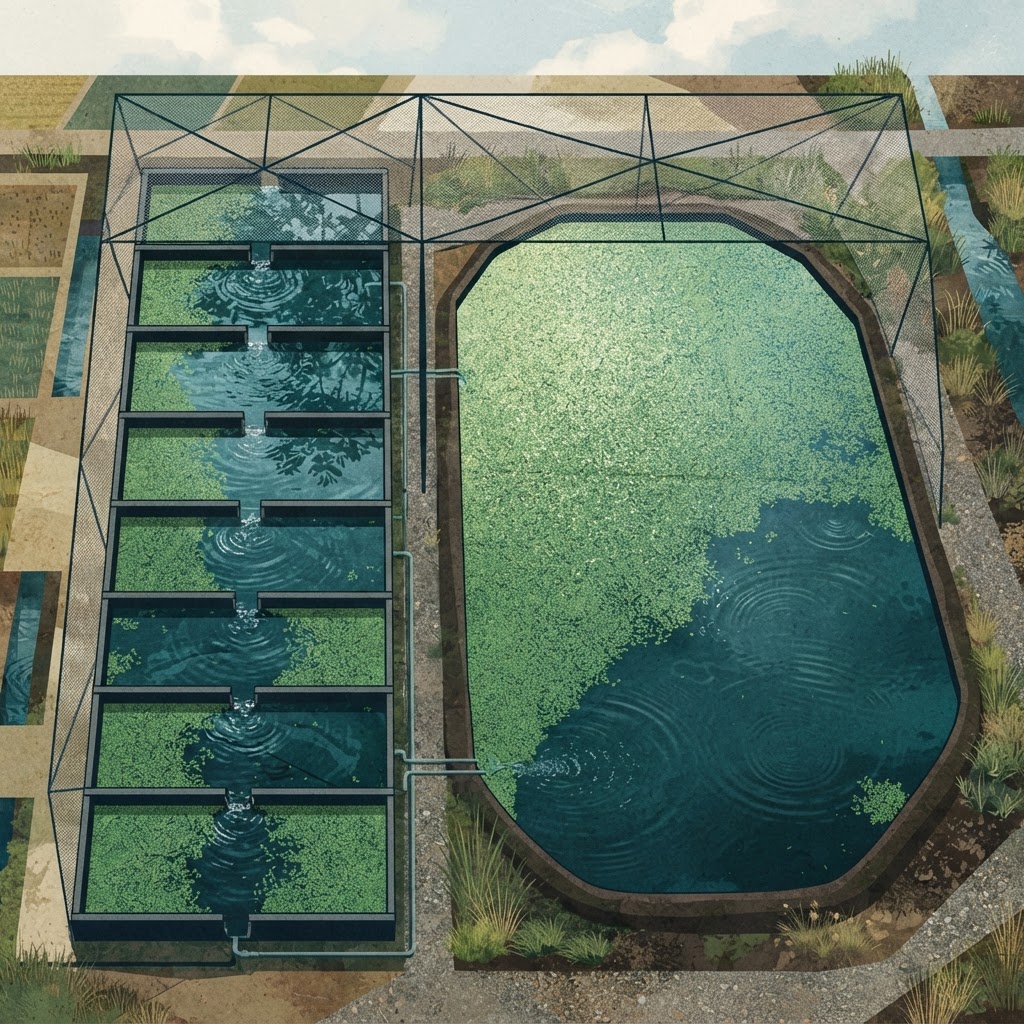
Search for duckweed cultivation and you get two libraries that never speak to each other. One is academic and indoor: culture media, photoperiods, flasks. The other is practical and outdoor: a tank, a starter culture, a claim about how fast it grows. Both are useful. Neither answers the question that actually blocks a decision, which is what to specify before anything gets built.
That question has an answer, and it starts earlier than most guides do.
Cultivation starts with four choices, not with a tank
Before hardware, four things get decided, and every parameter downstream inherits from them.
The goal. Nutrient removal, protein, or starch are not the same system tuned differently. They pull in different directions on density, harvest frequency and residence time. A system that maximises biomass is not a system that maximises phosphorus removal, and choosing later means choosing badly.
The water. The medium is an input you mostly do not control. Its nitrogen, its ammonium fraction, its pH and its temperature swing are the boundary conditions of the whole design.
The species, and really the clone. Roughly 37 species across five genera sit under the name duckweed, and they do not behave alike. A review of the family counts five genera and 36 species with cultivation records running from a 10 mL petri dish to an artificially designed pond 518 metres long.
The containment. If the water is wastewater, manure or anything contaminated, the biomass is a remediation output and stays one. At SERAPH that is not a preference, it is a published policy: remediation biomass is never sold or blended as food or feed, and the two streams are separated from the first sensor reading. Deciding that at the end is not possible. It is a design constant.
The published parameters, and what each depends on
The optimal ranges are real. What gets lost is the clause attached to each one.
Temperature is a species decision, not a setpoint
A meta-analysis of the scattered literature puts maximum duckweed growth between 11.4 and 32.3 degrees Celsius. That is the figure everyone quotes.
The figure almost nobody carries forward is the breakdown underneath it. Lemna performs well from 11.4 to 38.1 degrees. Landoltia optimises between 18.1 and 32.3, Spirodela between 19.0 and 29.2. Lemna grown outside its own window ran 55 percent below the above-baseline average.
Read as a setpoint, the headline range is a target you cannot hit outdoors. Read as a selection criterion, it tells you which genus your climate has already chosen for you. The second reading is the useful one.
Light is better read as a daily light integral
The same analysis places optimum growth at a daily light integral of 5 to 20 mol per square metre and argues that the integral beats photoperiod or intensity taken separately.
Then the medium interferes. Testing four Lemna minor clones under four light regimes, on Hutner’s medium and on the liquid fraction of anaerobically digested pig slurry, researchers found photoperiod mattered more than intensity under laboratory conditions, while intensity mattered more under moderate flow in a 3.96 square metre multitiered system. The lighting answer changed when the water and the scale changed. That is a lighting result and a warning about single-variable optimisation at the same time.
Nitrogen, phosphorus and the ammonium problem
Growth is limited below roughly 5 mg per litre of nitrogen and 1 mg per litre of phosphorus, with a recommended nitrogen to phosphorus ratio of 15 to 1 and an optimum pH near 7. Most wastewaters already sit near that ratio, which is why they are used as media rather than dosed.
Ammonium is where it gets specific. Duckweed takes up ammonium preferentially, which is an advantage until concentration turns it into a toxin, and the toxicity is governed by pH because pH sets the share present as free ammonia. Work compiled by the South African Water Research Commission concludes that holding growth inhibition at or below 30 percent requires total ammonia below 50 mg/l with pH kept under 8, and pH no higher than 7 where ammonium runs between 50 and 100 mg/l N. The same source draws the process consequence: because duckweed prefers ammonium, duckweed ponds must sit ahead of algal ponds in a train, never behind them.
Indoor and outdoor are two different technologies
They share a plant and almost nothing else.
Indoor, the design goal is area per square metre of floor. A review of duckweed bioreactors proposes stacked systems reaching 15 square metres of duckweed per square metre of floorspace, made possible by holding water depth at about 5 cm, with indoor doubling times as short as 1.24 days. The same review states plainly that outdoor cultivation is difficult to optimise and control operationally.
Outdoor, depth runs the other way, because depth buys hydraulic retention and thermal buffer. A pilot-scale treatment system of ten 12 square metre basins found 50 cm depth, 150 percent coverage and a four-day harvest regime preferable, producing 6.65 g of dry matter per square metre per day at 12 to 21 degrees, alongside 66.16 percent ammonium-nitrogen removal at a six-day retention time. That biomass carried 36.16 percent crude protein, and it is worth being exact about what that means: it is a measured composition of biomass grown on wastewater, which is a remediation output. Composition is not permission. The clean stream that produces duckweed protein for feed is a separate system with its own water, not a downstream option on this one.
Five centimetres against fifty. Both are correct, for different machines.
The yield figure that scale changes
Here is the finding that should reframe every yield number you have read.
A 2026 review of duckweed systems in controlled environment agriculture concludes that short-term laboratory experiments frequently overestimate long-term productivity, with relative growth rates declining as cultivation duration and system complexity increase. Not because operators are worse than researchers. Because a short run in a simple system measures a regime that a running plant never occupies for long.
The review lists what actually governs performance once you are past that regime: hydraulic design, culture depth, mat density, harvesting strategy, nutrient dosing, microbiological control and energy input. Seven coupled variables, managed together. Its own conclusion is that optimising single parameters does not get you there.
Now take the largest yield figure in the literature and read it with that in hand. A growth model optimised by machine learning calculated a maximum of 70 dry tons per hectare per year for a site in southwest Florida, which is the number that travels. The conditions rarely travel with it: an initial mat density of 169 g dry per square metre, a harvest threshold of 76, nitrogen at 50.1 mg/L, phosphorus at 7.5 mg/L, a harvest ratio of 0.35, and a harvest every single day.
That is a defensible modelling result and an indefensible brochure line. The difference between the two is whether the six conditions are printed next to it.
Density and harvest are the operating loop
Once running, the mat is the control variable, and it is self-defeating in both directions. Too dense and it starves itself of light, nutrients and space. Too thin and algae take the light it left on the water. Both failure modes are documented, and both are corrected with the same lever: how much you take off, how often.
That lever is why the published harvest regimes look so different from each other. A four-day cycle on a treatment pilot and a daily partial harvest in an optimisation model are not disagreeing about duckweed. They are optimising different objective functions, one for effluent quality and one for annual biomass. Which regime is right for a site follows from the goal chosen at the start, and it constrains the harvesting equipment before a single machine is quoted.
A duckweed pond is an ecosystem, not a monoculture
The biology you did not specify runs anyway.
Monitoring two 10 square metre ponds in series for 314 days under open field conditions, researchers recorded 93 percent total phosphorus and 91 percent total nitrogen removal, with a bacterial community showing strong heterogeneity between the seasons and high densities of microcrustaceans and rotifers under the mat.
Strong performance, and a community that was a different community in autumn than in spring. An outdoor system is not a plant in water. It is a seasonal microbial process with a plant on top, and a design that models only the plant is modelling the smaller half.
Designing a system before building it
This is the work SERAPH does, and it is worth being precise about what it is and is not.
Before a parameter is trusted, we ask how well evidenced it is. Our knowledge base indexes 256 duckweed papers across 31 research areas in 5 domains, each area carrying a coverage weight and a maturity band, because coverage in this literature is wildly uneven. Some areas are decades deep. Others are two papers thin and get cited as though they were settled.
Then measurement, because the lab-to-field gap cannot be closed by sampling occasionally. Our vision system reads the canopy continuously: from a single capture it reconstructs the tray in 3D using 170,000 surface points drawn from 5.9 million captured, computes canopy volume, and tells duckweed species apart in a live frame. Growth and stress reading are still in development.
And the honest part. SERAPH is at TRL 3, proof of concept, with outdoor field validation still ahead. We build the measurement layer first for the reason this whole article describes. AI proposes, the bench validates.
What to specify before you cultivate anything
Nine answers turn a cultivation question into a design:
- The goal, in one metric: removal, protein or starch.
- The water, with its nitrogen species, phosphorus, pH and seasonal temperature range.
- The genus, chosen against that temperature range rather than against a yield table.
- The clone, chosen for that water, which matters more than the species does.
- Indoor or outdoor, decided as a technology choice, not a scale choice.
- Depth, derived from the goal, since it trades growing area against retention.
- Target mat density and the harvest ratio and frequency that hold it.
- The containment plan, decided at the start if the water is dirty.
- The measurement plan, because everything above is a hypothesis until instrumented.
Answer those and the published literature stops being a set of conflicting numbers and becomes what it is: a map of other people’s conditions, useful exactly to the degree that you can state your own. It is also the point at which what duckweed cultivation costs becomes a question with an answer, and where the duckweed growth rate you should plan against stops being the one in the abstract. If nutrient removal is the goal, duckweed wastewater treatment is where the design constraints get sharper still, and if you are still choosing a species, Lemna minor is the usual starting point rather than the automatic answer.
FAQ
How deep should a duckweed pond be?
There is no single depth, because depth is set by what the system is for. Indoor stacked designs run about 5 cm to fit more growing area into a building. An outdoor treatment pilot preferred 50 cm, because outdoors depth buys hydraulic retention time and buffers the temperature swing. Pick the objective first and the depth follows.
What nutrient levels does duckweed need?
Growth is limited below roughly 5 mg per litre of nitrogen and 1 mg per litre of phosphorus, with a recommended nitrogen to phosphorus ratio of 15 to 1. Typical wastewaters already fall near that ratio, which is why they are used as a growth medium rather than dosed with fertiliser.
How often does duckweed need to be harvested?
Often enough that the mat never shades itself out. Published regimes span a four-day cycle on an outdoor treatment pilot to a daily partial harvest in a yield optimisation model, and the gap between them reflects two different objectives rather than two views of the plant.
Can duckweed grown on wastewater be used as animal feed?
Not at SERAPH. Remediation biomass is never sold or blended as food or feed, and the two streams are kept apart from the first sensor reading. A project that wants a feed output has to design the clean stream as its own system from the beginning, with its own water and its own traceability.
Why do duckweed yields fall when a system is scaled up?
Because relative growth rates decline as cultivation duration and system complexity increase, so a short laboratory run reports a regime a working system does not stay in. Treat the fall as a property of the original measurement window rather than as an operating failure.