Duckweed Based Wastewater Treatment System Design
A duckweed based wastewater treatment system is a configuration, not a plant: the treatment train, pond geometry, retention time, land and cost.
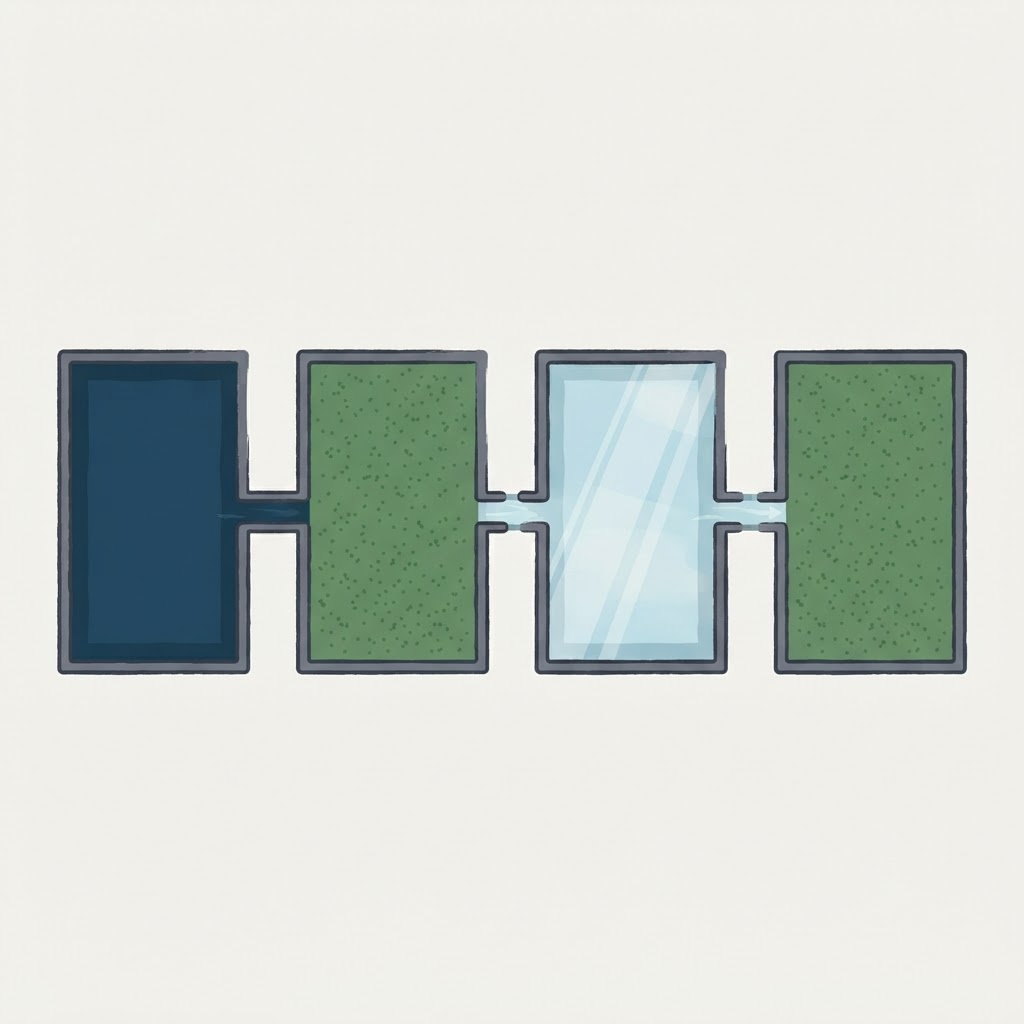
Duckweed based wastewater treatment is a term of art, and the literature gave it two acronyms. DWWT in the design guidelines, DUBWAT in the kinetics papers. Both name an arrangement of ponds. Neither names a species, and neither names a product.
That distinction is the whole article, and there is a blunt result that makes the case for it. Work on duckweed-covered sewage lagoons varied depth across the full range from 10 to 100 centimetres and found no effect on COD removal at all. The authors concluded that a medium-deep to deep system, 50 to 150 centimetres, essentially functions as a facultative lagoon with respect to COD, and that the role of duckweed in removing COD is marginal.
Read that carefully before spending money. The plant earns its place on nutrients and on what physically leaves the site in the harvest. Everything else is decided by how you arrange the ponds. This article is about the arrangement. The companion question, what a duckweed step actually removes, is answered separately.
The train, and why the order is not negotiable
A duckweed pond is a unit process. It is never the whole works, and the units around it have to come in a specific order for reasons of chemistry rather than convention.
Anaerobic pre-treatment comes first
Adequate primary treatment of raw wastewater is indispensable before a duckweed stage. The common low-cost option is an earthen anaerobic sedimentation pond, typically 2 to 3 metres deep at 1 to 6 days retention, clay lined, with berms or baffles against short-circuiting.
The reason is not just solids removal. Duckweed takes up mineral nutrients, so something upstream has to produce them.
Duckweed before algae, never after
South African work on combining duckweed and algal stabilisation ponds spells out the sequencing rule. Duckweed preferentially takes up ammonia nitrogen rather than nitrate, so duckweed ponds must precede algal ponds, not follow them: the aerobic environment of an algal pond nitrifies ammonia to nitrate, and the duckweed downstream wants the form that is now gone. The same logic puts an anaerobic process ahead of the duckweed, where organic material is mineralised and ammonia-nitrogen and orthophosphorus are released into the bulk liquid.
That report also proposes something neat at the tail. Rather than an aerated rock filter to strip algal cells out of the final effluent, put a last duckweed pond after the algal ponds. Duckweed survives and keeps taking up nutrients at very low concentrations, and the shading kills or senesces the algal cells, so the effluent clears.
Then maturation
Design guidelines for hot climates model five configuration options and conclude that anaerobic ponds plus a DWWT stage plus maturation ponds is the optimum on retention time, land and cost together. Maturation ponds are there because of two admissions in the same paper that most summaries skip: the duckweed mat gives low pathogen removal, and a DWWT system cannot receive shock loading if it is used without other treatment methods.
Those two weaknesses are what the train is for.
Pond geometry: long, narrow and shallower than intuition suggests
Plug flow is the recommended regime, because it maximises contact between wastewater and plants and minimises short-circuiting. The classic target is a length to width ratio above 38 to 1, from Alaerts and colleagues. The Queensland design work is honest that this is often impractical on cost and grounds, and cites Bonomo’s finding that better than 10 to 1 will suffice. Horizontal velocity should stay around 0.1 metres per second so the mat is not pushed around.
Depth is where published guidance splits. The hot-climate guidelines give 0.6 to 1.5 metres to limit temperature gradients. The aquaculture handbook reports a literature range running from 0.3 to 2.7 metres and, in one commercial case, up to 5, while noting that most authors put the optimum at 0.4 to 0.9 metres and that one metre is enough for acceptable temperature buffering. Shallow suits high organic loads and high recirculation rates. Deeper is defensible where land is expensive.
Nothing in that argument is about COD, which is the point of the null result above. Depth is a temperature and land decision.
Two more shape constraints are worth designing in early. A narrow, channel-like pond lets operators work from the embankment without contact with the wastewater, which matters for daily harvesting. And plug flow inevitably creates two zones: a farming zone near the inlet where nutrients are plentiful and growth is fast, and a nutrient-starved polishing zone downstream that produces the cleanest water. Where recirculation is needed, a U-shaped or serpentine layout keeps the start and end points close and the pumping distance short.
Retention time decides which pollutant you get
This is the parameter that actually gets specified, and the one where a short answer produces a system that meets the wrong consent.
A continuous-flow outdoor pilot in the Negev ran on domestic primary effluent at a mean residence time of 4.26 days. Solids and organics came out well, 13.1 mg/l TSS and 40.3 mg/l total BOD5 in the effluent, with faecal coliform removal around 95 percent. Nitrogen removal was 10 to 20 percent. Phosphorus removal was negligible.
Move up the scale and the picture inverts. A pilot-scale DUBWAT system found its optimum at 10 days retention, paired with an organic loading rate of 50 kg COD per hectare per day and a stocking density of 0.5 kg per square metre, under 30 to 36 degree ambient conditions. The optimised full train in the hot-climate guidelines lands at 15 to 18 days. For acceptable pathogen removal, the handbook reports 20 to 25 days.
So: roughly 4 days buys solids and organics, 10 to 18 buys nutrients, 20 to 25 buys pathogens. Longer is not free either. The guidelines note that a longer retention time improves pathogen reduction but drives more anaerobic conditions and lowers the protein content of the biomass produced.
Two ceilings sit over all of it. DWWT ponds are reported to tolerate influent COD concentrations of 300 to 500 mg/l, above which the arrangement stops behaving as designed. And duckweed production falls off below 17 degrees or above 35, which is a hard constraint on any temperate site and the reason growth rate figures quoted without a temperature are not usable.
Mat management is a capital line, not an afterthought
Duckweed floats, so wind moves it. An incomplete mat is not a cosmetic problem: it stimulates algal growth and encourages odours and mosquito breeding, which undoes the reason for choosing the process.
The standard answer is a floating grid dividing the surface into cells. Bamboo poles forming cells of roughly 2 to 5 by 4 to 8 metres have a design life of around two years at about US$500 per hectare. The patented UV-stable HDPE alternative uses 25 to 50 square metre squares and lasts several years, at a per-hectare cost that the same survey judged too high for low-income contexts. The Queensland report gives 16 to 50 square metres as the common cell range and makes the sizing rule explicit: higher wind and higher flow velocity mean smaller cells and a more expensive system.
Surface density is a two-sided constraint. Too high and the plants have limited access to nutrients, light, gas exchange and space. Too low and algae grow through the poorly attenuated light. And the mat itself can become diffusion limited, which is why gentle mechanical mixing or baffles is treated as a requirement rather than an upgrade. Aeration is the wrong tool here: it improves treatment on paper and opens holes in the mat in practice.
Retrofitting a lagoon you already own
The cheapest route into this process is usually not a new build, and it is the option no ranking page describes.
Many small communities and intensive livestock and processing operations already run passive lagoons, and most existing lagoons are already an appropriate depth and capacity for duckweed treatment. Where the shape is wrong for plug flow, baffles can direct the current and prevent short-circuiting. Containment grids configure to any pond outline. What does need changing is the spillway or discharge point, both to make harvest possible and to stop duckweed escaping into the receiving environment.
The worked example in that report is the most concrete thing in the literature. A pond of 100 by 50 metres at 1.5 metres deep: 5,000 square metres, half a hectare, 7.5 megalitres. Inlet and outlet at opposite ends. An HDPE baffle, held upright by floating logs in a top sleeve and steel weights in a bottom sleeve and anchored bank to bank, splits it into two 50 by 50 halves, which also separates the farming zone from the polishing zone so the two can be measured against each other. Two spillways, one per zone, each feeding a sealed collecting pan where the harvest stands for a day or two and begins to dewater. Expected yield on the basis of the Burdekin pilot trial: around 6,150 kg wet weight per week.
Batch operation is the other low-capital route, common at village scale, where using an existing pond avoids the earthworks entirely. The trade is less even nutrient distribution, so growth concentrates near the inlet points. Either way, plan the harvesting equipment into the earthworks rather than bolting it on.
Land and capital, and why the published numbers do not travel
The per-capita figures are the most quoted numbers in this field and the most often quoted out of context.
To meet effluent standards, the hot-climate guidelines put land at 1.5 to 1.8 square metres per capita excluding associated facilities, capital at 7.9 to 9.7 US dollars per capita, and retention at 15 to 18 days. The aquaculture handbook is less optimistic on area, at 2 to 3 square metres per inhabitant, and again excluding the primary treatment footprint. Adding multiple inlets and recirculation, which is what an ideal plug-flow system wants, raises land requirement by about 30 percent and capital by about 20 percent, with present values 1.2 to 1.5 times greater than a single-inlet design.
Two comparisons matter more than the absolute figures. Bangladeshi experience put a DWWT system at about one tenth of the design and construction cost of a conventional system, while occupying roughly three times the land. And against plain waste stabilisation ponds, DWWT needs less land but runs about 25 percent more expensive on investment and operations, because of seepage prevention and the skilled labour the process demands.
Siting drives that seepage line. Slowly permeable soils, below about 5 millimetres per hour hydraulic conductivity, are preferred, and the pond bed tends to seal over time through deposition and bacterial growth. Rapidly permeable sites need clay or artificial lining. Flat to slightly sloping topography keeps earthwork down.
Now the caveat, stated plainly. Those cost figures are from 2001, denominated per capita rather than per cubic metre, and derived for rural and low-income contexts in hot climates. They are a structure for a cost model, not a quote. Anyone building a European or North American case needs to rebuild them from local land, liner, labour and energy prices, which is a separate exercise in what duckweed cultivation costs.
What no configuration fixes
Shock loading needs upstream buffering; the ponds will not absorb it. A windy site needs grid spend that scales with the wind. Below 17 degrees, production falls whatever the layout, and no baffle arrangement changes that.
And there is one constraint that reaches past engineering. The hot-climate design guidelines state that cultivation of duckweed in wastewater ponds has a negative effect on the use of that duckweed for animal feed, because it may contain toxic organic compounds and heavy metals, which is why remediation biomass never enters the feed chain at all. The Queensland report reinforces it from the opposite direction: in the nutrient-starved polishing zone, plants scavenging for what they lack will take up toxins and heavy metals if any are present. The zone that produces your cleanest water produces your least trustworthy biomass.
At SERAPH this is settled rather than case by case. Remediation biomass is never sold or blended as food or feed, and the two streams are separated from the first sensor reading. Biomass grown on wastewater, manure or contaminated water is remediation-grade permanently. The production-grade stream is a different system on different water, and it is the only context in which we discuss duckweed as animal feed.
That has a direct consequence for the business case. The 2001 guideline assumed revenue from selling the harvested duckweed and said income generation depended mainly on whether the local community would accept it. Build the system with the firewall in place and that revenue line is not available. The case has to close on treatment value alone.
Where SERAPH is on this
We are at TRL 3, proof of concept, with outdoor field validation still ahead. Nothing above is our own performance data.
Notice what the sources in this article have in common. The two documents that define this configuration are from 2001 and 2005, and the earlier one says openly that its equations were derived from previous experimental data collected by different researchers under different conditions. The kinetics paper concedes that available design criteria are mainly empirical or rule of thumb. The South African report found a wealth of design information for algal ponds and a gap where the duckweed equivalent should be.
That gap is the reason we started with a measurement layer rather than a product. A knowledge base of 256 indexed duckweed papers mapped across 31 research areas in 5 domains exists to show where the evidence is thick and where two papers are carrying a whole design rule. AI proposes, the bench validates, and the bench work is designing the cultivation system around the water you have rather than around a table in a twenty-year-old spreadsheet.
FAQ
What is the difference between DWWT and DUBWAT?
Nothing physical. They are two acronyms for the same arrangement, coined in two literatures: DWWT in the design-guideline work of the early 2000s, DUBWAT in the kinetic-modelling work that followed. You will also see duckweed-covered sewage lagoon, or DSL, in the process-science papers. If a vendor uses one as though it were a proprietary system, it is not.
Can duckweed treatment ponds be run as a batch system instead of plug flow?
Yes. Batch operation is the common village-scale choice precisely because an existing pond can be used and the earthwork capital avoided. The cost is distribution: nutrients mix less evenly, so growth concentrates near the inlet points rather than spreading down a gradient. Plug flow is the recommendation for larger community or peri-urban flows.
Does a duckweed treatment pond need a liner?
It depends on the soil. Sites with surface soils or subsurface layers below roughly 5 millimetres per hour hydraulic conductivity are most suitable, because percolation loss is minimal and the bed seals further over time as solids deposit and bacterial films grow. Rapidly permeable sites can be used after sealing with clay or artificial materials. That seepage prevention is part of why this process costs more than a plain stabilisation pond of the same size.
Can duckweed ponds and algal ponds be combined in one system?
Yes, and the combination is proposed specifically so each covers the other’s weakness. The order is anaerobic, then duckweed, then algal, then a final duckweed pond that shades out the algal cells before discharge, in place of the aerated rock filter that was originally proposed for that job.
How much wastewater can one duckweed pond take?
The published ceiling is a concentration rather than a flow: influent COD of 300 to 500 mg/l is the reported tolerance for DWWT ponds. Flow follows from that ceiling, the retention time your consent requires and the depth your land allows, which is why sizing starts from the effluent standard and works backwards rather than starting from the pond.