Duckweed as a Protein Source: Strengths and Limits
Is duckweed a good protein source? It beats soy on protein per hectare, but extraction is hard, approvals are narrow, and water quality matters a lot.
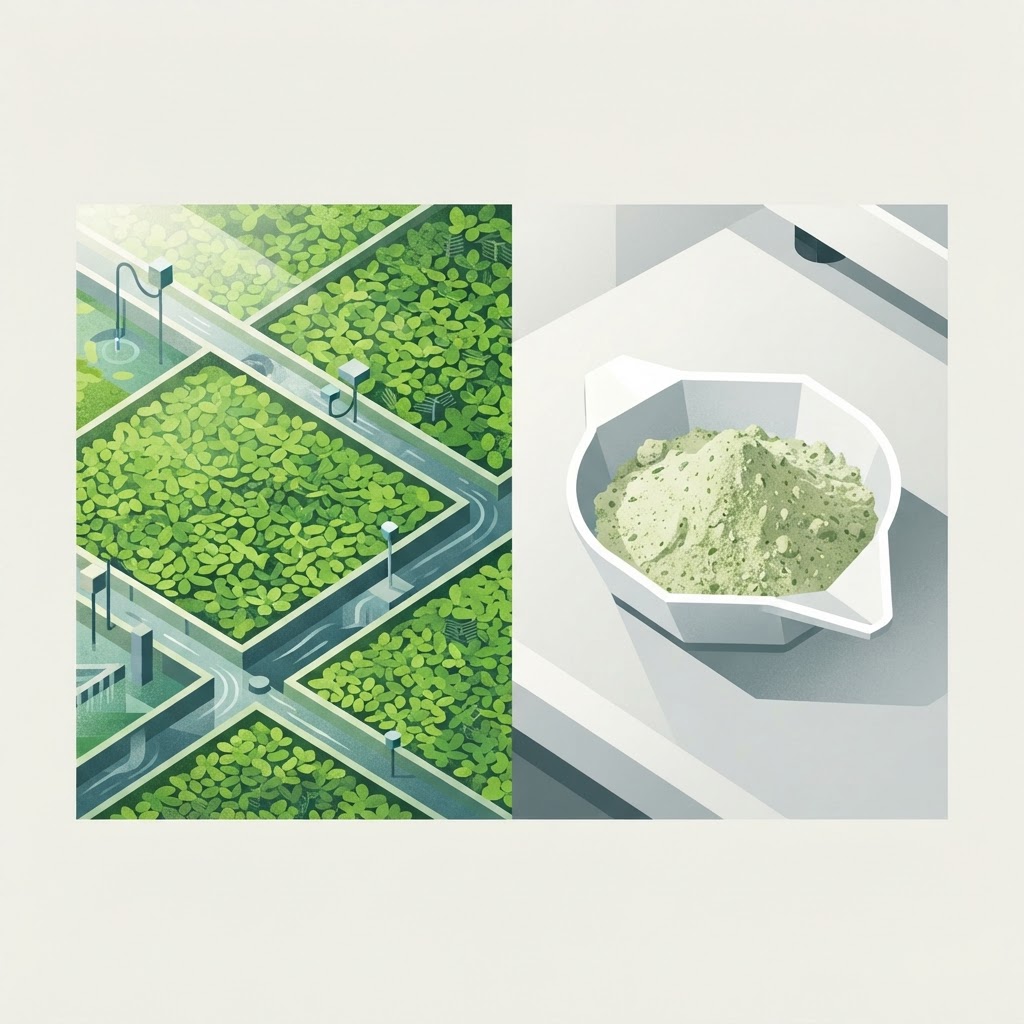
Search for duckweed as a protein source and you land in one of two places. A food-tech article says it could revolutionize what we eat. A journal review runs forty pages of amino acid tables and never tells you whether to act on them. Neither answers the question a buyer, formulator or investor actually has: is this worth building on now.
Here is the honest version. Duckweed’s case on land and protein yield is real and it is bigger than most crops can match. Its case on extraction, regulatory clarity and provenance is not there yet. And a good share of the most impressive numbers in the literature belong to biomass that a food-safety-first operator could never sell as food or feed in the first place. That last point is the one nobody puts next to the yield figure.
The short answer
Duckweed is a genuinely strong protein source on paper: high protein content, a complete and digestible amino acid profile, and a protein yield per hectare that beats soy by roughly an order of magnitude. It is not yet a drop-in replacement for soy or pea protein in a formulation today, because extraction from the leaf matrix is still hard, regulatory approval covers narrow product forms rather than the plant in general, and the crop absorbs whatever is dissolved in the water it grows on. All three of those are engineering and governance problems, not nutrition problems, and that distinction matters for how you evaluate them.
Where duckweed genuinely wins
Protein per hectare against soy and other crops
The headline comparison holds up. Grown under favourable conditions, duckweed can reach up to 45 percent protein by dry weight, and a hectare of it has been reported to produce 10 to 18 tonnes of protein per year, against 0.6 to 1.2 tonnes for soybeans, the world’s most widely grown legume.
A comparison table from Wageningen University research lines up the same figures against a wider field: soybeans at 35 percent protein, 1.5 to 3 tonnes dry matter per hectare per year, 0.6 to 1.2 tonnes protein per hectare; pulses like peas at 17 to 35 percent, 4 to 6 tonnes, 1 to 2 tonnes protein; seaweed at 10 to 30 percent, 25 tonnes, 2.5 to 7.5 tonnes protein; microalgae at 25 to 50 percent, 15 to 30 tonnes, 4 to 15 tonnes protein. Duckweed sits at 35 to 45 percent protein, 30 to 40 tonnes dry matter, and 10 to 18 tonnes of protein per hectare per year, ahead of every land crop in the table and competitive with microalgae without needing a bioreactor. It also does not compete for arable soil, since it grows on open water.
A complete, digestible amino acid profile
Yield is only half the case. A review comparing microalgae and duckweed as protein sources found duckweed protein digestibility running 80 to 95 percent, comparable to soy, with species-level protein content ranging from 20 percent in Lemna gibba to 51 percent in Wolffia arrhiza under nutrient-rich conditions. A separate nutrition review reports a protein digestibility corrected amino acid score of 0.89 for duckweed protein, high among plant proteins, with a full complement of essential amino acids that meets FAO and WHO reference values. That review also notes the FDA granted GRAS status to Lemnoideae-derived powders in 2018, which is the regulatory floor most alternative proteins have to clear before anyone will formulate with them.
Put the two together and the strong case is genuinely strong: more protein per hectare than any land crop reviewed, and a protein that digests about as well as the industry standard it would be replacing.
The limits the marketing pages leave out
Extraction is still an open engineering problem
This is the sentence that never makes it into a pitch deck. A 2026 review of duckweed’s use in food and nutraceuticals states plainly that purifying duckweed proteins is challenging, and that research and commercial interest in duckweed as a food protein are still in an early stage. A separate processing review looking specifically at protein recovery methods concludes that efficient, environmentally sustainable extraction technology for duckweed remains underdeveloped, even as it surveys promising techniques like ultrasound-assisted extraction paired with green solvents.
The protein is there. Getting it out at scale, at a cost that competes with soy meal, is the part still being solved.
Regulatory approval is narrow, not a category green light
“Duckweed protein is approved” is not a sentence that survives contact with the actual paperwork. The EU authorised protein concentrate from Lemna gibba and Lemna minor as a novel food, but the regulation names one company, ABC Kroos BV, as the only party permitted to place it on the EU market until 30 April 2029. A later entrant can sell the same ingredient, but only after building an independent dossier. The full regulatory picture, including a separate whole-plant application that was not authorised, sits in a dedicated piece on duckweed in the alternative protein landscape.
Duckweed absorbs whatever is in its water
This is the constraint that connects everything else in this article. A review of duckweed’s extraction and industrial applications reports measured heavy metal accumulation up to 109.294 mg/kg zinc, 4.226 mg/kg chromium and 0.196 mg/kg cadmium in wet weight, and states that most countries do not habitually use common duckweed species for human consumption for exactly this reason. The mechanism that makes duckweed excellent at pulling nitrogen and phosphorus out of contaminated water is the same mechanism that makes growing water a food-safety question rather than an agronomic detail.
There is a regulatory precedent for taking this seriously. In 2015 the European Food Safety Authority reviewed Lemna minor whole-plant material as a novel food and flagged a concern about manganese overexposure, alongside a separate palatability barrier to direct human consumption that has slowed uptake independent of the safety question. Composition claims and safety claims are not the same claim, and a source that is strong on one can still be unresolved on the other.
The number that gets quoted is often not the biomass you could sell
Here is the piece that connects the strengths section to the limits section, and it is the one most comparisons skip entirely.
A study valuing duckweed grown specifically on wastewater estimated an annual protein yield of 10.1 tonnes per hectare, worth roughly 4,800 USD per hectare per year using soybean meal as the pricing benchmark. Numbers like that circulate widely in the literature on duckweed’s protein potential, and they are real measurements. What they are not is a description of biomass anyone should be allowed to sell as food or feed, because it grew on nutrient loads pulled out of wastewater.
This is where SERAPH’s own operating rule is more conservative than most of the field it is reviewing. Production-grade biomass for food, feed and high-value products and non-food remediation biomass are permanently firewalled from each other, starting at the first sensor reading, not at the point of sale. A duckweed system optimised for nutrient removal from wastewater or manure effluent is not the same system, and not the same biomass, as one built for animal feed. Reading a protein-source comparison without that separation in view means quietly averaging together two different products with two different destinations.
How to actually evaluate it, not just quote it
Before duckweed goes on a sourcing shortlist, five questions are worth more than any headline percentage: which species and clone, because the protein band runs from 20 to over 50 percent depending on the answer; what water it grew on, and whether that water disqualifies the biomass from food or feed use before extraction is even considered; which regulatory object and jurisdiction, since an authorisation can belong to one company rather than to duckweed as a category; which extraction method produced the figure, and at what purity and cost; and whether the number being quoted is composition, content, or an achieved yield, because those are three different things measured three different ways.
That is also roughly the reading order this site’s own coverage follows: why every source quotes a different duckweed protein percentage, which levers actually move protein content in cultivation, the amino acid profile and its limiting amino acids, and what is authorised, built and still a forecast in the alternative protein category.
SERAPH’s own position in all of this is upstream rather than at the point of sale. The system is at TRL 3, proof of concept, with outdoor field validation still ahead, and that is stated as policy rather than left to be inferred. Behind it sits a knowledge base of 256 indexed duckweed papers mapped across 31 research areas in 5 domains, which is how a synthesis like this one can separate what the literature has actually shown from what a headline number implies. Duckweed’s case as a protein source is strong. It is strong on specific, checkable terms, not on the average of every number that has ever been printed next to the word duckweed.
FAQ
Is duckweed a good source of protein?
Yes, on protein per hectare and on amino acid completeness and digestibility, which run 80 to 95 percent, comparable to soy. The open questions are extraction cost and regulatory narrowness, not the underlying nutrition.
How does duckweed protein compare to soy protein?
Duckweed produces roughly 10 to 18 tonnes of protein per hectare per year against 0.6 to 1.2 tonnes for soybeans, an order-of-magnitude land advantage. Soy still wins on processing infrastructure, price per kilogram and regulatory familiarity, which is why the two are not yet competing head to head at commodity scale.
Is duckweed protein safe to eat?
It depends entirely on what water the plant grew on. Duckweed takes up heavy metals and other contaminants from its water, which is why growing medium is a food-safety question rather than an agronomic detail, and why an operator’s separation between clean-stream and remediation-stream biomass matters as much as the species chosen.
Why isn’t duckweed protein more widely used yet?
Extracting protein from the leaf matrix at scale is still technically difficult and commercially early-stage, and regulatory approval so far covers narrow, sometimes exclusive, product forms rather than duckweed as a category. Both are solvable engineering and governance problems, not evidence against the underlying nutrition.