Duckweed Protein Content: What Actually Moves It
Duckweed protein content is reported from 16 to 44 percent of dry weight. Only nitrogen and genetics move it; density, depth and harvest move yield.
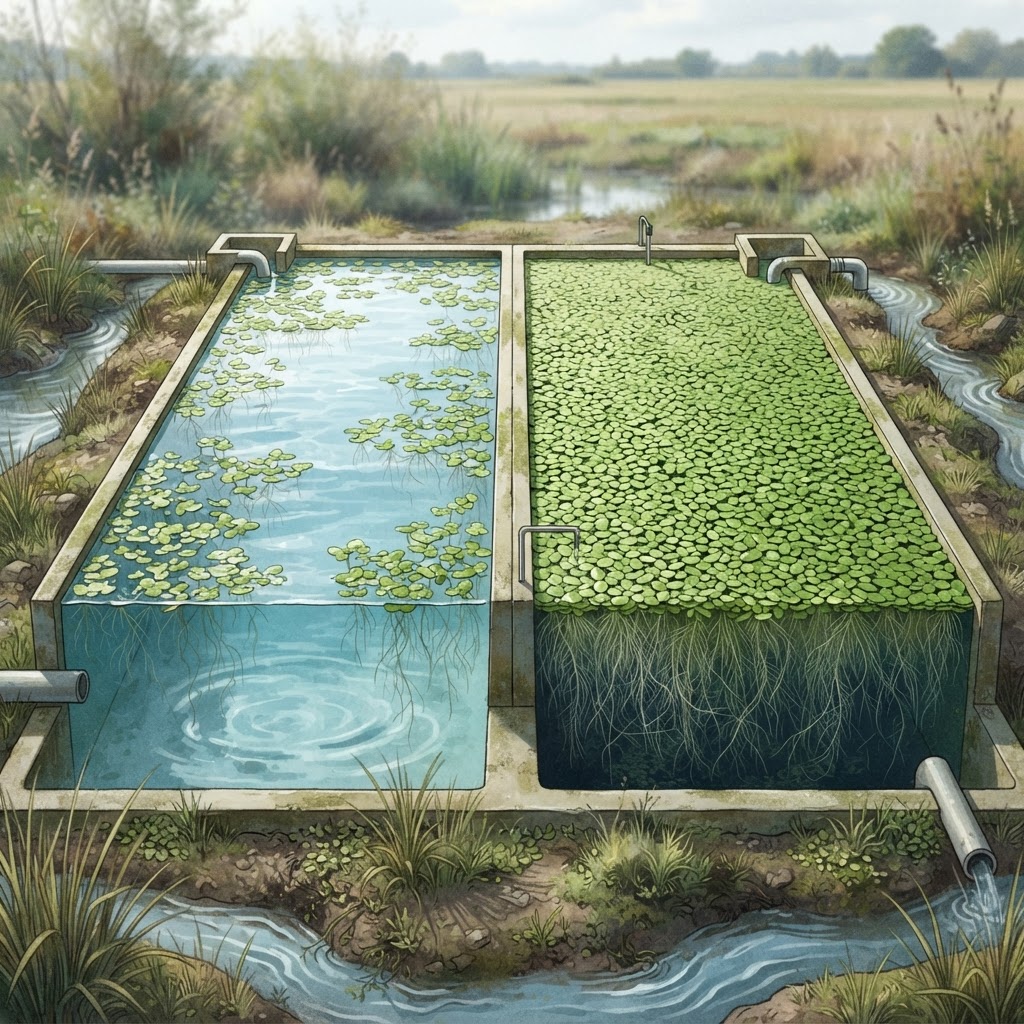
Duckweed protein content is usually reported as a range, and the range is real. What almost nobody separates is which of your operating decisions changes that percentage and which ones change how much biomass you get while leaving the percentage exactly where it was.
The literature is unusually clear on this once you line the studies up. Two things move content: how much nitrogen is in the water, and which plant you are growing. Almost everything else an operator can adjust, standing density, water depth, harvest interval, light within a normal band, moves productivity and leaves content flat.
That distinction is worth more than the number itself, because it tells you which knob to turn.
The short answer, and why it is a range
The reviewed range is 16.0 to 41.7 percent of dry weight, across a family of 35 species and two hybrids. Under an optimised nitrogen medium, Wolffiella hyalina has been measured at 43.9 percent. At the other end, feed reference tables that average many real samples are more sober: dried duckweed averages 27.8 percent crude protein across 18 samples, from 15.5 to 35.6 percent, with ash averaging 18.9 percent.
Part of that spread is not the plant at all. Crude protein is nitrogen multiplied by a conversion factor, and the studies below do not all use the same one, or even the same assay. That layer has its own article: here is why every source quotes a different duckweed protein figure. For this piece the consequence is a discipline rather than a debate. Compare these figures as directions and magnitudes, never as decimals against decimals.
Nitrogen is the lever that actually moves the percentage
How much nitrogen is in the water
The clearest data is also the oldest, and it came from ponds rather than flasks. In FAO-documented duckweed farming, protein rose from 17 to 37 percent of dry matter as nitrogen in the water went from 5 to 10 mg per litre, then from 36 to 42 percent across a 10 to 40 mg range. Held at 10 to 30 mg N per litre, the crop sustained 35 to 40 percent protein at around 100 g of fresh biomass per square metre per day.
Doubling nitrogen from 5 to 10 mg per litre roughly doubled the protein percentage. No other variable in this article does anything comparable.
Which form the nitrogen is in
Nitrogen quantity is the coarse control. Nitrogen form is the fine one, and it cuts differently than most operators expect.
Testing five nitrate to ammonium ratios at two dilutions, Lemna minor ran from 21.1 percent crude protein on the most dilute nitrate-only medium to 40.6 percent on ammonium-only at half strength. Wolffiella hyalina ran from 30.3 to 43.9 percent over the same treatments. Content climbed as the ammonium share climbed.
Content and yield peak at different settings
Then the same experiment produced the result that should change how the target is set. Maximum protein yield for both species did not occur where content was highest. It occurred at 75 percent nitrate and 25 percent ammonium at half strength: 41.6 g per week per square metre for Lemna minor and 45.0 for Wolffiella hyalina. Push the ammonium share to 50 percent and above, and yield fell even as the percentage held up.
A richer percentage on less biomass is a worse harvest. If you are buying or selling protein by the kilogram, the ammonium-heavy setpoint is the wrong optimum.
The applied version of the same curve appears in recirculating systems fed with graded cattle slurry, where crude protein of Spirodela polyrhiza and Landoltia punctata ran 29.3 to 37.9 percent and tracked total ammonia nitrogen upward, independent of species. Protein yield followed a quadratic, peaking at a TAN of 19 mg per litre, a 1:8 slurry dilution. Above that, ammonia toxicity and volatilisation start taking back what the nitrogen gave. Hold that thought until the last section, because the water in that study matters as much as the number.
Genetics sets the band that nitrogen moves within
Species chooses the range. Wolffia globosa leads the reviewed species at 39.6 percent protein, Lemna minor sits at 38.3 percent, and Spirodela polyrhiza is the carbohydrate specialist of the group at 34.5 percent. Those are different plants, not different measurements of one plant.
Clone chooses your position inside the species. A survey of all 11 Wolffia species identified by molecular barcoding found protein at 20 to 30 percent of freeze dry weight, and found differences between clones of Wolffia globosa and of Wolffia arrhiza, which is why the authors argue for selecting clones and not only species.
The nitrogen experiment is the cleanest demonstration that genetics and nutrition are separate axes: Wolffiella hyalina held a higher protein content than Lemna minor at every ratio and every dilution tested. The nitrogen moved both species. It never closed the gap between them. Which species you start with, and how that choice plays out for Lemna minor in particular, sets a ceiling that agronomy does not lift. Quantity is only half the specification anyway; the duckweed amino acid profile is the other half.
What does not move protein content, and moves yield instead
This is the section the ranking pages skip, and it is where the operating decisions actually live.
Standing density and surface coverage
Density is the variable operators fiddle with most. It does not do what they think.
Testing Lemna minor from 10 to 80 percent surface coverage on synthetic dairy processing wastewater, protein content showed no significant difference across densities in a stationary system, and stayed between 17 and 20 percent in a recirculating one. Meanwhile specific growth rate fell steadily as density rose, and per-area nitrogen removal dropped from around 2500 to around 500 mg N per square metre per day between 20 and 80 percent cover.
Pilot scale outdoors agrees. In ten basins of 12 square metres each running Lemna aequinoctialis at 12 to 21 degrees C, coverage from 75 to 300 percent produced crude protein of 36.14 to 36.44 percent, a spread of three tenths of a point, while dry matter production went from 4.34 to 6.80 g per square metre per day.
Density is a productivity control. Read as a protein control it is noise.
Water depth
Same study, same answer. Water depth from 20 to 50 cm gave crude protein of 36.16 to 36.92 percent with no significant effect, while dry matter production rose from 4.50 to 6.65 g per square metre per day. Deeper basins grew more. They did not grow richer.
Harvest interval
Harvest regimes of 2, 4, 6 and 8 days produced crude protein of 35.29 to 36.30 percent, again with no significant difference. The field data says the same thing from the other side of the world and forty years earlier: protein held at 38 to 41 percent across all harvest intervals tested, while yield was maximised at the two-day interval at 92 g per square metre per day.
Harvest frequency is one of the highest-leverage decisions in duckweed cultivation. None of that leverage is on the protein percentage.
Light, within a normal operating band
In a recirculating indoor vertical farm, light intensity of 50, 100 and 150 micromol left crude protein at 31.8 to 32.4 percent for Lemna minor and 39.3 to 40.0 percent for Wolffiella hyalina, with no significant difference. Over the same treatments, relative growth rate rose 67 and 76 percent, and relative protein yield rose 50 and 89 percent. Red to blue ratios from 70/30 to 30/70 had no significant effect on anything measured.
The honest caveat is in that paper’s own discussion. A much larger light step does move content: Lemna gibba has been reported rising from 25 to 46 percent protein between 50 and 1000 micromol. So “light does not change protein content” is wrong as a general statement and right as an operating one. Within the band a real system runs in, you are moving duckweed growth rate and not composition.
Reading protein status in the field without a lab
There is a free indicator, and it has been sitting in the FAO field data for decades.
Crude protein in dry matter regressed against root length as Y = 49.3 minus 1.14 X, with an r squared of 0.74. Against crude fibre it ran Y = 71.6 minus 3.29 X, also at 0.74. An earlier independent study found the same shape at Y = 56.3 minus 1.49 X.
The mechanism is intuitive. A duckweed plant that cannot find nitrogen invests in roots. Long roots mean a hungry plant, and a hungry plant is a low-protein plant. Both regressions explain about three quarters of the variance, which for a visual field indicator is a great deal more than nothing.
Roots and fibre are morphology. Morphology can be seen. That is precisely the wedge for non-destructive measurement, and it is where our own work sits. SERAPH Vision reconstructs a cultivation canopy in 3D from a single capture, using 170,000 surface points drawn from 5.9 million captured, computes canopy volume, and already tells duckweed species apart on a real tray frame by frame.
Growth and stress reading are still in development. We are not claiming a camera that reads protein content today. We are saying the literature has already shown the signal is morphological, which is the reason to build toward it.
The water that maximises protein is the water you cannot sell as feed
Look back at where every high-protein figure in this article came from.
Cattle slurry. Wastewater beside a lake. Synthetic dairy processing effluent. In the FAO survey, Vietnamese ponds enriched with pig excreta at 11 to 18 mg N per litre, returning 33 to 38 percent protein. Nitrogen is what raises the percentage, and the cheapest nitrogen on any farm is a waste stream.
Most of that literature treats the resulting biomass as feed. SERAPH does not, and the difference is a published policy rather than a preference. Biomass grown on wastewater, manure or contaminated water never becomes food or feed here. The production stream and the remediation stream are separated from the first sensor reading, not at the point of sale, and that separation is stated as an operating rule alongside our maturity: TRL 3, proof of concept, with outdoor field validation still ahead.
Which means the protein-maximising recipe in the literature is not available to a clean-stream operator on those terms. Nitrogen still has to come from somewhere, and that somewhere has to be food-safe, which is a harder and more expensive input problem than the papers make it look. The nutrient-removal case for duckweed wastewater treatment is a genuinely good one, and it never ends where duckweed as animal feed ends. Two streams, two supply chains, one very firm wall between them.
We do not have field-validated protein figures of our own to offer, and we say so. What we have is a view of which variables are worth instrumenting.
Four questions that turn a protein number into a specification
Which species, and which clone, because that sets the band.
What nitrogen concentration and what nitrate to ammonium split, and separately, was the water food-safe.
Which assay and which conversion factor produced the figure.
Content or yield, because they do not peak at the same setting and only one of them is what you actually sell.
A protein percentage that survives those four questions is a specification. One that does not is a headline.
FAQ
What is the protein content of duckweed?
Between 16.0 and 41.7 percent of dry weight in the review literature, with 43.9 percent measured in Wolffiella hyalina under an optimised nitrogen treatment. Feed reference tables averaging many real samples land near 27.8 percent, which is the safer planning figure.
How do you increase the protein content of duckweed?
Raise nitrogen in the water, and choose a higher-protein species or clone. Little else reliably moves the percentage. Field ponds went from 17 to 37 percent protein as nitrogen rose from 5 to 10 mg per litre.
Does harvesting more often change duckweed protein content?
No. Harvest regimes of 2, 4, 6 and 8 days showed no significant difference in crude protein at pilot scale, and field data show 38 to 41 percent across all intervals. What changes is yield, which peaked at the two-day interval.
Which duckweed species has the highest protein content?
Wolffia globosa leads the reviewed species at 39.6 percent, and Wolffiella hyalina reached 43.9 percent under an optimised nitrogen medium. Clone matters too, since differences were found within Wolffia globosa and Wolffia arrhiza.
Is duckweed protein content higher than soybean?
On a percentage basis they overlap. Soybean meal averages 35.2 percent crude protein as fed, which sits inside the 29.3 to 37.9 percent band measured for slurry-grown duckweed. The advantage duckweed claims is protein per hectare, not protein per kilogram.