Duckweed Alternative Protein: What Is Actually Real
The duckweed protein market forecasts disagree by an order of magnitude. Here is what is authorised, what is built and what is still a projection in 2026.
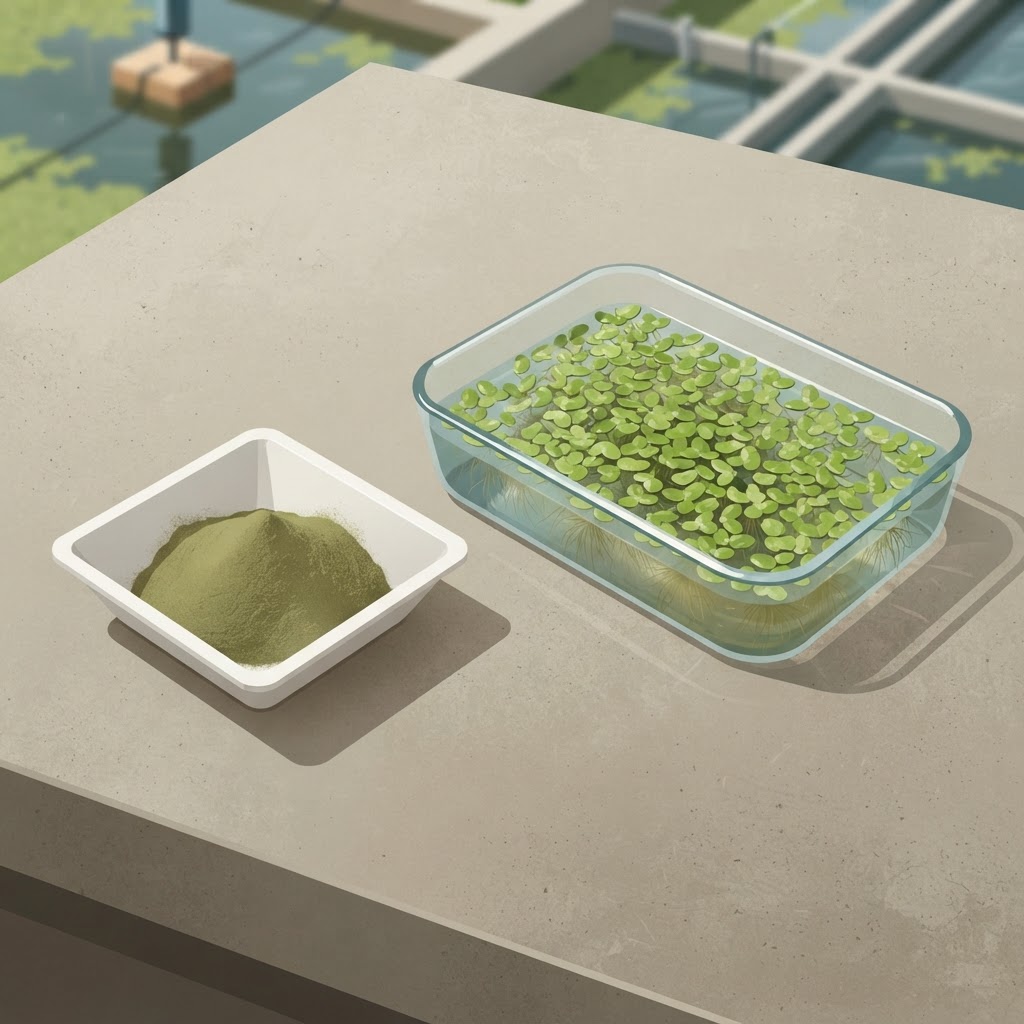
Ask what duckweed is worth as an alternative protein and you get a market size. Ask twice and you get two that cannot both be true.
That is the state of this category in 2026. Duckweed is a real ingredient with a real regulatory record and a real factory, and almost none of that shows up in the numbers people quote about it. So here is the same question answered from the other direction: what is authorised, what is built, and what is still a projection.
The category numbers do not agree with each other
Start with the disagreement, because it is larger than a rounding difference.
A peer-reviewed review of duckweed protein passes on a market projection of USD 77.70 million growing to USD 161.32 million at 11.0 percent CAGR, sourced to a commercial research vendor. A second vendor report sizes the global water lentil ingredient market at USD 0.3 billion in 2025, rising to USD 0.6 billion by 2034 at 8.5 percent. A third sizes the United States alone at USD 85 to 120 million in 2026, rising to USD 450 to 650 million by 2035 at 18 to 22 percent.
Line those up. One report’s figure for a single country is larger than another report’s figure for the world, and the two global figures are four times apart. At least one definition of the category is wrong, and none of the three publishes the method that produced it.
We are not going to adjudicate between them, because there is nothing to adjudicate with. The useful move is to stop treating the category as a number and start treating it as a set of checkable facts. Three of them decide whether duckweed belongs on a sourcing shortlist: what a regulator has authorised, what a factory has built, and what a buyer is actually paying for. A fourth decides whether any of it holds up outdoors.
What is actually authorised, and to whom
This is the part the category pages skip, and it is the part that determines whether you can put the ingredient in a product.
The EU authorisation belongs to one company until 2029
The European Union authorised duckweed protein. It did not authorise it for you.
Commission Implementing Regulation (EU) 2024/1048 of 9 April 2024 authorises protein concentrate from Lemna gibba (70 to 100 percent) and Lemna minor (0 to 30 percent) as a novel food, effective 30 April 2024, following an EFSA opinion adopted on 28 February 2023. Article 2 then restricts it: only ABC Kroos BV of Raalte, in the Netherlands, may place that novel food on the Union market for five years, with data protection running to 30 April 2029. A later applicant can sell the same ingredient, but only by building its own dossier from legally obtained data.
The regulation also defines what the ingredient is, in a specification tighter than any composition table in the literature. Protein (N x 6.25) 60 to 75 percent, ash 4 to 12 percent, fat 2 to 11 percent, fibre 6 to 17 percent, moisture 1.5 to 8 percent. Cultivation in greenhouse basins, on filtered and UV-treated water, held at pH 5.5 to 6.5. Mechanical separation of the protein fraction from insoluble fibres, acid precipitation, pasteurisation, spray drying.
Note what that is. It is not a plant, it is a process with a product at the end of it.
The same species failed a different application
The clearest evidence that the object matters more than the organism is that the same two species went through a second procedure and did not come out.
Wageningen Plant Research Institute applied on 20 May 2020 to place Lemna minor and Lemna gibba whole plant material on the EU market as a vegetable. The material is 92 to 94 percent water, 2 to 4 percent protein. The EFSA panel concluded that, given manganese intake relative to background dietary intake, the novel food may be of safety concern and its safety could not currently be established.
Same genus, same species names, opposite outcome. One is a concentrate made under a defined process; the other is the plant.
In the United States the picture is structurally similar. GRAS is strain-specific and process-specific, meaning each producer must file its own notification or self-affirm for its own product, and feed authorisation for some product forms is a separate question again. A no-questions letter belongs to a notifier, not to a plant family.
So “duckweed protein is approved” is not a true sentence in any market. The true sentence names a species mix, a physical form, a process, a jurisdiction and a holder. That is a narrower thing than the duckweed protein figures usually quoted, and far more useful. It also explains why Mankai and a Lemna concentrate do not travel the same regulatory route.
Buyers are not buying it as a plant protein
Here is the reframe that changes the competitive set, and it comes from the company with the most to gain from the opposite framing.
Plantible Foods cofounder and CEO Tony Martens told AgFunderNews that although the company is often described as an alt protein startup, the attraction for most food companies is less about going plant-based or green than about the functional properties: emulsification, gelation and binding, including as a clean-label alternative to methylcellulose.
The mechanism behind that is not marketing. Duckweed protein is roughly 40 to 50 percent RuBisCO, the photosynthetic enzyme, which is soluble, white and neutral in flavour once separated from the leaf matrix. A functional ingredient that performs at low inclusion is a different product from a bulk protein sold by the tonne of crude protein.
That distinction reorders everything downstream. Soy, wheat gluten and pea already dominate the plant protein market on price and availability, and duckweed will not out-commodity them: the same review notes that extraction is harder than from cereals or pulses, because the protein bodies sit inside cell walls bound to polysaccharides, and that economically feasible extraction technology is still an open problem. Competing on cost per kilogram of protein is the losing frame. Competing on what the protein does at 2 percent inclusion is the frame the market is actually buying in.
The trade-off is real and worth stating: low solubility remains the standing obstacle for whole-biomass routes, and RuBisCO recovery is precisely where the process gets expensive. Which is also why the crude protein content of the biomass tells you much less about the value of the ingredient than it appears to.
How much of it exists
Capacity is checkable in a way that forecasts are not.
In August 2026, Plantible raised USD 35 million to expand its site in Eldorado, Texas: a USD 25 million loan from X-Caliber Rural Capital under the USDA OneRD Business and Industry programme, plus USD 10 million in equity led by RA Capital, funding up to 50 new greenhouses at a 100-acre aquafarm first established in 2022. The stated goal is a five-fold increase in annual capacity to more than 1,000 metric tons, alongside a new proprietary strain the company reports has raised yield by more than 40 percent.
Now scale it. Across the whole sector, alternative protein companies raised USD 881 million in 2025, of which plant-based took USD 450 million, fermentation USD 357 million and cultivated meat USD 74 million, against USD 19.5 billion invested since 2017. One duckweed producer’s single round is a visible fraction of a lean year for the entire category.
Read that both ways, because both readings are true. Duckweed is not a laboratory curiosity: there is a financed plant with a capacity number and offtake behind it. And duckweed is not a commodity: an ingredient whose leading western producer is building toward a thousand tonnes a year is not substituting for crops traded in millions of tonnes. Treating it as either is a category error, and the second error is the more expensive one, because it produces sourcing plans and cultivation cost models that assume volumes nobody can supply yet. The same caution applies on the duckweed as animal feed side, where the volumes required are larger still.
The specification decides what water you can grow it on
There is one more constraint, and it is the one that connects the paperwork to the pond.
Read the EU specification again and notice what else it fixes. Lead at 0.3 mg/kg or less. Cadmium 0.2, mercury 0.1, arsenic 0.2. Microcystins and nodularin below 0.19 mg/kg. Nitrate below 3,000 mg/kg. Oxalic acid below 1,900 mg/kg. Cultivation in greenhouse basins on filtered, UV-treated water.
Duckweed takes up what is in its water. That is exactly the property that makes it useful for duckweed wastewater treatment, and it is exactly the property the specification is written to control. EFSA said the general version of this plainly in the whole-plant opinion: the concentration of trace elements and contaminants in the material is highly dependent on the conditions of cultivation and the fertiliser composition.
So growing water is not an operational detail downstream of the protein figure. It is upstream of whether the biomass can become the authorised object at all. A batch that misses a heavy metal limit is not a lower grade of the same ingredient. It is a different ingredient, with a different destination.
That is why SERAPH runs two permanently firewalled streams rather than one stream with a quality check at the end. Production-grade biomass for food, feed and high-value products is one. Non-food remediation biomass is the other, and it never crosses into either. The separation starts at the first sensor reading, not at the point of sale.
The same source states our maturity, and we state it here rather than leaving it to be inferred: TRL 3, proof of concept, with outdoor field validation still ahead. Behind the work sits a knowledge base of 256 indexed duckweed papers across 31 research areas in 5 domains, each area carrying a coverage weight and a maturity band, which is how a thin patch in this literature becomes visible instead of assumed. We are early, and we say so.
Six questions worth more than a market forecast
If you are deciding whether duckweed belongs on your shortlist, these will move you further than any CAGR.
Which regulatory object, named as it appears on the authorisation rather than as “duckweed protein”. Which jurisdiction, and whether the authorisation there is exclusive to somebody else. Whether you are buying protein or buying function, because that decides both the competitive set and the price you should accept. What contracted volume exists this year, as opposed to announced capacity. What water the biomass grew on, and who can prove it. And whether the growth data behind the offer was gathered indoors or outdoors, because the literature is overwhelmingly the former and the pond is the latter.
Duckweed’s case in alternative protein is stronger when it is argued on those six than on a market size. The forecasts flatter it and tell you nothing. The regulation, the specification and the capacity number are less exciting and considerably more load-bearing.
FAQ
Is duckweed protein approved for human food?
Not as a category. In the EU, protein concentrate from Lemna gibba and Lemna minor is authorised, but only ABC Kroos BV may place it on the Union market until 30 April 2029 unless a later applicant files its own dossier, and a separate whole-plant application was not authorised. In the US, GRAS status is specific to a notifier’s strain and process.
How does duckweed compare to pea and soy protein commercially?
They are not competing on the same basis. Duckweed capacity is counted in the low thousands of tonnes, and the leading producer says buyers come for functional properties rather than plant-based positioning, which puts it against functional ingredients at low inclusion rather than against bulk protein on price per kilogram.
How big is the duckweed protein market?
The published figures contradict each other by an order of magnitude, and none shows its method. Until a category definition is published alongside a number, the size estimate is not a decision input, and authorisations and installed capacity are.
Why is duckweed protein sold as RuBisCO or lemna leaf protein?
Because roughly 40 to 50 percent of the protein is ribulose-1,5-bisphosphate carboxylase-oxygenase, which comes out of the leaf matrix white, neutral tasting and functionally strong. The label names the fraction that carries the value, and it also names the regulatory object rather than the plant.
Can duckweed grown on wastewater be sold as protein?
Not at SERAPH. The two streams are firewalled from the first sensor reading, and remediation biomass never becomes food or feed. Independently of our policy, the EU authorised specification sets hard cadmium, lead, mercury, arsenic and nitrate limits, and EFSA has noted that contaminant levels depend heavily on cultivation conditions.