Wolffia Protein: Why the Figures Run From 20 to 46 Percent
Wolffia protein is reported from 20 to 46 percent of dry weight. What moves it: the growing medium, the species and clone, and how it was measured.
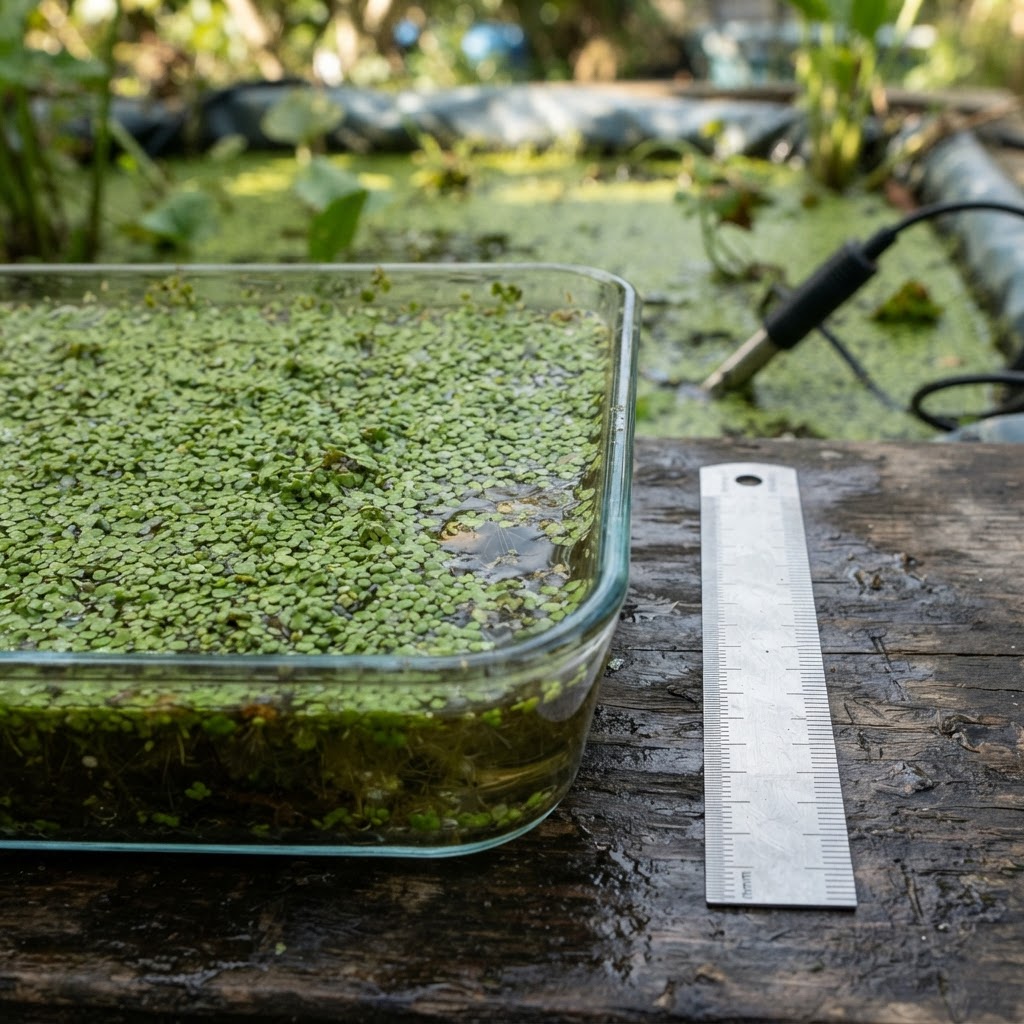
Search for Wolffia protein and you get a number. Which number depends on which page you land on: 26.76 percent, 39.6, 40.64, 45.54, 46.10. Each one is a real measurement. None of them is wrong. And none of them, quoted alone, tells you what the plant in front of you will contain.
Wolffia is one of five genera in the duckweed family, which spans about 37 species, and it is now studied seriously as a protein crop. Line the published figures up and they run from roughly 20 to 46 percent of dry weight. The spread is not noise. It has three identifiable causes, and each one is something a buyer, a food developer or a system designer can ask about.
The short answer: 20 to 46 percent, depending on three things
At the low end sits the only genus-wide dataset. When all 11 Wolffia species, identified by molecular barcoding, were grown and analysed under one protocol, total protein ran from 20 to 30 percent of freeze dry weight. In the middle, a Food Chemistry review lists Wolffia globosa at 39.6 percent, the highest protein of the duckweed species it reviewed. At the top, Wolffia globosa grown on a rich algal nutrient medium reached 46.10 percent of dry weight.
The three causes:
- The medium. How much nutrient the plant was given.
- The species and the clone. Which Wolffia, and which line of it.
- The basis. What the percentage is a percentage of, and how the protein was measured.
Part of the third cause applies to every duckweed, not only Wolffia, and it has its own article: why duckweed protein figures disagree. Here we stay with what is specific to this genus.
Cause one: the medium
The clearest evidence comes from a 2025 study that grew Wolffia globosa on four media for eight weeks and measured each. The Chlorella medium produced both the most biomass, 23.90 to 42.14 g fresh weight per square metre per day, and the highest protein, 46.10 percent. Every difference between treatments was statistically significant.
Then comes the detail the abstract readers skip. The authors did not recommend the 46 percent medium for food. On cost and overall nutrition they chose a cheaper 16-16-16 fertiliser supplemented with B vitamins and iron. The headline number describes a medium the study itself set aside as the practical option.
Other groups land nearby under their own recipes. A 2026 review in Foods reports that Wolffia globosa in outdoor polyethylene tanks with NPK 15:15:15 fertiliser over 35 days reached 40.64 percent protein. A limnology study measured 45.54 percent, with outdoor productivity of 97.757 to 176.659 g per square metre per day against 25.883 to 64.564 indoors.
The pattern matches the rest of the family: nitrogen supply is the coarse control on protein content. The mechanism, and the operating variables that move yield without moving the percentage, are laid out in which variables move duckweed protein content. For Wolffia the practical point is simpler. A protein figure without its medium is half a specification.
Cause two: species and clone
Under one uniform protocol, the 11 species did not converge on one value. They spread across a ten point band. The same study found intraspecific, clonal differences inside Wolffia globosa and Wolffia arrhiza for several nutrients, and concluded that selecting suitable clones is important. It singled out Wolffia microscopica, not for its protein percentage, but because very fast growth gave it the highest yield of most nutrients.
That last point deserves more attention than it gets. If you sell protein by the kilogram, the plant that grows fastest at a moderate percentage can beat a slower plant with a richer one.
It also explains why brand names complicate the picture. Mankai is one strain of Wolffia globosa. Its figures describe that strain in its producer’s system. They are not figures for Wolffia, and still less for duckweed as a family.
Cause three: what the percentage is a percentage of
Freeze dry weight, dry weight and crude protein
The genus-wide survey reports protein on a freeze dry basis. Most cultivation studies report dry weight, and many report crude protein, which is nitrogen multiplied by a conversion factor rather than protein measured directly. Different bases and different assays shift the result before any biology is involved. Compare figures across studies as directions and magnitudes, never decimal against decimal.
Ash takes its share of the denominator
The 45.54 percent study also measured 20.43 percent ash, alongside 5.33 percent fat and 9.98 percent crude fibre. A fifth of that dry mass was mineral. Minerals are part of what makes Wolffia nutritionally interesting, and they also reflect the water: the genus-wide survey found mineral content depended on cultivation conditions as well as genetics. Two samples with the same protein percentage can be very different ingredients once ash is on the sheet.
Quality: amino acids and bioavailability
Quantity is only half the question. On quality the genus reads well on paper. Across all 11 species, essential amino acid content was higher than or close to WHO requirements for preschool-aged children. A 2024 characterisation of Wolffia globosa found essential amino acids made up 67 percent of total amino acids at a protein content of 26.76 percent, with a vicilin-like protein accounting for 38 percent of total protein.
Composition is not the same as what a body absorbs. Human work exists: a randomised controlled trial on Wolffia globosa protein bioavailability was published in Clinical Nutrition. But the 2026 Foods review is direct that human clinical evidence remains limited and that regulatory assessments do not substantiate health claims. We make none. For how the family compares amino acid by amino acid, see the duckweed amino acid profile, and for the wider picture beyond protein, duckweed nutritional value.
Fresh plant or powder is a regulatory question, not a protein one
In the EU, fresh Wolffia and processed Wolffia are different legal objects. Implementing Regulation (EU) 2021/2191 authorises fresh plants of Wolffia arrhiza and Wolffia globosa as a traditional food from a third country. A dried powder travels a separate route, and the detail of that route sits in the Mankai article linked above. A protein figure measured on a dried sample does not tell you which of those products it describes.
Eaten whole: why the medium has to be food grade
Go back to cause one. Nutrient supply is what lifts the percentage. Now add the fact that makes Wolffia different from a crop you thresh or press: it is eaten whole. There is no husk, no stalk, no processing step that leaves the growing water behind. Whatever the plant took up is in the food.
Much of the wider duckweed literature raises protein with the cheapest nitrogen available, which is wastewater or manure. For a whole-plant food that route is closed, and at SERAPH it is closed by policy rather than preference. Biomass grown for remediation is never sold or blended as food or feed, and the production and remediation streams are separated from the first sensor reading. So the nutrient that pushes Wolffia toward the top of the range has to be food grade, which is a more expensive input than a paper abstract suggests. That is the real cost behind a 46 percent headline.
Species and clone matter just as much, and they are harder to keep straight in an open system than in a flask. Our computer vision work already distinguishes duckweed species on a real tray, frame by frame. Growth and stress reading are still in development.
We are early, and we say so: TRL 3, proof of concept, with outdoor field validation still ahead. We have no field-validated Wolffia protein figures of our own to offer. What we can offer is the list of questions a figure has to survive: which species and clone, which medium and whether it was food grade, on what basis and by which assay, and at what yield.
FAQ
How much protein does Wolffia contain?
Published figures run from 20 to 30 percent of freeze dry weight across all 11 species grown under one protocol, up to 46.10 percent of dry weight for Wolffia globosa on a rich nutrient medium. The medium, the clone and the measurement basis explain most of the gap.
Is Wolffia a complete protein?
Its essential amino acid content was higher than or close to WHO requirements for preschool-aged children across the genus. Composition is not absorption, though, and human evidence on bioavailability is still limited.
Is Wolffia the same as Mankai?
No. Mankai is one strain of Wolffia globosa. Wolffia is a genus of 11 species, with measurable differences between clones of the same species, so strain figures do not transfer to the genus.
Which Wolffia species is best for protein?
Percentage alone does not decide it. The genus-wide survey singled out Wolffia microscopica because its very fast growth gave the highest yield of most nutrients, which matters more than content if you sell protein by weight.