Duckweed Nutritional Value: What the Water Decides
Duckweed nutritional value shifts with species and water: fat, fibre, minerals, carotenoids, B12. The full panel, plus the anti-nutrient column.
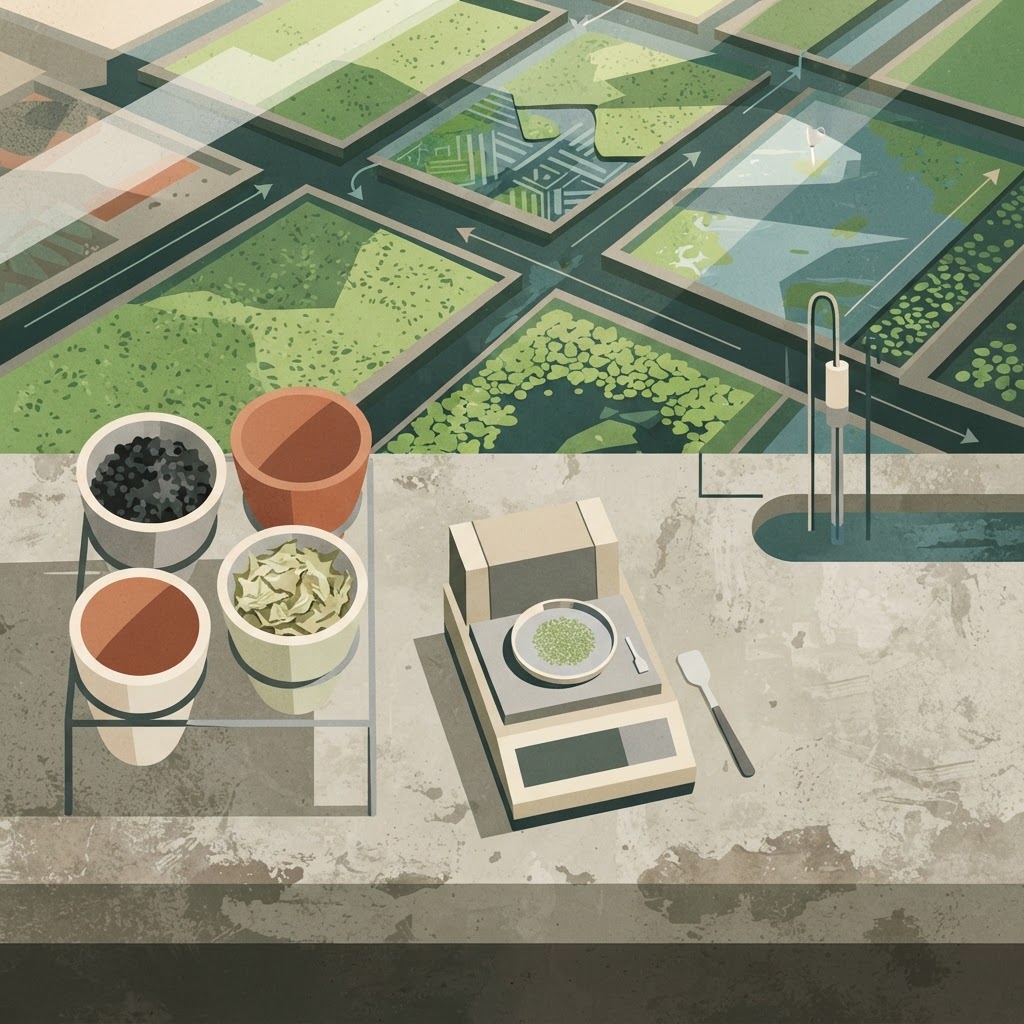
Most pages about duckweed nutritional value quote one composition table and move straight to what it might do for you. The table is usually real. The move is where it goes wrong, because a duckweed nutrition figure is not a property of the plant on its own. Minerals concentrate in duckweed at several hundred times the level in the water it floats on. Change the water and you change the panel.
That single mechanism explains most of the disagreement in the literature, and it is also the reason a composition number without a growing medium attached is not a specification. Here is the whole panel, what moves each part of it, and the column the health pages leave out.
The macronutrient panel, and how wide it really is
Take the family first. Measured under one protocol across all five genera, duckweed ran 20 to 35 percent protein, 4 to 7 percent fat and 4 to 10 percent starch on a dry weight basis. Narrow to one genus and the spread does not close: across all 11 Wolffia species, fat ranged from 0.7 to 5.3 percent, fibre sat near 25 percent and starch ran 10 to 20.
Widen to the review literature and it opens further. Pooled figures put crude fibre at 8.8 to 29.7 percent, lipid at 3.4 to 9.0 and ash anywhere from 3.5 to 26.0. A 2026 study of four species growing in Sri Lanka reported carbohydrate 6.95 to 14.55 percent, protein 17.34 to 26.45, fat 3.69 to 3.92, ash 8.03 to 9.55 and crude fibre 5.26 to 9.49.
The protein column has its own set of reasons for moving, and they are covered separately in duckweed protein. Everything below is the rest of the panel, which gets far less attention and carries most of the surprises.
The fat is small, and unusually good
Duckweed fat is a few percent of dry weight. Its composition is the interesting part.
Polyunsaturated fatty acids made up 48 to 71 percent of total fat in the five-genus survey, with an n6 to n3 ratio of 0.5 or less. Alpha-linolenic acid alone runs 11 to 25 percent of fatty acids, with linoleic, linolenic and palmitic acids accounting for roughly 80 percent of the total between them. The Sri Lankan set put omega-3 fatty acids at 44.42 to 50.38 percent of total fatty acids, with ALA alone at 29.53 to 46.44 percent.
Read that carefully before it becomes a selling point. Half of a small number is still a small number. A ratio that compares well with most terrestrial leaf crops sits on a base of roughly 1 to 7 percent of dry matter, so duckweed is a favourable fat profile rather than a meaningful fat source. Anyone quoting the omega-3 percentage without the fat percentage has quoted half the fact.
Fibre and starch are most of what is left
Fibre is the quietest quarter of the dry weight. In the Wolffia survey it held near 25 percent of freeze-dry weight across every species tested, barely moving while protein and fat swung by factors of two and seven.
Starch behaves in the opposite way. Across species it has been reported from 4.0 to 29.8 percent, and it climbs under nutrient deficiency and under moderate salinity. That is worth stating plainly: a stressed pond does not simply grow less duckweed, it grows compositionally different duckweed. Starch and protein trade against each other, which means the growing conditions that maximise one degrade the other.
The commercial specifications reflect all of this. The EU novel food dossier for a dried Wolffia globosa product lists carbohydrates at 24 to 40 percent, of which 75 percent is dietary fibre, with fat at 6 to 12 percent and minerals under 10 percent.
The minerals are written by the water
What the ash number is telling you
Ash is not a contaminant measure, but it is the closest thing to one in a standard proximate panel. It averaged about 18 percent of freeze-dry weight across the Wolffia species, and reached 26 percent at the top of the pooled review range. An ingredient that is a quarter mineral is a different purchase from one that is a twentieth, whatever the protein column says.
What that mineral fraction contains is set upstream. Fresh Lemna minor has been reported at 6,780 mg/kg potassium, 1,154 calcium, 230 iron and 201 sodium, with manganese at 29.35 and zinc at 6.35. Those are figures for one plant in one water. The five-genus study made the general point directly: mineral content can be adjusted at will through the composition of the nutrient medium.
The cadmium nobody added
The Wolffia survey contains the most useful single observation in this whole literature, and it is buried in a results table.
Growing all 16 samples on purified, desalted water with analytical-grade reagents, the authors measured magnesium at 1.91 to 4.55 g/kg, iron at 0.11 to 0.4 g/kg and manganese at 78.4 to 431 mg/kg. They also measured iodine at 0.20 to 0.92 mg/kg and cadmium at 0.009 to 0.59 mg/kg. Neither iodine nor cadmium was applied on purpose. Both entered as impurities in the chemicals and the water, and the plants concentrated them anyway.
That is the several-hundred-fold accumulation mechanism working under near-laboratory conditions on water cleaner than any production system will use. The uptake that makes duckweed effective at duckweed wastewater treatment is the same uptake that writes its mineral panel. There is no version of the plant that does one without the other.
Vitamins and carotenoids, and how much a batch moves
Duckweed is genuinely carotenoid rich. Lutein dominated at roughly 40 to 80 mg per 100 g of freeze-dry weight in the Wolffia species, followed by beta-carotene at 10 to 30, with alpha-tocopherol from 0.5 to 13 mg per 100 g and large differences between species. A commercial fresh Lemna specification caps beta-carotene under 3,160 micrograms per 100 g and folate under 38, on material that is 91 to 95 percent water.
Then there is the batch question, and one dossier answers it better than any review. The GRAS filing for a dried Wolffia globosa product tabulates four production lots from a single controlled producer: vitamin A from 20.095 to 46.19 mg per 100 g, vitamin B12 from 2.19 to 4.38 micrograms per 100 g, vitamin E from 6.06 to 31.2, iron from 387 to 723 mg/kg and zinc from 110 to 363 mg/kg.
One species, one producer, one process, and vitamin A more than doubles between lots. Riboflavin and B6 barely moved, at 3.28 to 3.49 and 1.1 to 1.27 mg per 100 g. So the variability is not uniform across the panel. Some nutrients track the plant and some track the water, and only a batch certificate tells you which figure you have bought.
The B12 question, answered narrowly
This is where duckweed content usually stops being careful, so it is worth stating exactly what has been measured and about what.
In a cultivated Wolffia globosa strain marketed as Mankai, several cobalamin congeners were identified by mass spectrometry, and no pseudo-B12 was detected. In an 18-month randomised trial with 294 participants, serum B12 rose 15.4 percent in the arm consuming a daily Mankai shake against 5.2 percent in the control arm.
Three limits on that. It is one greenhouse-grown strain, not the Lemnaceae family. Participants started with B12 in the normal range, so the trial shows a rise rather than correction of a deficiency. And the plant’s own B12 origin was not established. A broader 2025 review of the subfamily as human food concludes on favourable digestibility and low allergenic potential while naming consumer acceptance and regulation as the standing barriers, which is a fair summary of where the evidence sits.
The column the health pages leave out
Oxalate, and which subfamily you are eating
Calcium oxalate is the one compound in duckweed with a documented human toxicity route, and the family splits on it. Crystals form in Spirodela, Landoltia and Lemna. In the Wolffioideae the oxalate is in the free form, which is part of why Wolffia species are the ones with a long food history. Cooking helps in either case, because 50 to 75 percent of plant oxalate is water soluble and leaches out.
The measured comparison is reassuring. A human trial batch of L. minor carried 209 mg of calcium oxalate per gram of freeze-dried material, against spinach at 4.4 times that and rhubarb at 3 times. The EU dossier reaches the same conclusion for its dried product, placing oxalic acid at or below common vegetables.
Nitrate, metals and what else rides along
Nitrate tracks the growing medium, as everything else here does. Grown across six media including swine manure treatment effluent and aquaculture effluent, L. minor never exceeded 530 mg nitrate per kg fresh weight, below human safety limits in every case. The same work flagged ruminants as the exposed group, because of how nitrate is converted in the rumen. That is a feed formulation constraint rather than a food one, and it belongs with the rest of the duckweed animal feed picture.
The same human trial that measured oxalate also found the plant had accumulated heavy metals while growing on high-quality Dutch tap water, and recommended routine metal testing of both water and harvested biomass as standard quality control.
The biological load is separate and larger. Duckweed harvested from anaerobic reactor effluent carried about 7-log CFU per gram of E. coli, falling to roughly 4-log after ambient drying. Drying is a reduction, not a removal.
Composition is not the nutrition you deliver
Everything above describes what is in the plant. What reaches an animal or a person is a different measurement, and the gap is wide enough to invert conclusions.
In vitro standardised ileal digestibility of crude protein came out at 72 percent for Lemna, 69 for Wolffia and 39 for Spirodela, the last attributed to its high fibre and ash. Spirodela’s composition table does not look three times worse than Lemna’s. Its delivered protein is.
In humans the same distinction showed up sharply. Postprandial amino acid appearance after a large bolus of L. minor was low compared with peas, which the authors attributed to anti-nutritional factors including trypsin inhibitor, calcium oxalate, tannin and phytate. A favourable duckweed amino acid profile on paper is a starting point, not an outcome.
Why SERAPH separates the streams before there is a number
The accumulation mechanism is the whole argument for how this company operates.
A plant that concentrates whatever floats around it several hundred fold cannot have its food panel decided after harvest. So SERAPH runs two permanently firewalled streams. Production-grade biomass for food, feed and high-value products is one. Non-food remediation biomass is the other, and it never crosses into either. The split starts at the first sensor reading rather than at the point of sale. The systematic review quoted at the top of this article reaches the same conclusion from the literature side: duckweed intended for food cannot be associated with clean-up systems.
We are early and we say so. The system is at TRL 3, proof of concept, with outdoor field validation still ahead, and that is stated deliberately rather than softened. Behind it sits a knowledge base of 256 indexed duckweed papers across 31 research areas in 5 domains, which is how the thin patches in this evidence base become visible instead of assumed. Nutrition figures are not something we publish. Water, species and method are what we work on.
Five questions before you use a duckweed nutrition figure
Which species, and which subfamily, since oxalate form splits on exactly that line.
Which water, named and analysed, because the mineral half of the panel is written there.
Composition or delivered, since digestibility ranged from 39 to 72 percent across three genera.
Which lot, and what the batch spread was, given that vitamin A doubled between lots from one producer.
Whether the contaminant panel was measured at all, or simply not mentioned.
FAQ
Is duckweed good for you?
The composition is favourable and the evidence on digestibility and allergenicity is encouraging, but the honest answer depends on the species and the water more than on the family. Ask for a batch certificate rather than a family-level claim.
Is duckweed safe to eat raw?
Wolffia species are eaten fresh in Southeast Asia and carry oxalate in the free form rather than as crystals, which is the main reason that tradition works. Cooking leaches water-soluble oxalate and reduces microbial load, so raw gives up both. Wild or effluent-grown duckweed is a different question and not a food question at all.
How much omega-3 is in duckweed?
High as a fraction of fat, at 44 to 50 percent of total fatty acids in one four-species study. Low in absolute terms, because fat is only a few percent of dry weight.
Is duckweed higher in oxalate than spinach?
Not in the batch measured head to head. Spinach came in 4.4 times higher and rhubarb 3 times higher than the L. minor tested.
Does duckweed nutritional value change with the water it grows in?
Yes, and by more than most people expect. Minerals concentrate several hundred fold relative to the water, so the panel is a property of the system, not only of the species.