Duckweed Phytoremediation: Where the Metals Go
Duckweed phytoremediation does not destroy heavy metals, it moves them into biomass you must dispose of. What the evidence supports, and what it costs.
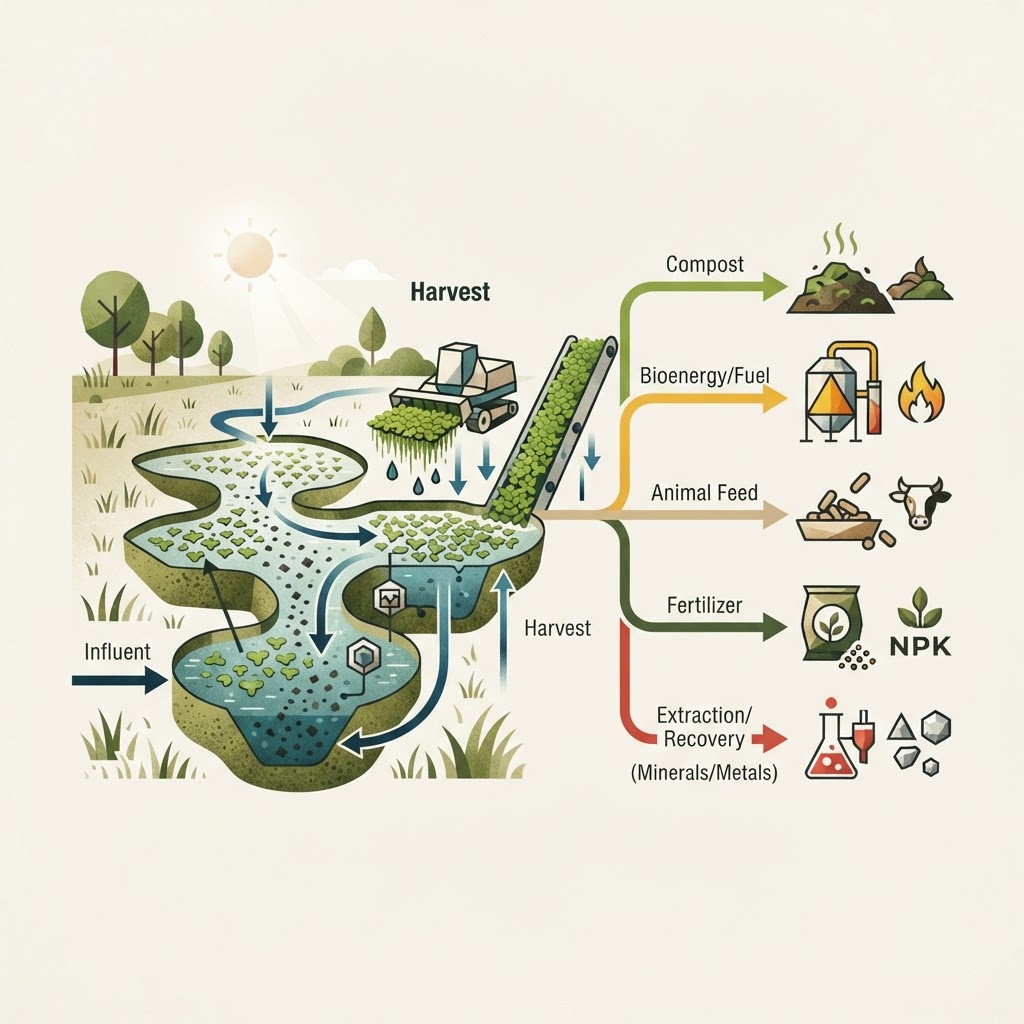
Duckweed phytoremediation is usually explained as removal. A percentage goes on a slide, the water gets cleaner, and the story ends there. It is a good story and it is missing the second half, because a plant cannot destroy a heavy metal. It can only move one.
That distinction is not pedantry. It decides what you are actually buying. Nitrogen and phosphorus become plant tissue. Many organic compounds get metabolised by the plant or by the microbes around it. But for pollutants that cannot be broken down, the review literature is explicit that bioremediation means uptake and sequestration of the pollutant, followed by removal and processing of the contaminated biomass. The metal leaves the water column and arrives in a floating crop. Somebody then has to harvest that crop, and somebody has to pay for wherever it goes next.
The appeal is real, which is why this matters. Phytoremediation is solar-driven and, on average around ten times cheaper than engineering-based heavy metal methods like ion exchange, filtration and adsorption. A tenfold cost difference is worth a great deal of engineering attention. It is also exactly the kind of headline that makes a disposal line item disappear from a budget.
The percentage moves with the concentration
Start with the numbers that make duckweed look unbeatable, and read them with their conditions attached.
A 2025 study of Lemna minor against three metals reported maximum removals of 92 percent for cadmium at 0.5 ppm, 99.7 percent for lead at 0.5 ppm and 99.75 percent for nickel at 1 ppm. The same study, same tanks, same plant, also reported 28.6 percent for nickel and 8.5 percent for lead at 10 ppm on day one. One order of magnitude more contaminant, and the efficiency collapses.
The published spread is wide in the other direction too. Reviews record Lemna minor at 99.99 percent lead removal at 10 mg/L at pH 5 to 6, 99.30 percent nickel at pH 6, and Lemna trisulca at 97 percent for zinc. Those are extraordinary figures, and the pH values next to them are doing a lot of work. Species selection and water chemistry move this result more than the choice of duckweed as a technology does.
A removal percentage quoted without an influent concentration, a species and a pH is not a specification. It is an advertisement.
Real water behaves differently
The closest thing in this literature to an operator’s problem is landfill leachate, which is a genuinely nasty mixed matrix rather than a spiked solution. Lemna minor on leachate removed more than 70 percent of every metal tested over two weeks, peaking at 91 percent for copper, while cutting COD by 39 percent and BOD by 47 percent. That is the number people quote.
The same authors also measured bioconcentration factors below 1 for all five metals and concluded the plant was a moderate accumulator rather than a hyperaccumulator on that leachate. Set that against the benchmark: roughly 400 plant species qualify as hyperaccumulators, taking up metals at 50 to 100 times the rate of a normal plant. Duckweed on real leachate was not behaving like one.
This is not a mark against duckweed. It is a sizing input. A moderate accumulator with a very fast growth rate can still shift a lot of mass, but it does it through biomass throughput rather than through concentration, and throughput is a harvesting problem.
The metal ends up in the part you harvest
Duckweed does not conveniently park contaminants somewhere you can leave them. Under copper chloride at 0.6 mg/L, Landoltia punctata held 550 to 600 micrograms per gram dry weight in the roots and 400 to 450 in the fronds, and Wolffia globosa reached 143.12 mg/kg fresh weight of cadmium. Wolffia has no roots at all.
The frond is the crop. Whatever the water contained is now in the material you scoop off the surface, and that is the single fact from which everything below follows.
Nutrients and metals are two different jobs
It is worth keeping these apart, because conflating them is how a remediation project acquires an imaginary revenue line.
Nutrient removal is a growth process. Nitrogen and phosphorus are consumed and built into tissue, which is why a duckweed treatment step can polish an effluent down to a discharge number and why duckweed on manure and lagoon effluent is a coherent proposition for a livestock operator. Metal removal is a sequestration process. Nothing is consumed.
One pond can be doing both at once, and one harvest carries both. When it does, the metal decides the destination of the whole harvest, not the nutrients. The presence of a contaminant is a property of the biomass, not of the fraction of the biomass you were interested in.
The harvest is a waste stream
Here is the question the reviews name in a clause and never answer: what do you do with several tonnes of wet plant matter that you deliberately loaded with cadmium.
The disposal literature treats this as an open technical problem. A review of disposal routes for heavy-metal-bearing phytoremediation biomass groups the published options into heat treatment, extraction treatment, microbial treatment, compression landfill and synthesis of nanomaterials, and notes that the metals migrate and transform differently in each process, so operating parameters have to be chosen per route. The authors call reasonable disposal of this material a difficult problem. That is the honest state of the art, and it belongs in a cost model rather than in a benefits column.
There is a variant worth knowing about, because it changes the shape of the problem. Dried duckweed also works as a sorbent. Dried powder of Lemna aequinoctialis showed a lead adsorption capacity above 57 mg/g, and 1.25 g/L of dried Landoltia punctata powder removed nearly 96 percent of uranium at pH 5, against 79 percent for 2.5 g/L of the live plant. Dead biomass outperforming live biomass tells you something about the mechanism. It does not remove the disposal question, it relocates it to a spent sorbent.
Stop harvesting and the removal reverses
The most useful operational finding in this whole topic sits in a thesis that ranks nowhere. On the municipal sewage lagoons at Wellsville, Utah, the duckweed dies off and decomposes at the bottom of the lagoon, forming benthic sludge and releasing much of the nutrients back into the water, which the author says greatly undermines nutrient removal through the treatment process.
Read that as a design rule. Uptake is not removal. Removal happens at the moment biomass physically leaves the system, which makes harvesting part of the treatment process rather than part of the cleaning rota. A duckweed system with no harvest schedule is a storage tank with a green lid.
Remediation biomass is never food or feed
Our position on this is published and it is absolute. Biomass grown on wastewater, manure or contaminated water is remediation-grade, it never becomes food or feed, and the two streams are separated from the first sensor reading rather than sorted at the end.
The reasoning is in the localisation numbers above, not in a policy document. A plant selected because it concentrates cadmium, lead and nickel is a plant that now contains cadmium, lead and nickel, sitting in the frond you harvest. The current review literature reaches the same place independently, warning that contaminant accumulation in plant tissues raises concerns about biomass utilization and contaminant carryover even as duckweed is proposed for circular bioeconomy schemes.
None of this argues against duckweed as a protein crop. Duckweed as animal feed is well evidenced and commercially serious. It is a different stream, grown on clean water, kept apart by design and not by intention.
Almost all of this evidence is indoor
Every figure above shares a footnote. The 2025 metals study ran in 30 plastic tanks under controlled light and temperature. Reviews of the field conclude in their own words that understanding of removal efficiencies is limited mainly to laboratory experiments and batch systems, rarely reaching microcosm or mesocosm scale. The most recent review names the blockers on field-scale implementation as environmental complexity, pollutant mixtures and variable climatic conditions, against a background where 80 percent of wastewater globally goes untreated and metals like lead and mercury persist in water sources for decades.
The gap shows up in a specific way. In one recirculated set-up, duckweed cut lead from an influent of 2.5 mg/L to 0.93 mg/L in three days, a bioaccumulation of 62.8 percent, while the effluent came out at 112 mg/L BOD5 against an influent of 0.23. The target contaminant was a success. The discharge was not. Your consent covers the whole effluent, and a system characterised on one line of the analysis has only been characterised on one line.
Built for the field, not the lab, is not a slogan about ambition. It is a statement about which evidence exists.
What to establish before this enters a project plan
- What influent concentration is behind that percentage? As the metals data shows, the number moves with the load.
- Which species, and at what pH? Both move the result more than the technology choice does.
- Is that a water measurement or a tissue measurement? They answer different questions, and the difference is the mass balance.
- What does the whole discharge measure? Not the target contaminant. See the lead study above.
- Who owns the harvest schedule, and what happens if it slips? Removal stops when harvesting stops.
- Which disposal route, and who pays? One of the five families, named before construction rather than after.
- Indoors or outdoors, and across how many seasons? Including the cold ones.
These are the same questions that separate a project from a press release when evaluating a duckweed phytoremediation company, and they apply doubly on frontier contaminants like PFAS.
Where SERAPH stands
We develop the cultivation system and the know-how, and our published maturity is TRL 3, proof of concept, with outdoor field validation still ahead. We have no field removal figures to quote, because producing them honestly is the next piece of work rather than a completed one.
What does exist is the measurement side. A knowledge base of 256 indexed duckweed papers mapped across 31 research areas in 5 domains, each area carrying a coverage weight and a maturity band, which is how we can say where the evidence is thin rather than guessing. And a vision layer that reconstructs a cultivation canopy in 3D from a single capture using 170,000 surface points drawn from 5.9 million, and tells duckweed species apart on a real tray frame by frame.
That focus follows from the argument of this article. If removal happens at the harvest rather than at the uptake, then knowing the continuous state of the canopy is the part of the problem worth instrumenting. AI proposes, the bench validates.
FAQ
How effective is duckweed at phytoremediation of heavy metals? Very high in the lab at low concentrations, and much lower as the load rises. Tank studies report above 90 percent for cadmium, lead and nickel at 0.5 to 1 ppm, and 28.6 percent for nickel and 8.5 percent for lead at 10 ppm on day one of the same experiment. Ask for the concentration before you accept the percentage.
What happens to duckweed after it absorbs heavy metals? It becomes contaminated biomass with a destination and a cost. The published routes group into heat treatment, extraction, microbial treatment, compression landfill and nanomaterial synthesis, and because the metals behave differently in each process, the route is an engineering decision made before the system is built.
Is duckweed a hyperaccumulator? Not on real water, on the evidence available. On landfill leachate the bioconcentration factors were below 1 for every metal tested and the authors classed the plant as a moderate accumulator, against a hyperaccumulator benchmark of 50 to 100 times normal plant uptake. Duckweed shifts mass through growth rate, not through concentration.
Can duckweed used for phytoremediation be fed to animals? No. Biomass grown on wastewater, manure or contaminated water is remediation-grade and never becomes food or feed. Feed-grade duckweed is a separate stream on clean water, and the separation has to be designed in and documented rather than asserted afterwards.
Does duckweed phytoremediation work outdoors at full scale? It has not been demonstrated to. Published efficiencies come mainly from laboratory batch systems, and the current reviews name environmental complexity, pollutant mixtures and variable climate as the reasons those results do not transfer. Any supplier quoting field performance should be asked which months it covers.