Duckweed Phytoremediation Companies: How to Evaluate One
Who sells duckweed phytoremediation, the four business models these companies mix up, and the questions that separate a real project from a press release.
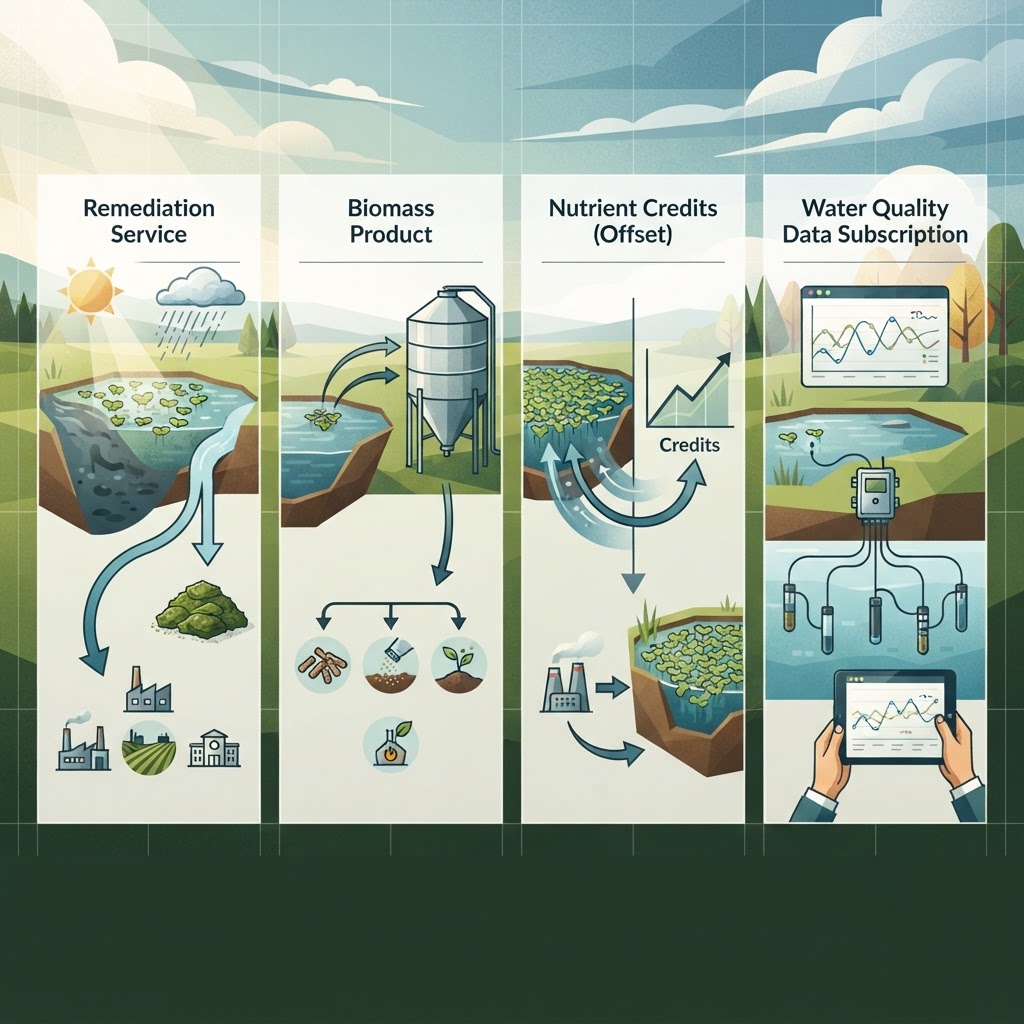
Search for duckweed phytoremediation companies and you get two kinds of page. One is a plant science review that never names a supplier. The other is a single company’s homepage, written for a funding round rather than for you. There is no map of the sector, which is inconvenient, and there is no way to compare the firms inside it, which is expensive.
The expense comes from a specific problem. The label covers at least four different businesses. They sell different things, carry different risk, and are priced in different units. Put three of them in the same procurement process and you are not comparing quotes, you are comparing categories.
This page is the map: what each model actually sells, what the published evidence supports and where it stops, and the questions that separate a project from a press release. We apply those questions to ourselves at the end, because a page telling you to demand a straight answer about maturity has to give one.
The four business models hiding behind one label
The treatment contractor
This is the model closest to what most buyers imagine: someone designs, builds and often operates a system that takes your effluent and hands back water that meets a number.
Lemnion Green Solutions in Pune is the clearest published example of what it looks like with a record behind it. The company has completed around 30 projects, treating river and drain stretches of 100 to 2,000 metres and running wastewater systems from 1 to 3,000 kilolitres per day. Its systems are designed around roughly four days of retention, about 75 percent of the mat is removed every other week, and the founders describe a configurable toolkit rather than fixed parameters. Duckweed is often only one stage: the typical build is a hybrid, with media and rooted plants in the first tanks and duckweed in the last.
Two things in that description are worth stealing as evaluation criteria. The contractor named a retention time and a harvest interval, and the contractor did not claim duckweed was the whole system.
The livestock and manure nutrient service
A narrower model, aimed at one buyer with one regulatory problem. Lemna, in Gilbert, Arizona, sells manure nutrient optimisation, regulatory compliant nutrient balancing and comprehensive nutrient management planning: a lagoon is treated as a nutrient inventory to be rebalanced rather than a tank to be cleaned.
It is also a useful lesson in reading stage. The company’s own record lists three employees, incorporation in 2020, and pilot agreements with California dairy farms for on-farm trials. None of that is a criticism. It is the difference between a pilot partner and a contractor, and knowing which one you are talking to changes what you should ask for.
The integrated water, food and energy developer
The most ambitious model. Aqua Lemna Group describes a closed loop producing potable water fit for human consumption, water for agriculture and aquaculture, high-protein biomass for food and animal feed, renewable energy and bioplastics, modular and replicable, aligned with all 17 UN Sustainable Development Goals, and described as proven technology already ready to deploy.
The vision is coherent and the plant can genuinely do several of those jobs. What a buyer has to establish is which outputs are engineered and which are implied, and whether the food stream and the polluted influent are separated by design. More on that below, because it is the single most important question in this sector.
The technology and know-how developer
The fourth group does not sell you treated water at all. It develops the cultivation system, the control logic and the design method, then transfers that to a partner who builds. Duckweed Bio in Florida, founded in 2021 and currently running a mini pilot around a proprietary hydroponic system, is one example. SERAPH is another, and we will be specific about our own stage at the end.
There is a fifth option that rarely appears in a duckweed search and often deserves to. An established phytoremediation consultancy such as Roux, with over 15 years of experience, more than 70,000 trees installed, and a turnkey scope running from water budget and concept development through engineering design, installation and operation, works mostly in trees and soil rather than the water column. For a contaminated site, that may simply be the right answer. It is also the professional standard the aquatic side of this field has not yet reached, which is worth knowing before you read a duckweed brochure.
If you want the mechanism behind all of this before you talk to anyone, we have written how a duckweed treatment step actually works separately.
What the evidence supports, and where it stops
Metals: high removal, at low concentrations
The published record for Lemna minor against heavy metals is genuinely strong at the top end. One 2025 study reports maximum removal of 92 percent for cadmium at 0.5 ppm, 99.7 percent for lead at 0.5 ppm and 99.75 percent for nickel at 1 ppm. Those are the numbers that end up on slides.
The same study also reports its low end: 28.6 percent for nickel at 10 ppm on day one, and 8.5 percent for lead at 10 ppm on day one. Same plant, same experiment, one order of magnitude more contaminant. Removal efficiency falls as concentration rises, which means a percentage quoted without an influent concentration is not a number. It is a mood.
Note the conditions too. That work ran in 30 plastic tanks under controlled light and temperature. Almost every headline figure in this field carries that same footnote, which is the whole reason duckweed phytoremediation is easier to demonstrate than to deploy.
A closer analogue to real water: Lemna minor on landfill leachate removed more than 70 percent of every metal tested, peaking at 91 percent for copper, while cutting COD by 39 percent and BOD by 47 percent. The authors also recorded bioconcentration factors below 1 for all five metals and concluded the plant was a moderate accumulator rather than a hyperaccumulator, on that leachate. Both halves of that finding are useful to a buyer.
The result nobody quotes
The most instructive study in this literature is one that reported a result it was not looking for. Duckweed cut lead from an influent of 2.5 mg/L to 0.93 mg/L in a recirculated set-up in three days, a bioaccumulation of 62.8 percent. In the same run, the effluent came out at 112 mg/L BOD5 against an influent of 0.23.
The lead result was a success. The discharge was not. Your consent covers the whole effluent, not the contaminant in the headline, and a supplier who can only characterise one line of the analysis has only solved one line of your problem.
Seven questions to ask a duckweed phytoremediation company
What is the influent concentration behind that removal number? A percentage with no concentration attached cannot be checked or compared, and as the metals data shows, the percentage moves with the concentration.
Indoors or outdoors, and for how many seasons? Controlled light and temperature is the default condition of this literature. A supplier quoting field data should be able to tell you which months it covers, including the cold ones.
What is the contract, a treated cubic metre or a design? A performance obligation and a know-how transfer are priced, insured and risked in completely different ways. Both are legitimate. Confusing them at proposal stage is how projects end up with no one accountable for the outlet.
What happens to the harvested biomass? The review literature is direct that duckweed phytoremediation works by bioaccumulating toxic nutrients and heavy metals for disposal. Disposal is a line item, and it belongs in the cost model rather than in the benefits column.
What does the whole discharge look like? Ask for the full analysis of the outlet, not the target contaminant. See the lead study above.
Who owns the harvest schedule? Removal stops when the mat stops growing, so the harvest interval is part of the treatment process, not the cleaning rota. Lemnion’s every-other-week interval is a design parameter. Find out whose staff hold that duty and what happens when they miss it.
What is the failure plan? If the biological step underperforms in month seven, what carries the consent? A supplier who has thought about this has a better answer than one who has only thought about month one. This is also where designing a cultivation system toward a defined target, rather than building first and tuning later, earns its cost.
The question the sector answers worst
Our position is published and it is absolute. Biomass grown on wastewater, manure or contaminated water is remediation-grade, it never becomes food or feed, and the two streams are separated from the first sensor reading rather than sorted at the end.
The reasoning is in the numbers above, not in a policy document. A plant selected because it concentrates cadmium, lead and nickel out of water is a plant that now contains cadmium, lead and nickel. That is the mechanism working, and it is the reason the output has to be treated as a waste stream with a destination.
This is why the integrated model deserves a specific question rather than general enthusiasm. Where potable water, human food and animal feed appear on the same loop as a polluted influent, ask to see the separation documented: which vessels, which sensors, which records, which physical barrier. If it is not written down before construction, it does not exist afterwards.
None of that is an argument against duckweed as a protein crop. It is an argument about provenance. Duckweed as animal feed is a real and well-evidenced use for purpose-grown biomass on a clean stream, and it is a different stream, deliberately.
Where SERAPH sits on its own list
We are in the fourth group, and the same published guidance quoted above states our maturity: TRL 3, proof of concept, with outdoor field validation still ahead.
That means we develop the cultivation system and the know-how. We do not contract for a treated cubic metre, and we have no field yield figures to quote, because producing them honestly is the next piece of work rather than a completed one. What we do have is a knowledge base of 256 indexed duckweed papers mapped across 31 research areas in 5 domains, and a vision layer that reads canopy continuously without destructive sampling.
Apply the seven questions to us and you get a clear picture of what we can and cannot do today. That is the point. You should be able to place any supplier in this sector within one conversation, and a company unwilling to say plainly where it stands has already answered a different question.
FAQ
Are there any commercial duckweed phytoremediation companies operating today? Yes, but few, and most are small and early. The examples with the deepest public record are a Pune contractor with around 30 completed projects, an Arizona firm of three people running dairy pilots, and several developers still at pilot stage. Treat the sector as emerging rather than established, and size your risk accordingly.
How much does a duckweed phytoremediation project cost? There is no public price for the category, and the reason is structural: the four models above are not selling the same scope. Price the model first. A turnkey phytoremediation scope covering concept, design, installation and ongoing operation is a different commercial object from a design licence or a pilot agreement.
Can duckweed remove PFAS or pharmaceuticals from water? The reviewed literature covers mineral nitrogen and phosphorus, various organic chemicals and heavy metals. Individual emerging contaminants are an active research question rather than a settled capability, so a company claiming a specific compound should be asked for the study on that compound, at your concentration.
Is duckweed phytoremediation approved by regulators? There is no category approval to point at, in the EU or elsewhere. Compliance attaches to the discharge consent on your outlet, not to the technology upstream of it, so the question that matters is what the whole effluent measures.
What is the difference between duckweed phytoremediation and a constructed wetland? A duckweed system works through a floating mat on the water column. A constructed wetland works through rooted plants and biofilm in a gravel or sand medium. Several contractors run hybrids and use duckweed in only one stage, so ask which stages of a proposed system actually contain duckweed.