Duckweed and PFAS: What the Evidence Supports
Duckweed removes over 95 percent of long-chain PFAS in the lab. At what concentration, where the mass goes, and what that means for a real discharge.
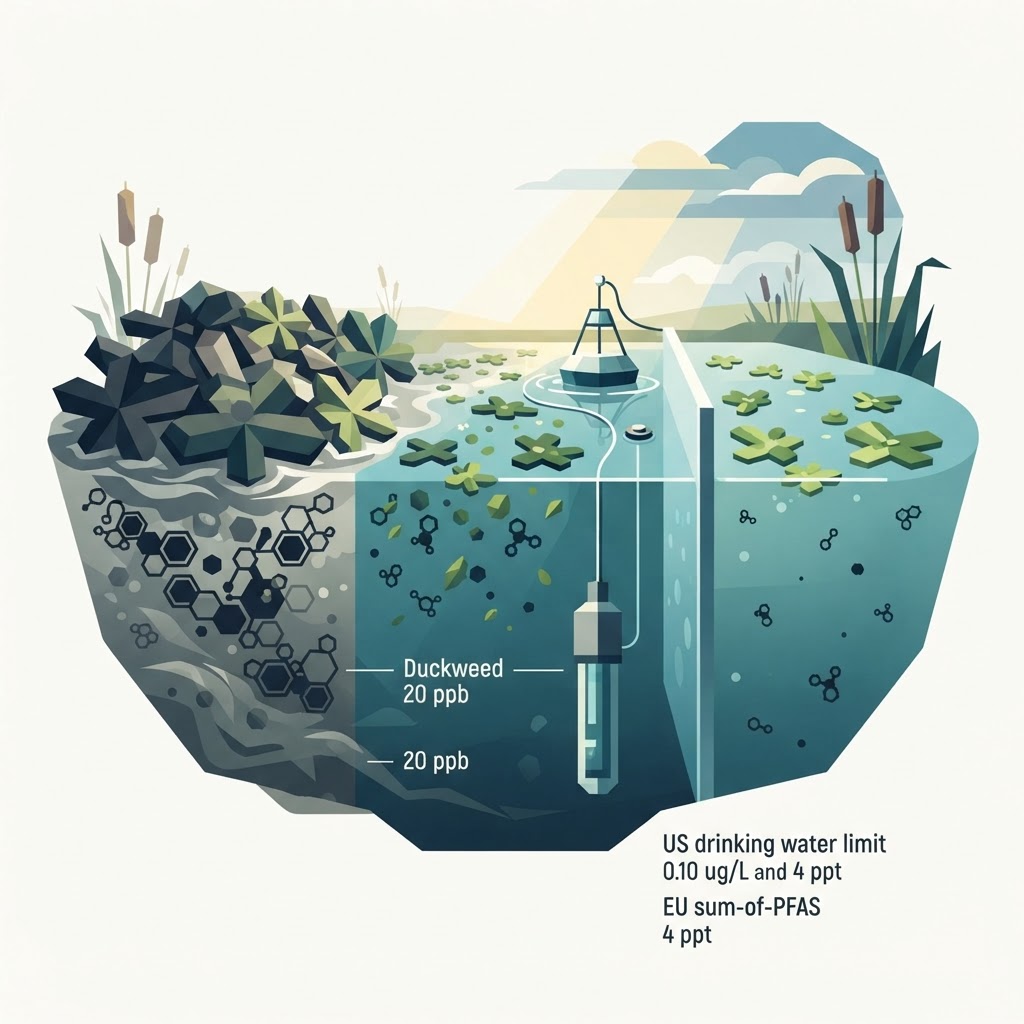
Search duckweed and PFAS together and one number comes back from almost every page: removal of long-chain PFAS above 95 percent. It is a real result from a real experiment, and quoted on its own it is close to useless.
The experiment behind it spiked eight perfluoroalkyl acids into solution and grew duckweed on the surface for two weeks. Removal of perfluoroheptanoic acid, perfluorohexanesulfonic acid, PFOA and PFOS exceeded 95 percent at 200 parts per billion, while removal of the short-chain compounds PFBA, PFPeA, PFBS and PFHxA was marginal. The same study reports a second figure that rarely travels with the first: at 2 parts per billion, duckweed accumulated 14.4 percent of the PFOS it was given over the same two weeks.
Two numbers, one experiment, two orders of magnitude apart in concentration. A PFAS removal percentage without a concentration attached is not a result. This page puts the concentration back next to every figure, follows the mass to where it actually ends up, and states our own position at the end rather than implying a capability we do not have.
What has actually been measured
Chain length decides almost everything
The split in that first study is the most reliable finding in this literature. Long-chain compounds came out of solution, short-chain compounds mostly did not. That is chemistry rather than technique: the longer perfluorinated tail is more surface-active and more strongly sorbed. It is also specific to water. In soil, the ranking inverts, with bioaccumulation factors running from about 10 for short-chain PFBS and PFBA down to about 1 for long-chain PFOS and PFOA, which is a reminder that results do not carry across matrices any more readily than they carry from indoors to outdoors.
The practical problem is that short-chain compounds are increasingly the ones turning up in groundwater, because they were adopted as replacements for the long-chain chemistry being phased out. An approach that works on the compounds leaving the market and not on the compounds entering it is a narrower answer than the headline suggests.
Precursors behave differently again. A review of duckweed phytoremediation reports accumulation of 86.7 and 1226 micrograms per kilogram for perfluorooctane sulfonamide and fluorotelomer sulfonate respectively after 14 days, a difference of more than an order of magnitude between two PFAS intermediates in the same plant. Compound list matters as much as concentration.
The one low-concentration study, and what it cost the plant
The closest thing to an environmentally realistic exposure in this field ran Lemna minor at 0.1 micrograms per litre of PFOA. The plant took it up, with an average bioaccumulation factor of 56 plus or minus 7, which is a genuine uptake result at a concentration you might actually meet in surface water.
It was not free. The same study recorded 15 to 25 percent more chlorosis than controls after 14 days, potassium, copper, iron, manganese, zinc and molybdenum reduced by 39.6, 33.4, 42.1, 35.2, 31.9 and 40.2 percent, and a 50 percent growth reduction against the control group. The authors treat that as an acceptable trade for the remediation benefit, which is a defensible scientific judgement. For anyone sizing a treatment step it is a design input: the biomass turnover that drives the whole process halves under the contaminant it is there to remove. If you are planning around how fast duckweed actually grows, that is the growth curve you would need to plan against, not the healthy one.
Where the PFAS ends up inside the frond
Imaging work using MALDI mass spectrometry found that PFAS were not localised to duckweed roots but diffused into the plant, sitting primarily in the mesophyll and mostly in the parent frond rather than the daughter frond. That has a direct operational consequence. If the load concentrates in older tissue, then harvest timing and the age structure of the mat are part of how much contaminant leaves the system per pass, not just how much biomass does.
The gap between a spiked beaker and a discharge consent
Here is the arithmetic nobody publishes next to the headline.
The US EPA’s final drinking water rule set enforceable maximum contaminant levels of 4.0 parts per trillion for PFOA and PFOS and 10 parts per trillion for PFHxS, PFNA and GenX chemicals. In the EU, the Drinking Water Directive sets a Sum of PFAS value of 0.10 micrograms per litre and a PFAS Total value of 0.50 micrograms per litre.
Convert the studies into the same units. The 200 ppb spike behind the 95 percent figure is 200,000 nanograms per litre, roughly fifty thousand times the US limit for PFOA. The 2 ppb condition is 2,000 nanograms per litre. Even the realistic 0.1 micrograms per litre exposure is 100 nanograms per litre, twenty five times the enforceable limit.
None of this is a criticism of the researchers. Their job was to establish whether uptake happens and by what mechanism, and spiking high is how you get a measurable signal. But the question an operator asks is different. It is whether a biological step can take water from tens of nanograms per litre to single figures, reliably, outdoors, across a winter. No published duckweed study has been run at that concentration, in that setting, for that duration. That is not a gap in the technology. It is a gap in the evidence, and it is the difference between a mechanism and a process.
The regulatory picture is also still moving. On 18 May 2026 the EPA proposed two rules: one upholding the PFOA and PFOS limits while offering water systems an additional two years to comply, to 2031, and one that would rescind the regulations for PFHxS, PFNA, GenX and the Hazard Index mixture. Anyone designing to a number today should check which number is in force on their outlet.
Removed from the water is not the same as taken into the plant
This is the distinction that matters most and gets collapsed most often.
In the same experiment that produced the 95 percent figure, close to 80 percent of PFOA and PFOS at 200 ppb was removed by aeration alone in deionized water at pH 2.3, with no plant involved at all. PFAS are surfactants. They concentrate at the air-water interface and they leave solution by routes that have nothing to do with biology.
A second study makes the caution explicit. Investigating PFOA and uranium together, the authors declined to predict contaminant concentrations in the duckweed at all, citing sorption to container walls and partitioning at the air-water interface. That is an unusually honest sentence for a paper to contain, and it is the sentence a buyer should read before a removal percentage. The same work found a slight stimulation of frond number at 0.3 ppb PFOA that did not appear at 3 ppb, so the dose response is not even monotonic.
So when a supplier quotes PFAS removal, there is one question that separates a result from a marketing number: was that measured in the water or in the biomass, and if the two do not reconcile, where did the rest of the mass go? Sorbed to a surface and unaccounted for is not treated. The same discipline applies to the nutrient side, where how a duckweed treatment step works is far better evidenced and the mass balance is far easier to close.
The harvest is the problem, not the solution
A plant selected because it concentrates PFAS is a plant that now contains PFAS.
Everything above describes a transfer, not a destruction. The contaminant moves from a dilute, large-volume stream into a small, concentrated, wet solid, and the concentration step is the point. What follows is a waste stream with a destination, a cost and a chain of custody. The review literature that carries PFAS phytoremediation through the full chain treats disposal and valorisation of contaminated plant biomass as an open research problem rather than a solved step.
The routes that exist are thermal and demanding. Pyrolysis probably needs to run above 800 degrees C to ensure PFAS destruction. At the industrial end, dedicated hazardous waste incineration is currently the only treatment expected to reach the Basel Convention destruction and removal efficiency above 99.9999 percent, with one full-scale study estimating 99.999997 to 99.99996 percent. Duckweed harvested wet, at high moisture content, has to be dried before any of that is even available. Put that line in the cost model at design stage, because it does not go away.
It also settles a question that should never be open. Our policy is published and absolute: remediation biomass is never sold or blended as food or feed, and the two streams are separated from the first sensor reading rather than sorted afterwards. The PFOA study above reaches the same conclusion from the other direction, noting that phytoremediation is viable provided non-edible plants are chosen. Biomass grown on PFAS-bearing water is remediation-grade permanently. Duckweed as animal feed is a real and well-evidenced use, and it is a deliberately different stream, grown on clean water, with its own traceability.
What to ask before duckweed and PFAS appear in the same proposal
- At what influent concentration was that removal figure measured, in nanograms per litre?
- Which compounds, by chain length, and does the list match what is on your outlet?
- Was removal measured in the water or in the tissue, and does the mass balance close?
- What is the disposal route for the harvested biomass, at what temperature, and who pays?
- Indoors or outdoors, and across how many seasons including the cold ones?
- If the biological step underperforms in month seven, what carries the consent?
Those are the same questions worth asking of anyone in this sector, which is why we wrote a longer guide to evaluating a duckweed phytoremediation company separately.
Where SERAPH stands on this
We do not treat PFAS today, and we have no field data on it.
Our published maturity is TRL 3, proof of concept, with outdoor field validation still ahead. Inside our knowledge base of 256 indexed duckweed papers mapped across 31 research areas in 5 domains, PFAS sits in the thinnest band we have. Nitrogen and phosphorus removal is decades deep. This is two useful papers and a frontier.
That is worth saying plainly rather than hiding, because the honest version of this topic is more useful to an operator than an optimistic one. Duckweed takes up long-chain PFAS. It does so at concentrations far above regulatory limits, at a measurable cost to its own growth, with an unresolved mass balance and an unsolved disposal chain. Every one of those is a researchable question. None of them is answered by a percentage on a slide. AI proposes, the bench validates, and the bench has not been outdoors on this yet.
FAQ
Can duckweed remove PFAS from water? Under laboratory conditions, yes, for some compounds. Removal of long-chain PFAS exceeded 95 percent at a 200 parts per billion spike over two weeks. Short-chain compounds in the same experiment barely moved. There is no published outdoor, multi-season result at regulatory concentrations, so treat it as a mechanism that has been demonstrated rather than a process that has been proven.
Does duckweed remove short-chain PFAS like PFBS and PFBA? Not meaningfully in the published work. In the study that produced the 95 percent headline, removals of PFBA, PFPeA, PFBS and PFHxA were marginal. This matters because short-chain compounds were adopted as replacements for the long-chain chemistry being phased out and are increasingly what shows up in groundwater.
Is PFAS toxic to duckweed? Mildly at tested concentrations, and the sublethal effects are the ones that matter for a treatment system. At 0.1 micrograms per litre PFOA over 14 days, researchers recorded chlorosis, reductions of roughly 30 to 42 percent in six essential elements, and a 50 percent growth reduction against control. Slower growth means slower biomass turnover, which means less contaminant removed per harvest.
What happens to duckweed after it has absorbed PFAS? It becomes a PFAS-bearing waste stream. Phytoremediation concentrates the contaminant rather than destroying it, so the harvest needs a documented disposal route. Thermal treatment is currently the only approach with demonstrated destruction efficiency, and the biomass never enters a food or feed chain under any circumstances.
Is duckweed PFAS treatment commercially available? No. The published record is small-scale and indoor, no outdoor multi-season dataset exists, and PFAS sits at the frontier of the duckweed literature rather than in its established core. Any supplier offering it should be asked for the study at your concentration, on your compound list.