Duckweed and Antibiotics: What Lab Studies Show
Duckweed antibiotics evidence: lab uptake of tetracyclines, quinolones and sulfonamides, at what concentration, by what mechanism, and what you can claim.
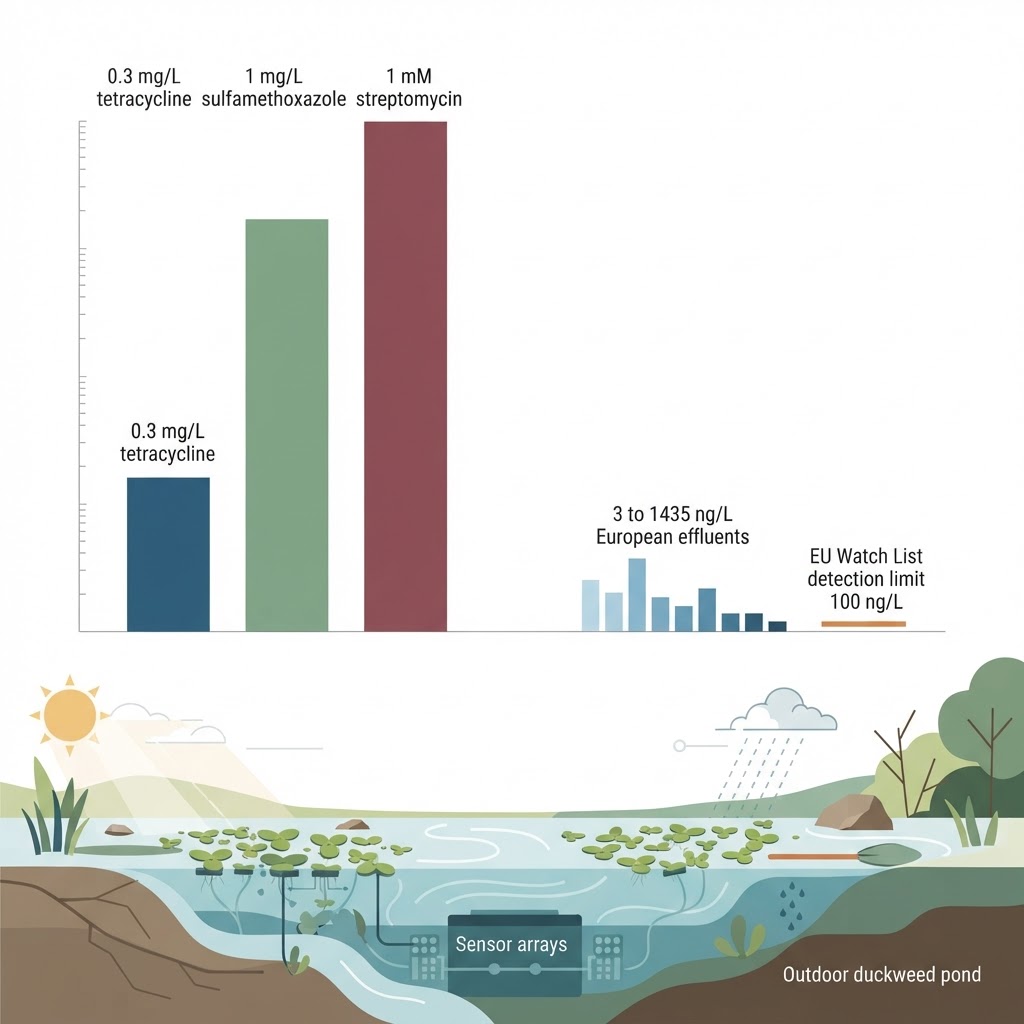
Search duckweed antibiotics and you get a column of journal abstracts. Each one tests a single drug, at a single concentration, for a week or so, and reports a removal percentage. Read together, they say something real: duckweed does take antibiotics out of water. Read carefully, they also say something the abstracts leave out. Almost every figure was produced at concentrations a thousand to a million times higher than what leaves a treatment plant, indoors, under lights that do part of the work themselves.
This page puts those numbers side by side with the concentrations an operator actually meets, separates what the plant did from what the sunlight did, follows the antibiotic into the harvested biomass, and asks the question none of the ranking pages ask: what happened to the resistance genes. It ends with where we stand, which is early, and we say so.
What has actually been measured
Tetracyclines and quinolones: uptake tracks the dose
The cleanest dose series come from a Polish group running 7-day tests on Lemna minor. With tetracycline, tissue content reached 0.87 milligrams per gram dry weight at the lowest dose of 0.3 milligrams per litre and 8.09 milligrams per gram at 19.2 milligrams per litre, with minocycline taken up less readily at 6.01 milligrams per gram. The same paper notes that 50 to 80 percent of an applied tetracycline dose ends up in the environment, which is why the class matters.
The same group ran four quinolones through the same protocol. Nalidixic acid was absorbed most, from 0.72 milligrams per gram dry matter at 0.4 milligrams per litre to 5.19 milligrams per gram at 12.8, while levofloxacin was not absorbed at all at the lowest dose. Growth inhibition started at EC20 values of 0.29 milligrams per litre for moxifloxacin, 0.48 for nalidixic acid, 0.62 for levofloxacin and 1.45 for pefloxacin. None of the four was lethal at 12.8 milligrams per litre, but all of them stripped assimilation pigments. These are toxicity tests that happen to measure uptake, and the design behind them is the Lemna growth inhibition test rather than a treatment trial.
Sulfonamides: the compound that resists everything except the plant
Sulfamethoxazole is the antibiotic a European operator is most likely to be asked about, and it behaves differently. In a study on Lemna aoukikusa with ciprofloxacin and sulfamethoxazole side by side, ciprofloxacin was reduced by hydrolysis, photolysis and plant uptake together, while sulfamethoxazole resisted hydrolysis and photolysis and came out of solution only through uptake, and only under illumination. Sulfamethoxazole also inhibited growth more than ciprofloxacin did.
A Japanese study put a number on what the plant alone can do. Sterilised duckweed of four species removed 26.7 to 39.1 percent of 1 milligram per litre sulfamethoxazole in five days; adding 10 millimolar iron(II) to drive a phyto-Fenton reaction pushed removal above 96.1 percent. The second figure is the one that gets quoted. The first is the one that describes duckweed. The gap between them is a chemical dosing step, not a plant.
Streptomycin and chloramphenicol: partial, slow, stressful
Two further papers fill out the picture. On streptomycin, Lemna aequinoctialis reduced the antibiotic by 72 to 82 percent after 20 days against 40 to 55 percent in plant-free controls, and at concentrations of 1 millimolar and above lost 21.5 to 41.5 percent of its biomass. Read that control figure twice: nearly half the streptomycin disappeared with no plant present. On chloramphenicol, Lemna minor reached a maximum of 33 percent removal at 10 milligrams per litre after 72 hours, and 23.2 percent at 2 milligrams per litre, while the antibiotic in the plant-free controls did not change. A third of a very high dose in three days is a mechanism, not a polishing step.
Put the concentration back next to the percentage
Every figure above was measured between 0.3 milligrams per litre and several hundred milligrams per litre. Here is what a treatment plant outlet actually carries.
A two-year campaign across 13 plants in seven European countries screened 53 antibiotics and detected 17 in final effluent, with ciprofloxacin peaking at 1435.5 nanograms per litre in Portugal and compliant plants discharging 7 to 12 compounds each at 3 to 598 nanograms per litre. Spanish effluent carried significantly more sulfamethoxazole than most other samples, and the southern countries plus Ireland sat at the top of the range.
Convert the units. The lowest tetracycline dose in the Polish study, 0.3 milligrams per litre, is 300,000 nanograms per litre. The 1 milligram per litre sulfamethoxazole in the Japanese work is a million nanograms per litre. Real effluent sits three to five orders of magnitude lower, and the same quinolone study found that uptake fell to zero for one compound at its lowest dose. Whether uptake persists at tens of nanograms per litre, where the regulatory interest is, has not been published for duckweed.
The regulatory interest is specific. The EU surface water Watch List keeps sulfamethoxazole and trimethoprim under Union-wide monitoring with a maximum detection limit of 100 nanograms per litre, added clindamycin and ofloxacin in 2022, and dropped amoxicillin and ciprofloxacin that year after their four-year monitoring period ended. For the next list, the Commission’s research centre has proposed tetracycline and oxytetracycline, citing resistance-selection thresholds of 1 microgram per litre and 0.5 micrograms per litre respectively. Those are the numbers a design would have to hit. No duckweed paper on this page tested within a factor of a hundred of them.
Uptake, photolysis or hydrolysis: which one did the work
An open duckweed pond is a sunlit, shallow, warm body of water. Several antibiotics degrade in sunlit, shallow, warm water on their own.
The Greek work that first grew Lemna minor on urine and treated domestic wastewater found ciprofloxacin and sulfamethoxazole both eliminated by more than 80 percent, but with photodegradation as the main route for ciprofloxacin and plant uptake plus biodegradation doing the work for sulfamethoxazole. That split is consistent with the Japanese result above, and it carries an operator-level consequence. For a fluoroquinolone, a plant-free pond with the same depth and light exposure removes most of it too. For a sulfonamide, the plant and its root microbiome are the mechanism. A supplier quoting a removal percentage should be able to say which of the two their control proved.
It also explains why the lit versus dark result keeps appearing. Uptake in these studies depends on an actively photosynthesising plant. A mat under a Canary Islands sky in January and a mat under a German one are not the same reactor, and nobody has yet measured the difference for antibiotics.
The system-scale evidence is one pond
Beakers and flasks dominate this literature. The nearest thing to a system is a baffled duckweed pond treating agricultural drainage water in Egypt, where amoxicillin removal rose from 52.9 to 82.9 percent and ampicillin from 55.3 to 90.6 percent when hydraulic retention time went from 6 to 8 days, with only a slight further gain at 12 days. That is a useful design point: the curve flattens after about a week of residence. It is also a spiked influent in a single hot climate with no mass balance.
The counterweight comes from a Canadian mesocosm study whose title states its finding: macrophytes may not contribute significantly to removal of nutrients, pharmaceuticals and antibiotic resistance in model surface constructed wetlands. The authors are not saying the plant does nothing. They are saying that when you subtract what the water, light and sediment do on their own, the plant’s marginal contribution is hard to detect at environmental concentrations. That is exactly the comparison the high-dose beaker studies are not designed to make, and it is why how a duckweed treatment step works for nitrogen and phosphorus is a different conversation from this one. On nutrients the plant’s contribution is decades deep and measurable. On antibiotics it is two dozen papers and a dispute.
Resistance genes are the question nobody on this SERP asks
Removing an antibiotic and removing antibiotic resistance are different measurements, and the duckweed literature has only done the first.
The constructed wetland literature has done both, and the result is uncomfortable. A survey of full-scale constructed wetlands found antibiotic resistance genes removed by 1 to 3 log overall, while ermB, sul2 and tetW increased by up to 1 log in some systems. A biological reactor fed sub-inhibitory antibiotic concentrations is, by design, a selection environment. A duckweed root mat is a dense bacterial habitat sitting in exactly that water. We found no duckweed-specific resistome dataset while preparing this page. Until one appears, the effect of a duckweed system on resistance genes is an unmeasured question. If the goal is resistance, specify it in the monitoring plan, because parent-compound removal will not tell you.
Where the antibiotic goes: biomass fate and the firewall
Uptake means the antibiotic is now in the frond. The Polish tissue figures, up to 8 milligrams of tetracycline per gram of dry weight, describe a harvest that is a pharmaceutical-bearing solid, not a crop.
Only one paper on this page follows that biomass anywhere. In the Japanese work, Spirodela polyrhiza grown on sulfamethoxazole wastewater produced biomass at 7.95 grams dry weight per square metre per day and yielded 353 normal litres of methane per kilogram of volatile solids in anaerobic digestion, within the range reported for duckweed grown on cleaner water. Digestion is a plausible destination, and we have written about duckweed biogas separately. What the paper does not report is what happened to the sulfamethoxazole and its transformation products in the digestate, which is the question a regulator will ask about anything that goes back to land.
What the biomass must never become is settled. Our policy is published: remediation biomass is never sold or blended as food or feed, and the two streams are separated from the first sensor reading rather than sorted afterwards. Duckweed grown on antibiotic-bearing water is remediation-grade permanently, whatever the residue analysis says on the day. Duckweed as animal feed is a real and well-evidenced use, and it is a different stream, grown on clean water, with its own traceability. An article that discusses both in the same breath has to say so, and this one does.
Questions to ask before duckweed and antibiotics share a proposal
- At what influent concentration, in nanograms per litre, was the removal figure measured, and how far is that from your outlet?
- Which compound class? Fluoroquinolones photodegrade on their own; sulfonamides mostly do not.
- Did the plant-free control get the same light and depth? If not, the percentage is for the pond, not the plant.
- Was removal measured in the water, in the tissue, or both, and does the mass balance close?
- Were resistance genes measured, or only parent compounds?
- Where does the harvested biomass go, who certifies it never entered a feed chain, and what is in the digestate?
- How many seasons, and were any of them cold and dark?
Those are the same questions worth asking anyone in this sector, which is why we wrote a longer guide to evaluating a duckweed phytoremediation company separately.
Where SERAPH stands on this
We do not treat antibiotics today, and we have no field data on them.
Our published maturity is TRL 3, proof of concept, with outdoor field validation still ahead. Inside our knowledge base of 256 indexed duckweed papers mapped across 31 research areas in 5 domains, emerging contaminants is one of the thin bands, alongside duckweed and PFAS. Nitrogen and phosphorus removal is decades deep. Antibiotics are a few dozen indoor papers, most of them toxicity tests read backwards as treatment studies.
That is worth stating plainly because the honest version is more useful to an operator than the optimistic one. Duckweed takes up tetracyclines, quinolones and sulfonamides. It does so at milligram-per-litre doses, at a measurable cost to its own growth, with sunlight doing an unquantified share, with no resistome data, and with a harvest that is a regulated waste. Every one of those is a researchable question, and the ones about light, season and real concentrations are exactly the ones an instrumented outdoor system is built to answer. AI proposes, the bench validates, and the bench has not been outdoors on this yet.
FAQ
Can duckweed remove antibiotics from water? In the laboratory, partially, for tetracyclines, quinolones, sulfonamides, streptomycin and chloramphenicol. Removal in those studies ranged from about a quarter of the dose in three days to over 80 percent in two to three weeks, at concentrations of 0.3 milligrams per litre and above. No published study has tested duckweed at the tens to hundreds of nanograms per litre found in real effluent, outdoors, across seasons.
Which antibiotics does duckweed take up best? In the Lemna minor dose studies, tetracycline and nalidixic acid were absorbed most readily and in proportion to the dose. Minocycline, moxifloxacin, pefloxacin and levofloxacin were taken up less, and levofloxacin was not absorbed at all at 0.4 milligrams per litre. Sulfamethoxazole is the compound where uptake matters most, because it resists the photolysis and hydrolysis that remove fluoroquinolones anyway.
Are antibiotics toxic to duckweed? At milligram-per-litre doses, yes, though rarely lethal. Growth inhibition began at 0.29 milligrams per litre for moxifloxacin, and streptomycin at 1 millimolar and above cut biomass by 21.5 to 41.5 percent over 20 days. Pigment loss and reduced photosynthetic efficiency were consistent across classes. Slower growth means slower biomass turnover and less contaminant removed per harvest.
Does duckweed reduce antibiotic resistance genes in wastewater? Nobody has published a duckweed-specific resistome dataset. In full-scale constructed wetlands, resistance genes fell by 1 to 3 log overall, but ermB, sul2 and tetW rose by up to 1 log in some systems. Parent-compound removal does not predict resistance-gene removal, so the two must be measured separately.
Can duckweed grown on antibiotic-contaminated water be used as animal feed? Not under our policy, and not under any sensible one. Biomass from a remediation stream is never sold or blended as food or feed, and the separation starts at the first sensor reading. The one study that followed antibiotic-exposed biomass anywhere sent it to anaerobic digestion, yielding 353 normal litres of methane per kilogram of volatile solids.