Does Duckweed Absorb Heavy Metals? What the Evidence Shows
Does duckweed absorb heavy metals? Yes: cadmium, lead, nickel and arsenic. How much depends on dose, clone and mechanism, and the metal stays in the plant.
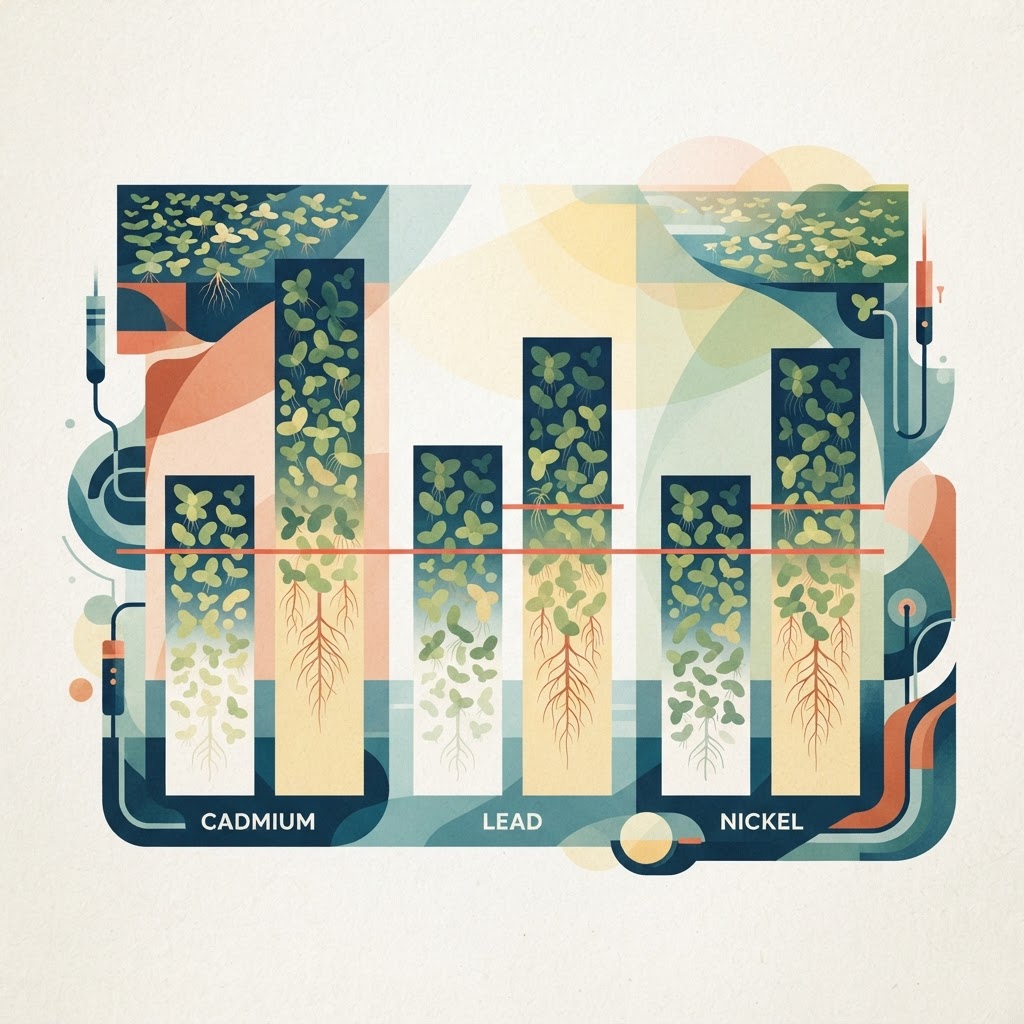
Does duckweed absorb heavy metals? Yes. Cadmium, lead, nickel, chromium, zinc and arsenic have all been measured moving out of water and into duckweed tissue. That part is settled. What is not settled, and what most pages on this question skip, is how much, at what concentration, by which mechanism, and what happens to the metal once it is inside the plant.
Those four questions decide whether a lab result means anything for a real effluent. This article answers them from the published evidence, and it ends where the metal ends: in the harvest.
Short answer: yes, and the number depends on the dose
A recent Lemna minor study is a good example of how the headline numbers are made. Researchers exposed the plant to nickel, cadmium and lead at three concentrations each. The highest removals were 92 percent for cadmium at 0.5 ppm, 99.7 percent for lead at 0.5 ppm and 99.75 percent for nickel at 1 ppm. The same abstract records a low of 28.6 percent at 10 ppm on day one.
Same plant, same lab, same metals. The near-total removals come from the lowest doses. As concentration rises, the plant falls behind.
That is the thesis of everything below: a heavy metal removal percentage without a concentration next to it is not a result. It is half of one.
How duckweed takes up metals: binding versus absorbing
“Absorb” covers two different processes, and the difference matters for anyone designing around them.
A study comparing fresh and dried Lemna minor describes the uptake as biphasic. First comes fast adsorption, metal ions binding to functional groups on the cell walls. Then comes a slower phase, active transport across membranes and sequestration inside the tissue. The first is chemistry on a surface. The second is the plant doing work.
Living plants keep going, dead biomass saturates
The same study ran dried duckweed alongside living plants. Dried biomass reached equilibrium within 4 to 48 hours: zinc in about 4 hours, cadmium in 4 to 24, chromium in up to 48. Once its binding sites were full, it stopped. Living duckweed kept accumulating across the full 168 hours and took up more metal overall.
There was one exception worth knowing. From low-level cadmium solutions, dried duckweed took up more than living plants, because dead tissue does not have to switch on detoxification pathways before it can bind anything. Toxicity does not slow a biosorbent.
For a treatment design, the distinction is practical. Surface-bound metal and internalised metal both leave the water with the harvest. But only a living system keeps generating new binding capacity, and only a living system can be poisoned by what it is removing.
Which metals, and how much
The cleanest way to compare uptake is the bioconcentration factor (BCF): metal concentration in the plant divided by concentration in the water. Here the literature appears to disagree with itself by three orders of magnitude.
The 2025 study above reported BCFs of 10,550 for cadmium, 385,352 for nickel and 484,382 for lead, all at the lowest doses. A glasshouse study that grew Lemna minor for 31 days on raw municipal and sewage-mixed industrial effluent found removal above 80 percent for cadmium, copper, lead and nickel, peaking at 99 percent for nickel. Yet its BCFs were all below 1,000, with a maximum of 558 for copper and 523.1 for lead. The authors called the plant a moderate accumulator.
Both can be true. One measured single spiked metals in clean medium. The other measured a real effluent: mixed metals, competing ions, organic load, and the plant growing in all of it. Removal from the water stayed high in both. What the plant concentrated per unit of biomass did not. When you see a six-figure BCF, check whether the water was a real effluent or a clean spike.
Tolerance is a property of the clone, not the family
Duckweed is not one plant. The family covers 36 recognised species in five genera, and the variation does not stop at species.
A study of three Lemna clones collected from different regions of Vietnam made the point clearly. The clones grew at 0.3 to 0.5 mg/L arsenic, 0.15 to 0.3 mg/L cadmium and 0.15 mg/L lead over 14 days, but their tolerances split. Two clones handled arsenic and cadmium. The third handled lead.
So “duckweed tolerates cadmium” is a statement about a specific clone in a specific medium. A system aimed at a particular metal profile has to be built on a clone selected for that profile, and the selection has to be checked rather than assumed.
Lab doses against real limits
To put the concentrations in context, set them against regulatory values. The EU Drinking Water Directive sets parametric values of 5 micrograms per litre for cadmium, 10 for lead, 10 for arsenic and 20 for nickel.
The 0.5 ppm cadmium dose behind the 92 percent figure is 500 micrograms per litre, 100 times the drinking water value. The 0.5 ppm lead dose is 50 times the limit. Even the lowest cadmium level in the Vietnamese clone study, 0.15 mg/L, is 30 times above it.
None of this makes the studies wrong. Effluents are not drinking water, and dosing high is how you see an effect in 14 days. What it means is that the question an operator actually has (does duckweed polish this effluent down to my consent limit?) sits at much lower concentrations than most published tests. At those levels both the removal rate and the time needed have to be measured, not extrapolated. We made the same point about duckweed and PFAS, where the gap between test dose and regulatory limit is even wider.
Where the metal goes: the harvest is the hard part
Nutrients become plant growth. Metals do not break down. The field’s most cited review says it plainly: for pollutants that cannot be degraded, remediation means uptake and sequestration followed by removal and processing of the contaminated biomass. Duckweed does not destroy cadmium. It moves cadmium from a large volume of water into a small mass of plant.
That is genuinely useful, and it is also the start of a new problem. A 2026 review notes that metal accumulating in tissue raises concerns about biomass utilisation and contaminant carryover. The harvest is now a metal-bearing waste stream, and it needs a documented route.
What it cannot become is food or feed. EU law sets maximum levels for arsenic, cadmium, lead and mercury in animal feed. Biomass grown to pull those metals out of water is the opposite of a feed ingredient. Our own policy is stricter than case-by-case testing: remediation biomass is never sold or blended as food or feed, and the two streams are separated from the first sensor reading. Duckweed as animal feed is a real use. It is a different stream, grown on clean water, and the two never meet.
What we can and cannot say from where we stand
We are early, and we say so. SERAPH is at TRL 3, proof of concept, with outdoor field validation still ahead. We do not have a heavy metal field dataset, and nothing in this article is our measurement.
What we have is a map of the evidence. Our knowledge base indexes 256 duckweed papers across 31 research areas. Read across the metal studies above, the pattern is many lab papers, a consistent direction, and little outdoor data. The 2026 review reaches the same verdict: despite extensive laboratory validation, field-scale use is still held back by environmental complexity, pollutant mixtures and variable climate.
If you are weighing duckweed phytoremediation for a metal-bearing effluent, ask four questions of any supplier:
- At what concentration was the removal measured, and how does it compare to your effluent?
- Was it a single spiked metal, or a real mixed effluent?
- Which clone, and was it selected for your metal profile?
- Where does the harvested biomass go, and who signs for it?
The fourth one matters most. We cover the rest in our guide to evaluating a duckweed phytoremediation company. For the nutrient side, where the evidence is far deeper, see duckweed wastewater treatment. A metal-by-metal breakdown of cadmium, lead and arsenic uptake in detail is in progress.
FAQ
Does duckweed absorb arsenic?
Yes, within limits that depend on the clone. In the 14 day Vietnamese study, Lemna clones grew at 0.3 to 0.5 mg/L arsenic, but only two of the three tolerated it. Arsenic uptake has to be checked clone by clone rather than assumed for the family.
Can duckweed that has absorbed heavy metals be used as animal feed?
No. Feed law caps arsenic, cadmium, lead and mercury, and biomass grown to concentrate those metals is the wrong starting material. It is a waste stream with a disposal route, kept permanently separate from any food or feed production.
Does dried duckweed remove heavy metals?
Yes, by biosorption. Dead biomass binds metals on its surface and reaches equilibrium within hours, and it is not slowed by toxicity. Its capacity is finite, though. Once the binding sites are full it stops, while living plants keep taking metal up.
Do heavy metals kill duckweed?
At high enough doses they slow it sharply. In the 2025 Lemna minor study, removal fell to 28.6 percent at 10 ppm, against over 90 percent at the lowest doses. Slower growth means less fresh biomass and less metal removed per harvest.