Duckweed Novel Food: EU Status of Every Dossier (2025)
Duckweed novel food status in the EU, dossier by dossier: fresh Lemna authorised 2025, Lemna protein 2024, fresh Wolffia 2021, two powders refused.
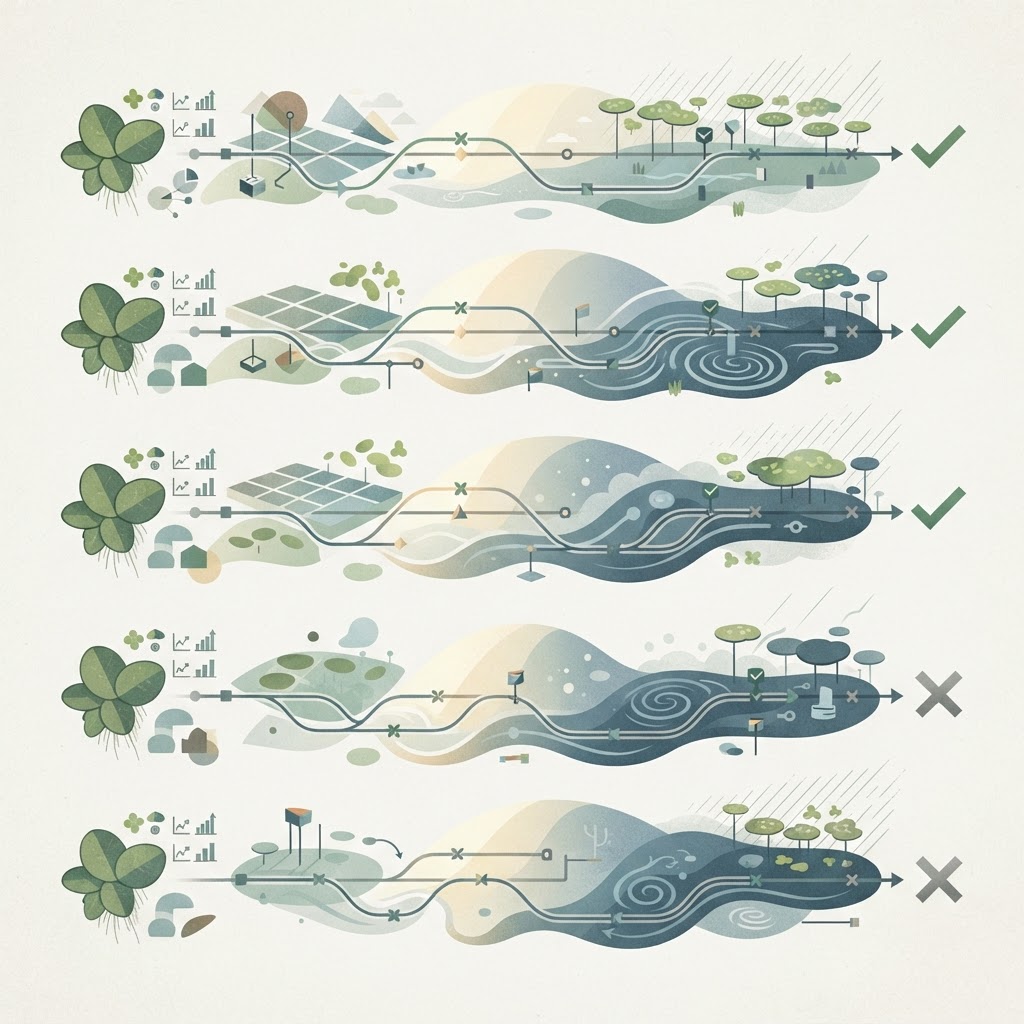
Duckweed novel food status is usually reported as a headline: approved, or rejected. Neither word is right on its own. Between 2018 and 2025 five separate duckweed products went through the EU novel food system. Three are now on the Union list. Two were refused. Read the documents side by side and the pattern is not about the plant at all. Every decision turned on a single element, manganese, and manganese is a property of the water the plant grew in.
This article lays out each dossier with its dates, its applicant and its outcome, cited to the primary text. It then draws the conclusion the documents support: the regulator’s question is a cultivation question.
What novel food means for duckweed
Under the EU novel food framework, only novel foods that have been authorised and entered in the Union list may be placed on the market. A food is novel if it was not consumed to a significant degree in the EU before 15 May 1997, and the Commission’s novel food status catalogue is explicit that the burden of proving a history of consumption sits with the business, not with the regulator.
Duckweed fails that history test in Europe. Wageningen University and Research, which carried the fresh plant dossier, notes that a Dutch herbal book from 1644 mentions duckweed but that it never reached the general public, and that long consumption in Asia is not a determining factor for EFSA.
Two more facts frame everything that follows. The family covers 38 species in five genera: Spirodela, Landoltia, Lemna, Wolffiella and Wolffia. And an authorisation attaches to a defined product from a defined process, never to “duckweed”.
The five EU dossiers, side by side
| Product | Applicant | Submitted | EFSA conclusion | Commission outcome |
|---|---|---|---|---|
| Fresh Wolffia arrhiza and W. globosa plants | GreenOnyx | 7 Sept 2020 (traditional food notification) | No safety objection | Authorised 10 Dec 2021, Reg. 2021/2191 |
| Wolffia globosa powder | Hinoman | 24 Sept 2019 | Safety cannot be established (Dec 2021) | Not authorised |
| Water lentil powder from Lemnaceae | Parabel | 15 Nov 2018 | Safety cannot be established (Sept 2021) | Not authorised |
| Protein concentrate from Lemna gibba and L. minor | ABC Kroos | 28 Dec 2018 | Safe under proposed uses (Feb 2023) | Authorised 30 April 2024, Reg. 2024/1048 |
| Fresh Lemna minor and L. gibba plants | Wageningen Plant Research | 20 May 2020 | Not established (Sept 2022), then resolved (July 2024) | Authorised 29 Jan 2025, Reg. 2025/153 |
Each row is expanded below.
Fresh Lemna: refused in 2022, authorised in 2025
This is the dossier that explains the others, because the same plant was turned down and then let through.
Why the 2022 opinion said no
Wageningen Plant Research applied on 20 May 2020 to sell heat-treated Lemna minor and Lemna gibba as a vegetable, cooked or added to ready-to-eat products, for the general population. EFSA’s panel adopted its opinion on 28 September 2022. It found the risk of allergic reaction low and the food not nutritionally disadvantageous, with one exception. The plants contained more manganese than other leafy vegetables, the EU has no tolerable upper intake level for manganese, and the panel concluded that safety could not currently be established.
The same opinion contains the sentence that recurs in every duckweed file: the concentration of trace elements and contaminants is highly dependent on the conditions of cultivation and the fertiliser composition.
What changed by 2025
The applicant did not argue with the finding. It changed the water. New data showed that by reducing manganese in the cultivation medium, the manganese content of Lemna gibba fell to a level that does not exceed spinach. EFSA’s technical report of 10 July 2024 set the maximum specification at 6 mg/kg fresh weight, noting that spinach, the highest leafy vegetable, reaches up to 9 mg/kg. It also stressed that the rest of the production process must not deviate from what was assessed in 2022.
On 29 January 2025 the Commission authorised the product. The specification in the regulation describes heat-treated plant material with 91 to 95 g of moisture and 1 to 4 g of protein per 100 g, oxalates under 1.6 g/kg and manganese capped at 6 mg/kg, labelled as “Lemna minor and Lemna gibba plants”.
WUR describes nearly ten years of work, a greenhouse grower producing at commercial scale for the analyses, and forms now being tested with the supply chain: fresh in bags, frozen cubes, pesto, ravioli, soup. Ingrid van der Meer’s own caution is worth quoting: growers, producers and supermarkets are watching one another, because whoever starts cultivating must also have buyers.
Lemna protein concentrate: the first processed duckweed on the Union list
ABC Kroos BV of Raalte, now trading as Rubisco Foods, applied on 28 December 2018 for a protein concentrate made from Lemna gibba (70 to 100 percent) and Lemna minor (0 to 30 percent). The company’s own account calls it almost five years of procedure.
EFSA’s opinion of 28 February 2023 found the concentrate safe under the proposed conditions of use. Protein is about 64 percent of the product, allergy risk is low, there is no genotoxicity concern, and manganese from the supplement use alone would raise adult intake by about 2 percent. Compare that with the powders below. The concentrate passed where the whole-plant powders failed because the protein separation step and the controlled medium together kept the intake arithmetic small.
The Commission authorised it on 30 April 2024. Implementing Regulation (EU) 2024/1048 fixes the specification at 60 to 75 percent protein, manganese under 100 mg/kg and oxalic acid under 1,900 mg/kg. It writes the cultivation into law: greenhouse basins, filtered and UV-treated water, pH held between 5.5 and 6.5. Permitted uses are powdered drink bases, cereal bars, bread and rolls, noodles, and food supplements for adults only, with a vitamin K declaration where the amount is significant. Data protection runs to 30 April 2029, so until then only ABC Kroos may place it on the market unless a second applicant wins authorisation on its own data.
For a formulator the lesson is the one in our duckweed protein article: a protein percentage belongs to a specified product, not to a plant.
Wolffia: fresh plant allowed, powder refused
The Wolffia genus took two routes and got two answers.
Fresh plants went through the faster traditional food procedure. GreenOnyx notified the Commission on 7 September 2020 on the basis of a long history of consumption in Southeast Asia, where the plant is known as khai nam and eaten in Myanmar, Laos and Thailand. The notification describes an indoor aquatic vertical farm with tightly controlled nutrient water. Implementing Regulation (EU) 2021/2191 of 10 December 2021 authorised fresh Wolffia arrhiza and Wolffia globosa, with upper limits on heavy metals, microcystins, copper, molybdenum, zinc, boron and manganese.
The dried powder did not pass. Hinoman’s application for Wolffia globosa powder, submitted 24 September 2019, met an EFSA opinion in December 2021 that the increase in manganese intake was a safety concern and that safety could not be established. The full story of that strain is in our article on Mankai duckweed protein.
The Parabel powder, and the same product’s status elsewhere
The fifth file is instructive for anyone who assumes a US clearance travels.
Parabel’s water lentil powder is a polyculture of Lemna (70 to 100 percent) and Wolffia (0 to 30 percent). The company first took it to the Dutch novel food committee on 28 June 2017, was advised to revise and resubmit, and applied to the Commission on 15 November 2018. EFSA’s panel adopted its opinion on 14 September 2021: the increase in manganese intake was of safety concern and safety could not be established. The panel also considered that, given the protein concentration, the powder may trigger allergic reactions.
The same EFSA document records what other regulators had already said about the identical product. The US FDA had concluded in 2018 that it was GRAS for use at 3 to 20 percent in foods. Food Standards Australia New Zealand had called it a non-traditional food in January 2017 but required no safety assessment up to 24 g per serving. Health Canada had issued a history of safe use declaration in 2018.
One product, four jurisdictions, three different answers. The EU’s was the strictest, and the reason was the same element as in every other row of the table. The wider duckweed alternative protein market is built on exactly these jurisdiction-by-jurisdiction permissions.
One variable decided every file
Put the five outcomes together and manganese explains all of them.
The same two Lemna species were refused at the manganese levels measured in 2022 and authorised at 6 mg/kg in 2025. Nothing about the plant changed. The medium changed. Both refused powders concentrated the whole plant, so whatever manganese the fronds had taken up was multiplied by drying and then by the proposed daily dose. The one processed product that passed had separated protein from the rest of the plant and grown it in water whose composition is now written into the regulation.
This is not a quirk of regulation. It is the biology. A systematic review in Agronomy found that duckweed accumulates minerals several hundred fold relative to the water it grows on, and concluded that duckweed for food cannot be associated with clean-up systems. The property that makes duckweed wastewater treatment work is the property that EFSA keeps flagging. Every duckweed nutritional value table is really a description of a water recipe.
SERAPH’s published policy exists for this reason. Biomass grown on wastewater, manure or contaminated water is never sold or blended as food or feed, and the production-grade and remediation streams are separated from the first sensor reading. The EU’s five dossiers are, in effect, the regulator arriving at the same line from the other side.
What this means if you want to grow or buy it
Three practical consequences follow from the documents.
Check the Union list, not a summary. As of the consolidated list we checked, three duckweed entries are authorised: fresh Lemna minor and Lemna gibba plants, protein concentrate from Lemna gibba and Lemna minor under ABC Kroos’s data protection, and fresh Wolffia arrhiza and Wolffia globosa. Dried Wolffia powder and the Lemnaceae polyculture powder are not on it. Lists change; read the current consolidated text before you label anything.
The specification is the product. A grower who wants to sell fresh Lemna as a vegetable has to hit the 6 mg/kg manganese line, the oxalate limit and the microbiological criteria in the 2025 regulation, with a process that matches the one EFSA assessed. That is a cultivation-control problem before it is a sales problem. Our articles on whether duckweed is edible and on edible duckweed species go through what that means plant by plant.
A different species, process or water is a new dossier. Spirodela, Landoltia and Wolffiella have no entry. A powder made from authorised fresh Lemna is a different product. Outdoor-grown material of any species starts with a water chemistry nobody has assessed.
That last point is where SERAPH sits. We are at TRL 3, proof of concept, with outdoor field validation still ahead, and we sell a cultivation system and the know-how behind it, not biomass or protein. Our knowledge base indexes 256 duckweed papers across 31 research areas, and the novel food files sit squarely in the gap it maps: everything a regulator asked about was a property of the water, and the water is what an adaptive system is built to control. We publish no yield or composition figures, because none of ours has been validated in the field yet.
Built for the field, not the lab. AI proposes, the bench validates.
FAQ
Is duckweed approved as a novel food in the EU?
Partly. Three products are on the Union list: fresh Lemna minor and Lemna gibba plants under Regulation 2025/153, protein concentrate from Lemna gibba and Lemna minor under Regulation 2024/1048, and fresh Wolffia arrhiza and Wolffia globosa under Regulation 2021/2191. Two dried powders received negative EFSA opinions and are not authorised.
Why did EFSA reject duckweed in 2022?
The heat-treated Lemna plants contained more manganese than other leafy vegetables, and the EU has no upper intake level for manganese, so the panel could not establish safety. The applicant later cut manganese in the growing medium to 6 mg/kg fresh weight and the product was authorised in 2025.
Can anyone sell Lemna protein concentrate in the EU?
No. Data protection means only ABC Kroos BV may place it on the market until 30 April 2029, unless another applicant obtains authorisation without relying on the protected data or with ABC Kroos’s agreement.
Does a US GRAS notice count in the EU?
No. Parabel’s water lentil powder was GRAS in the United States in 2018 and still received a negative EFSA opinion in 2021. Each jurisdiction assesses the product on its own terms and its own intake data.