Duckweed Turions: How Duckweed Survives Winter Outdoors
Duckweed turion, explained for growers: the phosphate and cold signals that trigger it, the starch inside, and what it means for an outdoor pond.
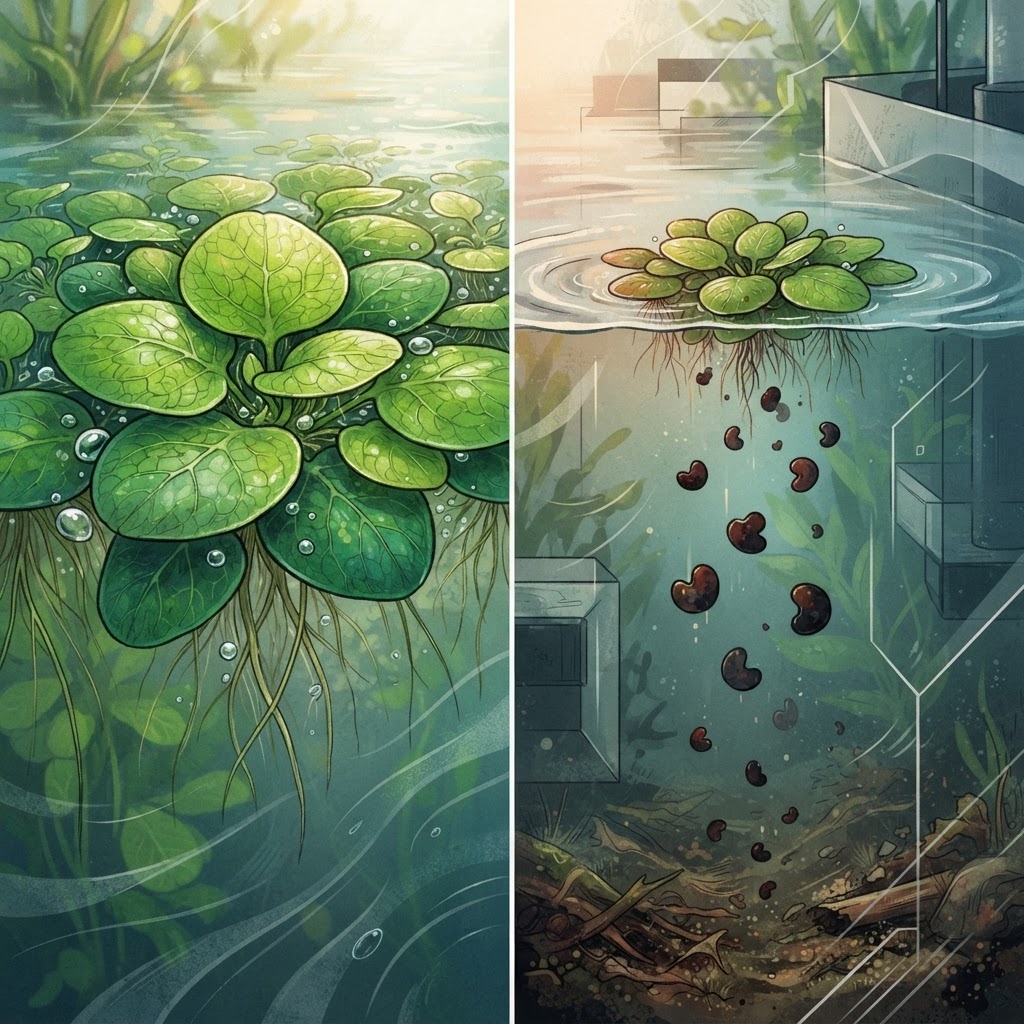
Search for duckweed turion and you get botany: a dormant frond, full of starch, that sinks to the bottom of the pond in autumn and comes back up in spring. True, and useless to anyone running a pond. For an operator, the turion is a production event. It is the moment the crop stops making crop and starts making survival capsules instead, and the trigger is not the one most people assume. This article is the grower’s version, built on the one corner of the duckweed literature where the signals were measured outdoors first.
What a duckweed turion is
A frond that chose not to grow
A duckweed frond carries one or two pockets where daughter fronds bud off. A turion is what comes out of that pocket when the developmental program switches. It is a resting frond: smaller, denser, thicker walled, with almost no air spaces and a great deal of starch. It separates from the mother, sinks, and cannot grow. In Spirodela polyrhiza the mother fronds measure about 8 by 6 mm and the turions about 2 by 3 mm, thicker and nearly round, coloured with anthocyanin, and dense enough to drop to the bottom of the vessel on their own.
The word matters. Many duckweeds overwinter as resting fronds that stay capable of growth. A true turion is innately dormant: it cannot grow for some time after it forms, even though it respires and can photosynthesise, and only prolonged cold releases it. Everything in this article hangs on that distinction. For the plain definition on its own, see what is a turion in duckweed.
Which duckweeds make them
Not all of them, and the list decides a lot for an outdoor system. The 2023 survival review records true turions in S. polyrhiza, Lemna turionifera, some clones of Lemna aequinoctialis, and many Wolffia species. Lemna minor, the species most people picture, overwinters as resting fronds instead. Spirodela intermedia, a close relative with fronds just as frost sensitive as S. polyrhiza, forms no turions at all. And Wolffia arrhiza turions are as sensitive to cold as its ordinary fronds, so the organ exists without the protection.
Turions are not a duckweed invention. Adamec’s 2018 review counts them in at least 14 genera of aquatic plants from nine families, from hornwort to hydrilla, and then excludes S. polyrhiza from the review because its physiology is so different from the rest. The family itself holds 36 recognised species in five genera, doubling biomass clonally every 48 to 72 hours when conditions allow. The turion is the other half of that growth rate: the mechanism for when conditions do not.
The trigger is phosphate, not the calendar
What the Jena pond measured
Here is the fact that changes how you plan a season. In S. polyrhiza, the species whose turions have been studied more than any other, the switch is driven by nutrient shortage first and temperature second. Appenroth and Nickel measured a pond near Jena through two growing seasons. Nitrate and sulphate stayed in the millimolar range all summer. Phosphate fell from about 13 micromolar at the start of the season to 2 micromolar when turion formation began, on 17 August in 2002 and 21 July in 2003. The plants had eaten the phosphate, and the empty water was the signal. They then took the outdoor numbers, day temperature, night temperature, photoperiod and that 2 micromolar phosphate, back into controlled culture and reproduced the induction.
Four conclusions came out of it. Low phosphate is the decisive inducer. Cooler days, and especially cooler nights at 15 rather than 18 degrees, enhance the effect by raising the turion yield. At much higher phosphate levels, the kind that come from human inputs, low temperature takes over as the inducer. And at very low phosphate, turions form regardless of the season.
When cold takes over
The earlier 2002 paper maps the two signals against each other. Above about 30 micromolar phosphate, a drop to 15 degrees raised the specific turion yield and the phosphate level no longer mattered; between 10 and 30 micromolar at 25 degrees, lower phosphate drove the yield, and the cold effect was the stronger of the two. The useful measure is specific turion yield, the number of turions per frond, rather than a raw count, because more biomass makes more turions without any change in the switch. The standard culture protocol puts the practical threshold at 60 micromolar phosphate or less for easy turion formation.
Photoperiod, the signal that most other aquatic plants use, plays no role here. S. polyrhiza is photoperiod neutral and reads nutrient and temperature instead. And even genetically identical fronds do not switch together: mothers of later birth order produce turions sooner than first-born fronds, a built-in spread that hedges the colony against an unpredictable freeze. A pond does not go dormant on a date. It goes dormant frond by frond, as the phosphate runs down.
What happens inside: three days to commit, two weeks to fill
Starch and the sinking density
The switch is fast and then final. Under abscisic acid induction in the lab, three days after treatment the primordium is irreversibly committed to becoming a turion, and all primary synthesis of protein, RNA and DNA shuts down. After that, starch accumulation starts around day 5, rises through day 10, and is nearly stable by day 14, finishing at 60.1 percent of dry mass. Fronds of this species normally hold under 20 percent starch; mature turions hold 60 to 70 percent, carry three times the triacylglycerol of fronds as a second energy reserve, and measure 1 to 3 mm across. The starch is not only fuel. It is ballast. As intercellular air space shrinks and starch fills the cells, density rises above water and the turion sinks below the ice line.
A seed program without a seed
Duckweed rarely flowers. The turion is its answer to the seed, and the molecular machinery agrees. The 2023 turion transcriptome found that key regulators of seed maturation and germination had been retooled for turion biology, with pathways for stress tolerance, starch and lipid metabolism and dormancy reprogramming the frond meristem, and genome-wide methylation changes alongside. Late embryogenesis abundant proteins, the ones that keep seeds dormant and desiccation tolerant, are among the most strongly induced genes. Yet about 80 percent of all expressed genes sit within fourfold of their frond levels: transcription has stopped, but the transcripts are stored, ready to be translated the moment dormancy breaks. The turion is a clone that behaves like a seed.
One side note for anyone eyeing that starch. Fronds grown on swine wastewater in one study reached 45.8 percent starch, with 25.8 percent of dry biomass fermented to ethanol. That biomass is remediation grade. At SERAPH it goes to energy or stays in the remediation stream. It never becomes food or feed, and the starch question for the clean stream is a separate one we take up in duckweed starch content.
Winter on the bottom: dormancy has two stages
Innate dormancy and the chilling requirement
A newly formed turion cannot germinate, even in perfect conditions. That is innate dormancy, and it has a purpose. Turions form in late summer, while the water is still warm and bright. Without a lock, they would sprout immediately and produce fronds with no time to make new turions before the surface froze. The lock is opened only by cold. Several weeks at 0 to 5 degrees are usually required, and a period of 4 to 5 weeks is routinely used to break dormancy experimentally; the survival review puts the minimum at about two weeks. Frond growth stops anywhere below 8 to about 17 degrees depending on the species, and turions withstand long periods of intense cold just above freezing. They do not withstand severe frost. In other aquatic plants, non-hardened turions froze at minus 7 to minus 10 degrees with survival of 0 to 38 percent, which is why sinking matters more than hardiness.
Something chemical happens during the chilling. Freshly harvested turions do not contain enough soluble sugar to germinate; after-ripened ones do, and the sugar comes from slow breakdown of the stored starch. Supply sugar from outside and you can force germination in the dark, but only about half the population responds. Cold and light together are the design.
Imposed dormancy and the wake-up signal
Once chilled, the turion moves from innate dormancy to imposed dormancy: able to germinate, prevented only by the environment. It waits on the bottom until the water warms. Then the signal is light, specifically red light through phytochrome, and maximal responsiveness is reached after about 4 weeks of after-ripening in the dark and cold. The same study found that photosynthetic activity in the dormant turion dipped over the first three weeks of chilling and then recovered to the level of a fresh turion while still in the dark, which suggests the plant tunes its photosynthetic machinery to the dormancy clock rather than to light. To reach the surface, the germinating turion forms an external gas bubble on its waxy skin that carries it up. Early work assumed the bubble was oxygen from photosynthesis; it forms in darkness too, so it is at least partly metabolic carbon dioxide. A frond emerges in two to three days and the colony restarts.
What the turion means for an outdoor system
A yield cliff that starts in summer
Put the Jena data next to a production pond and the implication is blunt. In a closed system, or a polishing pond at the end of a treatment train, the crop depletes phosphate as it grows. In a temperate pond that depletion crossed the threshold in late July and mid August. The season did not end with the first frost. It ended weeks before, in warm water, when the plants ran out of one nutrient. An operator watching the thermometer would have missed it. An operator watching phosphate would have seen it coming.
The same data say the opposite for a nutrient-rich effluent. Where phosphate stays high, the inducer becomes temperature, and the growing season runs until the nights cool. This is the pond type most water operators actually run, and it is also where the duckweed growth rate is most often quoted from indoor data that never saw a nutrient fall or a cold night. The two pond types behave differently, and the papers that explain why were written for physiologists, not for the people operating them.
Species choice is a turion choice
If the goal is continuous biomass, a species that does not make true turions is a different crop from one that does. Lemna minor rests at the surface and resumes. S. polyrhiza, the largest frond and often the fastest growing duckweed species in the comparisons, abandons the surface entirely. Wolffia makes turions but some of them freeze anyway. Knowing which species is in the pond is the first question, which is why duckweed species identification sits at the front of the measurement stack rather than at the end.
A restart bank, not a seed bank
A practitioner coming from aquatic weed control expects a turion bank. Hydrilla turions stay viable in sediment for up to 3 years, which is why those programmes run for years after the adult plants are gone. Duckweed does not work that way. In the other turion-forming genera, Adamec never found a live turion from the previous season at the end of the following summer at his Czech sites: they had sprouted or decayed. For S. polyrhiza the picture is more spread out. Field and culture work at Carleton reports turion reactivation ranging from early spring to the end of fall, with some turions not reactivating for a few years, a bet-hedging spread across clonal offspring. Either way, a turion is a one-season to few-season restart, and an operator who wants a reliable spring inoculum should plan for it rather than rely on it.
Latitude and strain
The turion yield of a strain is not fixed. Different S. polyrhiza strains produce different numbers of turions, and that yield has been linked to the average temperature and rainfall of the place the strain came from. Populations from higher latitudes have evolved to make turions earlier in the season. A strain collected from a long, warm season will hold the surface longer in a long, warm season. Moving duckweed across climates moves its dormancy clock with it, which is one more reason an indoor result from one clone says little about an outdoor pond stocked with another.
What SERAPH can and cannot see
We are early, and we say so. SERAPH is at TRL 3, proof of concept, with outdoor field validation still ahead, and none of the figures above are our measurements. We have no turion dataset. What we have is a reason to care about this corner of the literature more than most: the Jena study is the cleanest lab-to-field loop in all of duckweed research. Signals were measured in a real pond across two seasons, then reproduced indoors, then explained. That is the order of operations we are built around. AI proposes, the bench validates, and the pond gets the last word.
Two things follow for the measurement stack. First, the turion switch has visible signatures: anthocyanin colouring on the underside of fronds, then a loss of surface cover as the turions sink out of frame. SERAPH Vision already distinguishes duckweed species frame by frame on a real tray, with growth and stress reading in development. Reading the onset of turion formation from the canopy is a target, not a capability, and we will say when it is one. Second, the phosphate curve is the leading indicator, and a system that logs water chemistry alongside the canopy can see the switch before the camera can.
Our research map indexes 256 papers across 31 areas in 5 domains, each with a coverage weight and a maturity band, and the turion literature reads like one of its uneven areas: deep on S. polyrhiza, thin on every other species, and almost nothing on what the switch looks like in a production pond. The Canary Islands, where we are based, offer a year-round growing season and a climate where phosphate rather than cold would be the trigger. That is the field setting for the validation ahead of us. It is not a result. For the broader design questions, start with duckweed cultivation and, for the nutrient that drives this whole story, duckweed and phosphorus.
FAQ
Does Lemna minor form turions?
No. Lemna minor overwinters as resting fronds that remain capable of growth and stay near the surface. True turions in the family are formed by Spirodela polyrhiza, Lemna turionifera, some clones of Lemna aequinoctialis and many Wolffia species. Spirodela intermedia forms none.
Can duckweed turions form in a warm climate?
Yes. In the Jena pond work, very low phosphate induced turions regardless of season, and cold took over as the trigger only where phosphate stayed high. A warm pond that runs out of phosphate can switch to turions in high summer.
How long do duckweed turions need in the cold before they can germinate?
At least about two weeks at 0 to 5 degrees, with 4 to 5 weeks used routinely in the laboratory. After that, warm water and red light trigger germination, and the turion rises on a gas bubble.
Are duckweed turions the same as seeds?
No. They are vegetative clones, genetically identical to the parent frond, produced without flowering. They do reuse seed machinery: regulators of seed maturation and germination and the LEA proteins that maintain seed dormancy are among the most strongly induced genes in a mature turion.