Duckweed Protein: Why Every Source Quotes a Different %
Duckweed protein is quoted at 16 to 45 percent. The spread is species, water, assay method and extraction, not noise. Here is what each layer costs you.
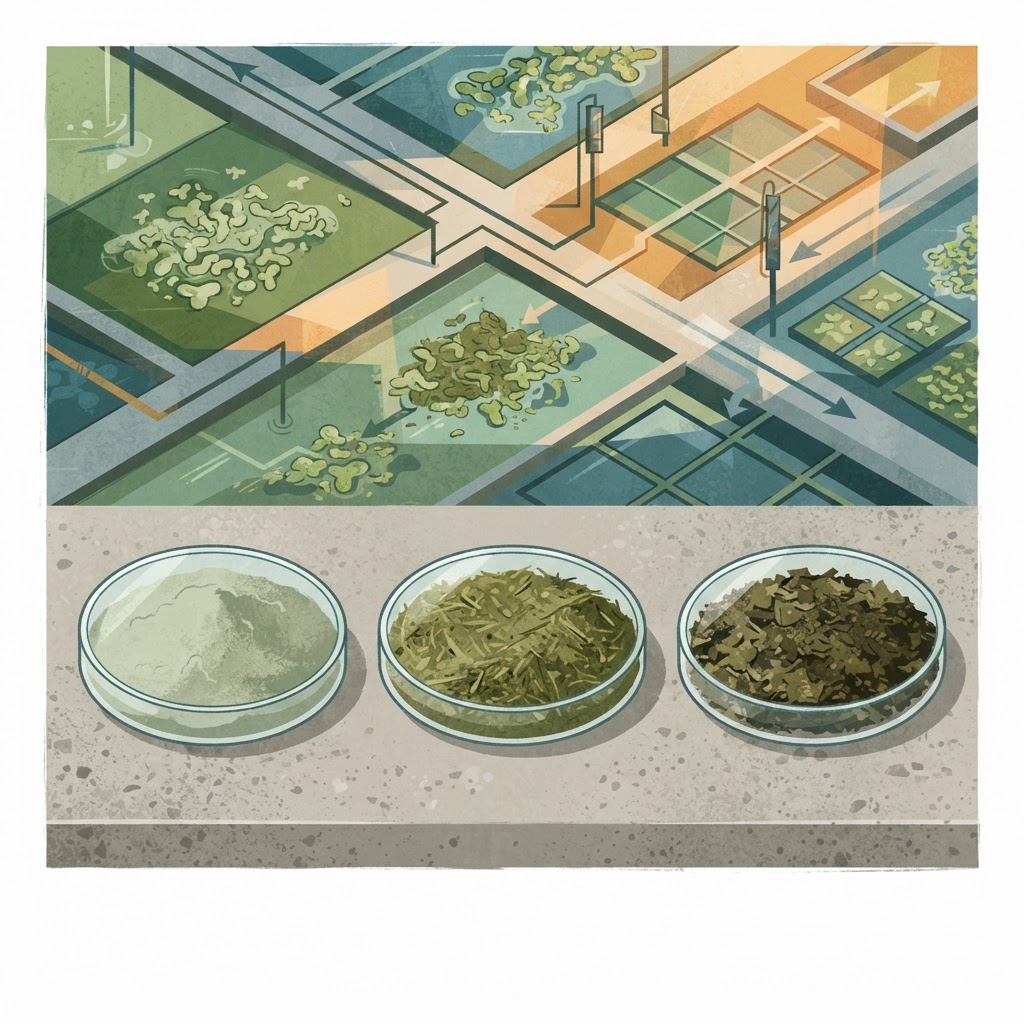
Ask four sources how much protein is in duckweed and you get 45 percent, 29 percent, 41.7 percent and 16 percent. Every one of them is correct. That is the problem.
The range gets quoted as if it were measurement noise, something that will tighten up once the field matures. It will not, because it is not noise. Duckweed protein varies for four separate reasons that happen to compound: what the species and the water put into the plant, what the assay method adds on top, what survives extraction into a usable ingredient, and what a regulator will let you call it. Each layer is measurable on its own. Nobody quoting a single headline figure has told you which layers are in it.
Here is how to take the range apart.
Where the 16 to 45 percent range actually comes from
The species sets the range you are playing in
Duckweed is not one plant. The family runs to 35 species plus two interspecific hybrids across five genera, and they do not compose alike.
The widely cited synthesis puts protein anywhere from 16.0 percent in a Lemna sp. sample to 41.7 percent in Lemna gibba, on a dry weight basis. Narrow to a single genus and the spread survives: across all 11 species of Wolffia, protein ran 20 to 30 percent of freeze-dry weight, starch 10 to 20 percent, fat from 0.7 to 5.3 percent and fibre about 25 percent. That paper also found meaningful differences between clones of the same species, which is why it argues for selecting clones rather than selecting species.
So “duckweed protein” is a family-level claim about a family with an eightfold spread in fat content. It tells you very little about what is in a specific tray.
The water decides where in that range you land
Species sets the range. Nutrition sets the position within it, and the effect is larger than most people expect.
A mass production study grew Lemna minor in outdoor tanks and a pond on different media. The same plant reached 36.07 percent protein on organic manure and 27.12 percent on inorganic fertiliser. The same paper reports the wider pattern from the literature: 9 to 20 percent protein in nutrient-poor water, 24 to 41 percent in nutrient-rich water, and crude protein rising toward 40 percent at ammonia concentrations of 7 to 12 mg N per litre.
Nitrogen form matters and not only nitrogen quantity. Work on the nitrate to ammonium ratio in Lemna minor and Wolffiella hyalina found that the balance between the two nitrogen sources moves both growth rate and crude protein content.
The plant is also making a trade you can see in the numbers. Under unfavourable conditions protein content falls while starch rises. A stressed pond does not simply produce less. It produces something compositionally different, which is why a duckweed growth rate figure and a protein figure from the same system have to be read together rather than separately. The same logic runs through the species question in Lemna minor specifically.
The assay adds several points before anything is grown
This is the layer almost nobody mentions, and it is the one that quietly inflates every headline number in the field.
Crude protein is not measured. Nitrogen is measured, then multiplied by a conversion factor. The default factor is 6.25, which assumes protein is 16 percent nitrogen and that all nitrogen in the sample is protein nitrogen. Neither assumption holds well for leaf material.
For duckweed there is now a measured alternative. A 2025 extraction study derived the factor from total amino acid analysis and put it at 5.78 plus or minus 0.02, consistent with a proteome dominated by RuBisCO. That is the first duckweed-specific factor in the literature.
Run the arithmetic. A figure reported using 6.25 is about 8 percent higher, in relative terms, than the same nitrogen expressed with 5.78. A quoted 30 percent becomes roughly 27.7. A quoted 45 percent becomes roughly 41.6. Nothing changed in the pond.
This is not a duckweed quirk. Conversion factors derived from amino acid nitrogen across 90 plant species ranged from 5.15 to 5.93, which the authors read as confirmation that 6.25 is not valid for plant proteins in general. A broader review of the question proposes 5.6 as a default in place of 6.25.
The practical consequence is narrower and more useful than the debate. Feed reference tables and regulatory specifications still use 6.25. A supplier quoting 5.78 and a table quoting 6.25 are not describing different biomass. They are describing the same biomass in two units. Ask which factor was used before you compare two numbers.
Protein in the pond is not protein in the bag
Composition is what the plant contains. Yield is what you can get out of it, and the gap between them is wide.
The same 2025 study measured that gap directly. Ultrasound-assisted extraction reached 80.83 percent protein release at 40 percent amplitude over 10 minutes, but the highest protein yield achieved was 41.30 percent, producing a Lemna gibba concentrate at 50.91 percent protein. Purity was the price: co-extraction of other plant components rose, and recovery of RuBisCO subunits fell compared with non-ultrasound methods. A cleaner route can reach a 66 percent protein isolate with 11 percent carbohydrate and 3 percent ash, from a plant whose proteome is roughly half RuBisCO. Low protein solubility remains the standing obstacle to wider food use.
Then there is the number that never appears next to a protein claim. Ash.
The feed reference tables are blunt about it. Fresh duckweed averages 29.1 percent crude protein of dry matter across 15 samples, minimum 24.9 and maximum 38.6, alongside 15.9 percent ash. Dried duckweed averages 27.8 percent crude protein across 18 samples, from 15.5 to 35.6 percent, with ash averaging 18.9 percent and reaching 35.6 percent in the worst sample recorded.
An ingredient that is one third mineral is a different purchase from one that is one tenth mineral, whatever the protein column says. Ash tracks how the biomass was grown and how it was washed, which puts it downstream of the pond and the harvesting equipment rather than downstream of the species choice.
Quantity and quality are different questions
A high protein figure with a poor amino acid profile is not worth much. Duckweed generally does well here, and the reason is structural: RuBisCO is a photosynthetic enzyme, and a plant that is almost entirely metabolising tissue carries a lot of it.
The quality metric bears that out. Wolffia globosa protein has been reported at a protein digestibility corrected amino acid score of 0.89, which is high among plant proteins. In the outdoor Lemna minor work, essential amino acids made up 39.20 percent of the total.
But which amino acid is limiting does not agree across the literature, and that disagreement is the point. The 2025 extraction study identified lysine and tryptophan as limiting, except where ultrasound raised them above an amino acid score of 1. The Wolffia genus survey found lysine slightly limiting against the WHO preschool reference, with most ratios close to 1. The Feedipedia fresh table puts methionine at 0.8 percent of protein, which is the shortfall that dominates monogastric feed formulation and the reason duckweed as chicken feed needs a methionine source in the premix.
Three sources, three limiting amino acids. They are not contradicting each other. They are describing different batches. Any duckweed amino acid profile is batch-specific for the same reasons the protein figure is.
What you are allowed to sell it as
The most decision-relevant layer, and the one least covered by the reviews. A protein number does not become a product until a regulator has seen the specific form you intend to sell.
In the United States, two notices are closed. FDA had no questions on GRAS Notice 742 from Parabel, closed on 22 August 2018, covering duckweed powder and degreened duckweed powder with a crude protein specification of 39 to 55 percent and dietary fibre of 30 to 45 percent, for use as a protein source at 3 to 20 percent, with estimated dietary exposure of 27.8 to 55.6 grams per person per day. More recently, GRAS Notice 1256 from Plantible Foods closed on 5 February 2026 for Lemna leaf protein at use levels up to 5.0 percent.
The European position is more specific than “approved”. Commission Implementing Regulation (EU) 2021/2191 of 10 December 2021 authorises fresh plants of Wolffia arrhiza and Wolffia globosa as a traditional food from a third country. The separate application for Wolffia globosa powder did not follow it onto the Union list: a Commission Implementing Decision of 20 April 2022 terminated that procedure without amending the list.
Fresh plants and a dried powder of the same species are two regulatory objects. So the honest version of the question is not whether duckweed protein is authorised. It is which species, in which physical form, in which market. A Wolffia protein claim and a Lemna protein claim do not travel the same route.
Five questions that collapse the range
Ask these and the range usually narrows to something you can act on.
Which species, named, rather than the common name. Which growing medium, treated as a food safety question before an agronomic one. Which nitrogen-to-protein factor produced the figure. Whole biomass or concentrate, and at what ash. Which market and which authorised form.
SERAPH’s work sits upstream of all five. The system is at TRL 3, proof of concept, with outdoor field validation still ahead, and that is stated deliberately rather than softened. Behind it is a knowledge base of 256 indexed duckweed papers across 31 research areas in 5 domains, which is how a coverage gap in this literature becomes visible instead of assumed.
The measurement side is further along. SERAPH Vision reconstructs a cultivation canopy in 3D from a single capture, using 170,000 surface points drawn from 5.9 million captured, computes canopy volume, and already distinguishes duckweed species on a real tray frame by frame. Growth and stress reading are still in development.
One separation runs through all of it. SERAPH operates two permanently firewalled streams. Production-grade biomass for food, feed and high-value products is one. Non-food remediation biomass is the other, and it never crosses into either. The split starts at the first sensor reading, not at the point of sale. Everything in this article is about the production-grade side; the nutrient removal case for duckweed wastewater treatment is a different stream with a different destination. Independent reviews list heavy metal contamination as a standing barrier to commercialising duckweed protein, which is exactly the reason to design containment in rather than test for it afterwards.
Which returns to the opening. The protein figure is not the hard part. Knowing which tray it came from is.
FAQ
How much protein is in duckweed?
Between 16 and 45 percent of dry matter, depending on species and growing water. Feed reference tables averaging many samples land near 28 to 29 percent, which is the more realistic planning figure. A few points of any quoted number come from the conversion factor rather than the plant.
Is duckweed protein a complete protein?
It carries all nine essential amino acids, and Wolffia globosa has been reported at a PDCAAS of 0.89, high for a plant protein. The caveat is that studies disagree about which amino acid is limiting, because they tested different batches.
Can you buy duckweed protein powder?
In the United States, yes, under closed GRAS notices with defined use levels. In the EU the authorisation covers fresh Wolffia plants as a traditional food, and the separate procedure for Wolffia globosa powder was terminated in April 2022 without listing, so the form on the paperwork matters as much as the species.
Is duckweed protein better than soy protein?
Per hectare per year the reported gap is large: about 2,080 kg of protein for Wolffia arrhiza against 303 kg for soybean, 229 for nuts, 179 for corn and 71 for rice. Per kilogram of delivered ingredient it is a closer contest, because ash, fibre and low solubility all count against it.
Is duckweed grown on wastewater safe to eat?
SERAPH does not put that question to the test. Remediation biomass never enters food or feed, and the two streams separate at the first sensor reading. That is our operating policy, and it is stricter than what the published literature permits.