Duckweed and Heavy Metals: Cadmium, Lead, Arsenic Uptake
Duckweed heavy metals, metal by metal: how cadmium, lead and arsenic enter the plant, the doses it tolerates, and the variable that changes each result.
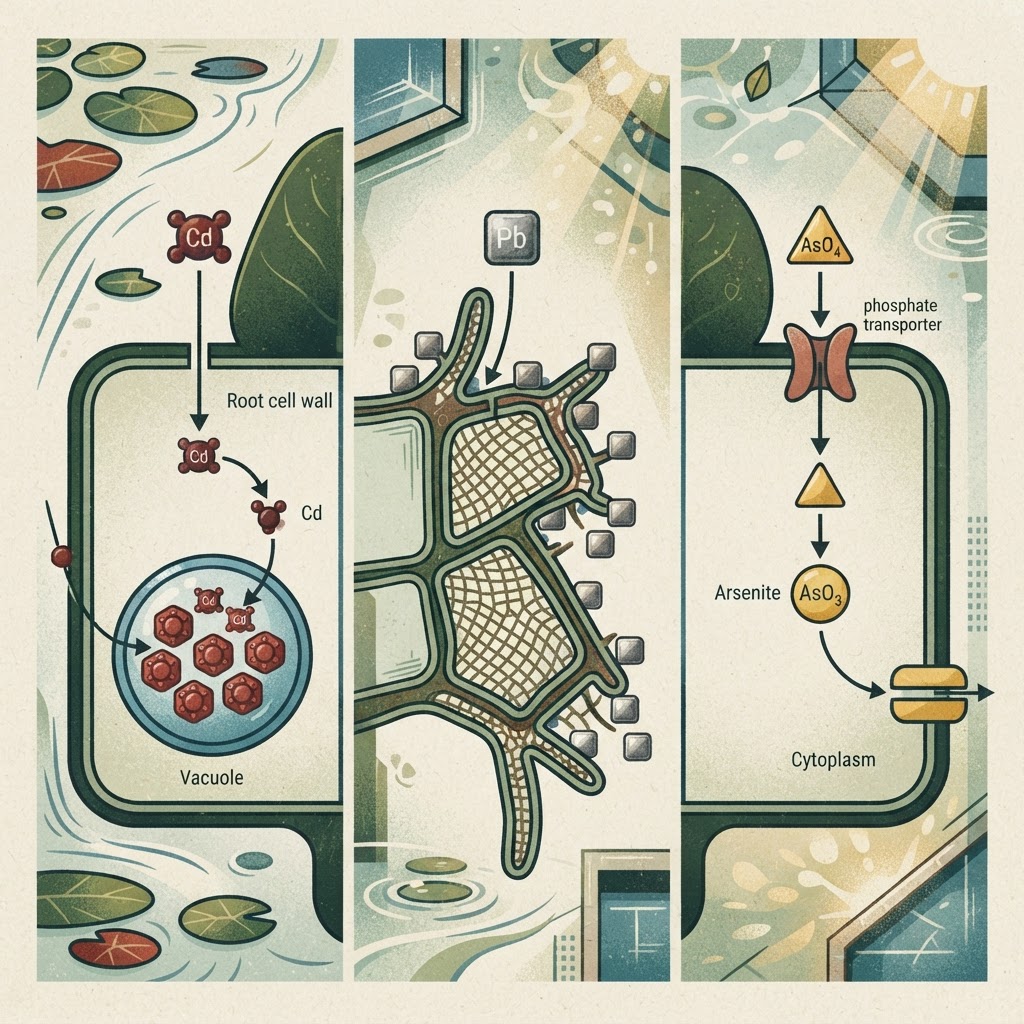
Most pages on duckweed heavy metals treat “heavy metals” as one thing. The literature does not. Cadmium, lead and arsenic enter a duckweed frond by different routes, sit in different places once inside, and each is limited by a different variable in the water. An operator who knows which variable to control for which metal is ahead of most of the published reviews.
We answered the yes/no question, and the warning about reading the dose before the percentage, in does duckweed absorb heavy metals. This article is the breakdown that one promised: three metals, three mechanisms, three control variables.
Three metals, three different plants
The field’s standard review describes the general machinery in one sentence. Duckweed resists metal toxicity through chelation and compartmentalisation in vacuoles, and removes metals from water through biological adsorption and intracellular accumulation. It lists cadmium, chromium, copper, iron, mercury, manganese, nickel, palladium, lead and zinc as metals duckweed takes up, and it flags toxicity to the plant as the main factor limiting application. Then it moves on.
That sentence hides three different stories. Cadmium is the most toxic of the common metals to the plant itself, so the limit is how much the plant survives. Lead is held hard and in bulk, but how much depends on the water chemistry around the frond. Arsenic is not a metal at all, it is a metalloid that behaves like a nutrient, gets chemically transformed inside the plant, and can leak back out.
Cadmium: the most toxic, and the one plant density changes
How much cadmium Lemna and Spirodela hold
A 22 day comparison of the two most studied species gives the shape of the answer. Across cadmium concentrations of 0.5 to 3.0 mg/L, Lemna minor removed 42 to 78 percent and Spirodela polyrhiza 52 to 75 percent. Tissue loads peaked at 4,734.56 mg/kg in L. minor at 2 mg/L and 7,711 mg/kg in S. polyrhiza at 3 mg/L. The highest bioconcentration factors, 3,295.61 and 4,752, came at the lowest dose of 0.5 mg/L. Spirodela held more. Both concentrated the metal thousands of times over.
The time axis matters too. A short Lemna minor exposure study found the bioconcentration factor close to 1,000 after 48 hours and above 1,000 after 72 hours at 13 and 22 micromolar cadmium, with a tolerance index at or above 0.6 at those doses. Photosystem II efficiency fell with dose and time throughout. The plant was accumulating and being damaged at the same time.
Where the damage starts
Cadmium’s problem is that the threshold for harm sits close to the concentrations that make it worth treating. In a four metal comparison on Lemna minor, 0.5 mg/L cadmium caused visible damage within one day, the plant tolerated 0.4 mg/L without symptoms, and 0.91 mg/L halved the growth index. The toxicity order was copper, then cadmium, then nickel, then zinc. The control doubling time was 1.9 days, which is what makes the OECD test valid in the first place.
Expressed in molar terms, a 7 day test put the cadmium EC50 at 1.9 micromolar, against 9.7 for copper, 56.3 for nickel and 46.1 for zinc. The same study has the detail that matters for a pond that sees pulses rather than steady loads: plants exposed to cadmium, copper and nickel recovered considerably once the exposure ended. Zinc exposed plants did not, even 7 days later.
The role of plant loading
Two findings from the review change how a cadmium system should be run. First, dried duckweed powder works as a biosorbent: dry Spirodela polyrhiza and Landoltia punctata powder removed 96 and 83 percent of cadmium from a 50 mg/L solution. Second, duckweed grown without bacteria took up slightly more cadmium than plants carrying their normal microbial partners, which suggests the bacteria protect the plant by keeping cadmium out. A cleaner culture accumulates more and suffers more.
Add the density effect from the 22 day study, where the highest bioconcentration came at the lowest concentration, and the operating lesson is this: for cadmium, you tune the amount of living plant per litre and you accept that the harvest cycle has to run faster than the toxicity.
Lead: held hard, moved by pH and nutrients
Tissue loads and the five day plateau
Lead is the metal duckweed holds in bulk. Exposed to 0 to 50 mg/L lead for up to 7 days, Lemna minor accumulated 561 mg/g dry weight and Spirodela polyrhiza 330 mg/g. The water concentration fell quickly and reached a plateau after about 5 days in the Lemna treatments. The authors judged both species good accumulators on the usual bioconcentration threshold of 1,000, and found Lemna the more effective of the two.
Lead removal is also fast on dead tissue. The review records that dried Lemna aequinoctialis powder adsorbs more than 57 mg of lead per gram, the kind of figure that puts duckweed biomass in the same conversation as engineered sorbents.
What pH and temperature do
Unlike cadmium, lead uptake is governed by the water more than by the plant. A 168 hour batch study across pH 4.5 to 8.0 and 15 to 35 degrees found the highest accumulation at pH 4.5 and 30 degrees: 8.622 mg of lead per gram at 10 mg/L and pH 5, down to 0.291 mg/g at 0.1 mg/L and 15 degrees. Tissue lead rose with the concentration in the water. The percentage removed fell as the concentration rose. The two curves move in opposite directions, so a supplier quoting one without the other is quoting half a result.
Flow helps as well. A set-up that recirculated water past the plants took lead from 2.5 to 0.93 mg/L in 3 days, a 62.8 percent reduction, while the still water version needed 9 days to reach 1.38 mg/L. The same paper describes the entry route: passive uptake through micropores in the root cell walls, the apoplastic pathway, before anything is sequestered. Contact drives lead removal, and moving water means more contact.
Nutrients trade accumulation for tolerance
Here is the trade-off operators rarely hear about. In the 7 day study above, adding phosphorus, nitrate and sulphate raised the plants’ tolerance to lead: better growth, better pigments. It also cut lead accumulation from 561 to 128.7 mg/g in Lemna minor and from 330 to 68.7 mg/g in Spirodela. The metal and the nutrients compete at the same uptake sites. On a nutrient rich effluent, duckweed will grow through the lead and pick up less of it per gram. On a nutrient poor mine water, it will load up and suffer. Neither is wrong. They are different systems.
Arsenic: a metalloid that fights back
Which species take it up
Arsenic exists in four oxidation states, and the two that matter in water are arsenate, As(V), and arsenite, As(III). The review names six duckweed species reported to remove arsenic: Lemna gibba, Lemna minor, Spirodela polyrhiza, Wolffia globosa, Wolffia australiana and Lemna valdiviana. Lemna minor accumulated more arsenite than arsenate from polluted water, reached 430 mg/kg dry weight in a survey of running waters, and removed more than 70 percent of 0.5 mg/L arsenic by day 15 in hydroponics. Lemna valdiviana reached 1,190 mg/kg and cut the solution by 82 percent between pH 6.3 and 7.0, but concentrations above 1 mg/L damaged it.
Arsenate rides the phosphate transporter
The single most useful fact for anyone treating arsenic with duckweed is that arsenate enters through the plant’s phosphate transporters. In Lemna valdiviana, arsenic was only absorbed after phosphate in the medium declined. The same competition shows up in the strongest accumulator in the family.
Wolffia globosa and the arsenite leak
The 2009 screening that identified Wolffia globosa as the family’s strongest arsenic accumulator is still the reference study. Grown with 1 micromolar arsenate, W. globosa accumulated two to ten times more arsenic than four other duckweed or Azolla species. It reached more than 1,000 mg As/kg dry weight. It tolerated about 400 mg/kg without growth inhibition, and its EC50 of around 1,000 mg/kg was roughly ten times that of Azolla. Most non-accumulating plants show toxicity at 10 to 100 mg/kg.
Three mechanisms from that paper explain why the metalloid behaves differently from cadmium or lead:
- Phosphate competition. Adding 0.1 millimolar phosphate suppressed arsenate uptake markedly and barely touched arsenite. With phosphate present, the arsenite uptake rate was nearly three times the arsenate rate.
- Internal reduction. Whatever form was supplied, about 90 percent of the arsenic inside the plant was arsenite. No methylated species were found. The plant converts arsenate to the more toxic form itself, which is why the two forms are equally toxic once measured by tissue concentration.
- Efflux. The plant pushed arsenite back out. Solution arsenic fell from 200 to 116 micrograms per litre in 48 hours and then stopped falling, and by 72 hours 30 percent of the original arsenate had reappeared in the water as arsenite. The authors called arsenite efflux the limiting factor for phytofiltration.
The species is rootless, so there is no root to frond barrier slowing the metalloid down. That is also why it accumulates so much. By the formal definition, which requires tolerating as well as accumulating 1,000 mg/kg, it is a strong accumulator rather than a hyperaccumulator.
Microbes sit in this story too. Sterile Wolffia australiana did not oxidise arsenite in the medium or in its tissue, while plants carrying their phyllosphere bacteria did. An arsenic pond is a plant plus its bacteria, and a lab culture that scrubbed the bacteria off is measuring something else.
Field evidence from uranium mines
Arsenic is the one metal in this article with outdoor data. Duckweed arsenic removal was first demonstrated in 2004 in waters from abandoned uranium mines in eastern Germany, where Lemna gibba showed high bioaccumulation coefficients in the mine wetlands as well as in the lab. The potential extraction from those surface waters was estimated at 751.9 kg of arsenic per hectare per year. A second study at a tailing water site measured an average 40.3 percent reduction in solution. These are the field numbers. Everything else in this article is indoor.
The variable that moves each result
Put the three metals side by side and the practical difference is clear.
- Cadmium is limited by the plant. Visible harm at 0.5 mg/L, half growth at 0.91 mg/L, highest concentration factors at the lowest doses. Control variable: living plant density and harvest frequency, with the microbial partners as a hidden brake.
- Lead is limited by the water. Accumulation peaks at low pH and warm temperatures, reaches a plateau in about 5 days, and nutrients cut tissue lead by three quarters while making the plant healthier. Control variable: pH, temperature, nutrient level and contact.
- Arsenic is limited by chemistry and biology together. Phosphate blocks the arsenate route, the plant converts it to arsenite, part of it leaks back out, and bacteria decide whether it gets oxidised. Control variable: phosphate concentration, speciation and the microbiome.
And the tolerance behind each number belongs to a clone, not a family. Three Lemna clones from different regions of Vietnam grew at 0.3 to 0.5 mg/L arsenic, 0.15 to 0.3 mg/L cadmium and 0.15 mg/L lead, and their tolerances split by metal. Which species, and which clone, is part of the design, which is why we built duckweed species identification into the measurement stack. The wider case for duckweed phytoremediation rests on the same point.
One thread runs through every study above: indoor, short exposure, usually one metal in a clean medium. Real effluents carry mixtures, swing in pH and temperature, and come with their own phosphate load. The phosphate point alone means arsenic and nutrient removal pull against each other in the same pond, a question we take up in duckweed and phosphorus.
What SERAPH can say, and what it cannot
We are early, and we say so. SERAPH is at TRL 3, proof of concept, with outdoor field validation still ahead. We have no heavy metal field dataset, and none of the figures in this article are our measurements. What we have is the map: our research map carries Hou 2007 as its verified citation for heavy metal phytoremediation, with a coverage weight and a maturity band, so we know the metal literature is deep on mechanism and thin on field.
What the map lets us do is design toward a target before building. A cadmium system and an arsenic system are not the same system, and the choice of species, density, nutrient regime and harvest cycle follows from which metal is in the water. The Canary Islands, where we are based, offer a year round outdoor season. That is the setting for the validation still ahead of us, not a result.
One rule does not change with the metal. Biomass that has concentrated cadmium, lead or arsenic is remediation biomass. It is never sold or blended as food or feed, and the two streams are separated from the first sensor reading. If you are comparing suppliers, our questions for duckweed phytoremediation companies apply, and for the nutrient side, where the evidence is far deeper, start with duckweed wastewater treatment.
FAQ
Which duckweed species is best for arsenic removal?
Wolffia globosa accumulated two to ten times more arsenic than four other duckweed or Azolla species in the 2009 screening, and Lemna gibba has the only field data, from uranium mine wetlands. But W. globosa pushes arsenite back into the water, so the best accumulator is not automatically the best phytofilter.
Does phosphate in wastewater stop duckweed taking up arsenic?
It slows the arsenate route. Phosphate and arsenate share the same transporter: 0.1 millimolar phosphate suppressed arsenate uptake markedly in Wolffia globosa, and Lemna valdiviana only absorbed arsenic after phosphate in the medium declined. Arsenite uptake was barely affected.
Does adding nutrients help duckweed remove lead?
It helps the plant, not the removal. Nutrient enrichment raised lead tolerance and protected pigments in Lemna minor and Spirodela polyrhiza, but cut tissue lead from 561 to 128.7 mg/g in Lemna over 7 days.
Can duckweed recover after cadmium exposure?
Partly. In a 7 day Lemna minor test, plants exposed to cadmium, copper and nickel recovered considerably once the exposure ended. Zinc exposed plants did not recover even 7 days later. Cadmium was still the most toxic of the four, with an EC50 of 1.9 micromolar.