Duckweed Fish Feed: Inclusion Rates the Trials Support
A meta-analysis of 58 trials puts duckweed fish feed at 15 to 30 percent inclusion. Form and moisture, not protein, decide where you land in that band.
The dose question about duckweed fish feed has been answered, and it has been answered properly. A systematic review and meta-analysis published in Reviews in Aquaculture went through 58 papers covering 18 fish species, 16 freshwater and 2 marine, together worth 263 billion USD a year and 28 percent of aquaculture production by mass. Inclusion levels between 15 and 30 percent were associated with positive outcomes on growth and feed conversion ratio, with no negative effect on survival. Twenty percent was the most common formulation tested.
So the band is settled. What is not settled is why two farms working inside it get different answers, and that is the useful part of this question.
It is not the protein. It is what form the biomass arrives in, and how much water is still in it.
Form and moisture decide where you land in the band
Duckweed is sold and fed in three ways: live grazing, dried, and pelleted into a compound feed. Those are not three delivery methods for one ingredient. They are close to three different ingredients.
Fresh duckweed: the fish stops eating before the protein matters
Fresh biomass is mostly water. A 2025 Brazilian trial that fed fresh Lemna minor to Nile tilapia juveniles measured the material it was actually using: 96.55 percent moisture, 29.78 percent crude protein, 17.24 percent ash and 5.56 percent total lipids on the harvested plant. Fish getting 70 percent of the control ration plus 30 percent fresh duckweed ate 33 percent less commercial feed, and their body measurements and fillet composition were unchanged.
Read that carefully, because it is easy to read as a win when it is really a constraint. The intake fell. Growth held. Which means fresh duckweed displaced feed by filling the fish, not by matching it kilo for kilo.
The mechanism was described decades ago and still holds. Gaigher and colleagues found in 1984, in work the tilapia study cited below builds on, that fresh duckweed intake is limited both by the moisture, around 96 percent, and by the air pockets in the fronds that keep the plant afloat. The fish reaches its physical limit long before its protein requirement. Any duckweed nutritional value figure quoted on a dry matter basis has to be divided by about 25 before it means anything in a bucket of fresh plant.
Dried duckweed: a different ingredient with the same name
Drying changes the answer. In a 50 day tilapia fingerling trial, dried duckweed at 38.86 percent crude protein and 13.22 percent fibre replaced half of a 40 percent crude protein commercial feed with no significant difference in final weight, 21.67 g on commercial feed against 19.53 g on the fifty-fifty mix. The same study recorded two operational details worth more than most of what ranks for this query: dried duckweed floats and holds together in water for up to 3 hours, and it should not be relied on as the sole food below 18 degrees C.
Fifty percent of the ration is well above the meta-analysis band, and the difference is exactly the water.
There is a floor under all of this. Duckweed alone does not work in any trial that has tested it. Feeding Nile tilapia for 21 days, one Nepali study recorded fresh weight gain of 65 percent on conventional feed, 37 percent on a one-to-one mix, and 9 percent on duckweed powder alone. Duckweed is a partial substitution. The literature is unanimous on that, and the pages telling smallholders that tilapia will thrive on a 60 to 80 percent fresh duckweed diet are ahead of every published result.
The dose depends on which fish and which duckweed
Species matters on both sides of the equation, and it moves the number more than most feed tables admit.
On the fish side, Nile tilapia and common carp dominate the record. In a common carp fry trial, Spirodela polyrhiza replaced soybean meal at 5, 10, 15 and 20 percent. Broken-line regression put the breakpoints at 10 percent for final weight and 13.4 percent for specific growth rate, and yet the 20 percent diet produced significantly the highest final weight and specific growth rate and the lowest feed conversion ratio. Digestive enzyme activity rose linearly with inclusion. Monounsaturated fatty acid content in the fish fell as inclusion rose, which is a composition change rather than a defect, and it belongs in the decision either way.
On tilapia, the substitution behaves differently. Replacing soybean meal protein at 25, 50, 75 and 100 percent in isonitrogenous diets, 25 percent replacement gave the best weight gain, growth rate, survival and feed utilisation while full replacement gave the worst feed conversion of the set.
On the plant side, the record is narrower than the family. Lemna minor and Lemna gibba account for most of the published work, Spirodela polyrhiza is second, and the genus Wolffiella is essentially untested as a fish feed. SERAPH works across about 37 duckweed species in five genera, and the gap between that biological range and the handful of species with feeding trials behind them is one of the more honest reasons to be careful with a generic duckweed protein number. Two plants called duckweed can differ as much as two grains. If you want the species-level picture on the most-studied one, start with Lemna minor.
The cost case, and where the saving actually comes from
Feed can account for up to 70 percent of production cost in semi-intensive tilapia culture, on the figure reported in that same 50 day study, which is why this question gets asked at all.
The savings in the trial record are real and they are specific. That 2025 fresh-duckweed study reported a 23 percent lower cost per kilogram of fish at 30 percent supplementation, and it came from the 33 percent drop in commercial feed intake rather than from faster fish. In an aquaponics system feeding duckweed meal to tilapia fingerlings at 0, 10, 20 and 30 percent, 20 percent was both the growth optimum and the most profitable level, returning 63.2 g of weight gain in 56 days, 32.7 percent above the control.
Two cautions before anyone puts that in a model. These are trial economics from specific systems, with the duckweed grown on site and its labour largely absorbed. And the studies are short. The meta-analysis puts the average experiment at 72 days with a standard deviation of 42, mostly at the fingerling stage, against a tilapia grow-out that runs six months or more.
Water quality is the other half of the ledger
The reason integrated systems keep reappearing in this literature is that the plant is doing two jobs.
In that aquaponics trial, tanks at 30 percent inclusion showed ammonium, nitrite, nitrate and phosphate reductions of 60.48, 70.96, 62.23 and 32.91 percent against the control. The feed saving and the treating the water benefit are the same plant, counted twice, which is the actual economic argument for growing it rather than buying it.
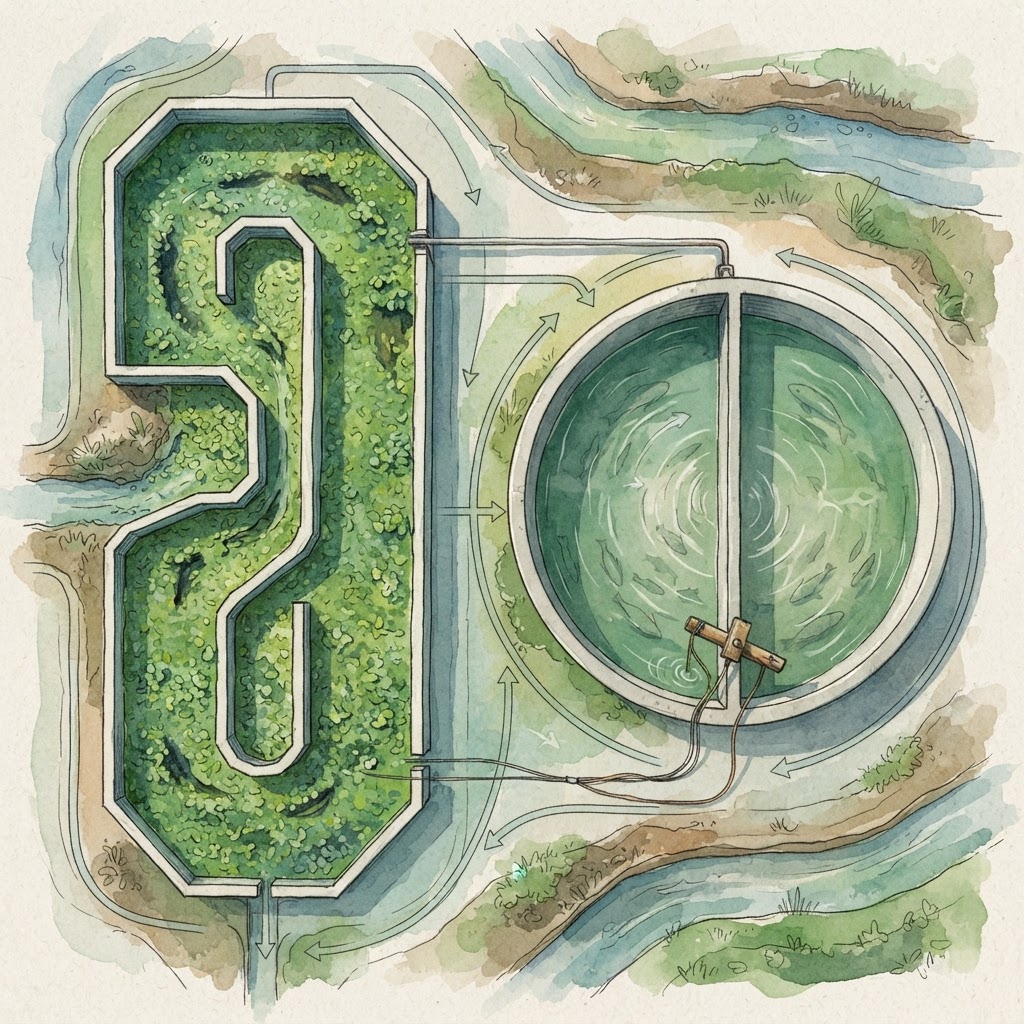
Growing it is work. The classic integrated tilapia and duckweed design puts the sedimentation and duckweed zone at no less than 20 percent of total grow-out area, holds standing crop density between 400 and 800 g per square metre, and treats daily harvesting of the incremental growth as standard practice, not as an option. A duckweed mat left to thicken shades itself, dies underneath and returns the nutrients you just removed.
Which water it grew on decides whether it is feed at all
Here is the part of this literature that practical guides skip.
A great deal of the published duckweed feeding work grows the crop on a waste stream, because that is cheap and it is what the plant is good at. The 50 day tilapia study above fertilised its culture tanks with swine manure at 1 kg per 1000 L per week. The meta-analysis bibliography goes further and includes a 2004 microbiology paper arguing that biomass raised on treated effluent is safe to use. That is the literature’s position. It is not ours.
SERAPH does not operate that way, and the divergence is deliberate rather than incidental.
We run two permanently separated streams. Production-grade biomass for food, feed and high-value products is one. Non-food remediation biomass, grown on wastewater, manure or contaminated water, is the other, and it never crosses into either. The separation starts at the first sensor reading rather than at the point of sale, because containment and traceability are cheap to design in and impossible to retrofit into a harvest that has already been mixed.
That is a company policy, not a regulation, and it is stricter than what the published work permits. The reason to hold it is that duckweed concentrates what is in its water, which is precisely why it works as a treatment step. A buyer evaluating duckweed as animal feed should ask what the growing medium was before asking what the crude protein was, and should treat the answer as a food-safety question rather than an agronomic one.
What the trial record still does not tell you
Three gaps are worth naming, because none of them will be closed by another review of the existing papers.
Marine species are almost unstudied: 16 of the 18 species in the meta-analysis are freshwater. Life stage is skewed to fingerlings, so the dose response in a finishing fish is largely assumed. And the experiments are short relative to a production cycle.
SERAPH’s own position sits upstream of all three. The system is at TRL 3, proof of concept, with outdoor field validation still ahead, and that is stated plainly rather than softened. Behind it is a knowledge base of 256 indexed duckweed papers mapped across 31 research areas in 5 domains, which is how coverage gaps like the marine one become visible instead of assumed.
The measurement side is further along. SERAPH Vision reconstructs a cultivation canopy in 3D from a single capture, using 170,000 surface points drawn from 5.9 million captured, computes canopy volume, and already tells duckweed species apart on a real tray, frame by frame. Growth and stress reading are still in development.
Which is the point this article keeps returning to. An inclusion rate of 20 percent is a statement about a specific plant, at a specific moisture, from a specific water. If you cannot say which species is in the tray and what it grew on, the number is not a formulation. It is a hope. The same logic applies whether you are evaluating duckweed as a protein source for fish or for anything else.
FAQ
How much duckweed can you feed fish?
Fifteen to 30 percent of the diet is the band the trial record supports, with 20 percent the most commonly tested formulation. Dried duckweed has matched commercial feed at 50 percent of the ration in tilapia fingerlings, but that is above the general band and depends on the biomass being dried and of known composition.
Can fish live on duckweed alone?
No. Every trial that has tested a duckweed-only diet reported the worst result in the study, including 9 percent weight gain against 65 percent on conventional feed over 21 days. Treat it as a partial substitution for part of the protein, never as the ration.
Is fresh or dried duckweed better for fish?
Dried, if you are formulating. Drying concentrates the protein, gives you a stable ingredient that holds together in water, and lets you use a larger share of the ration. Fresh saves the drying step and works as a supplement, but at roughly 96 percent water the fish fills up before the protein arrives.
Which fish eat duckweed?
Nile tilapia and common carp carry most of the published evidence, with catfish, rohu, silver barb, milkfish and grass carp also tested. Marine species are the open gap: only 2 of the 18 species in the meta-analysis were marine.
Can you feed fish duckweed grown on wastewater or manure?
The research literature does exactly that and reports usable feed values. SERAPH does not. Remediation-grade biomass never enters food or feed here, and the two streams are separated from the first sensor reading. That is our operating policy rather than a legal rule, and it is deliberately stricter than what the published work permits.