Edible Duckweed Species: Which Are Eaten and Allowed
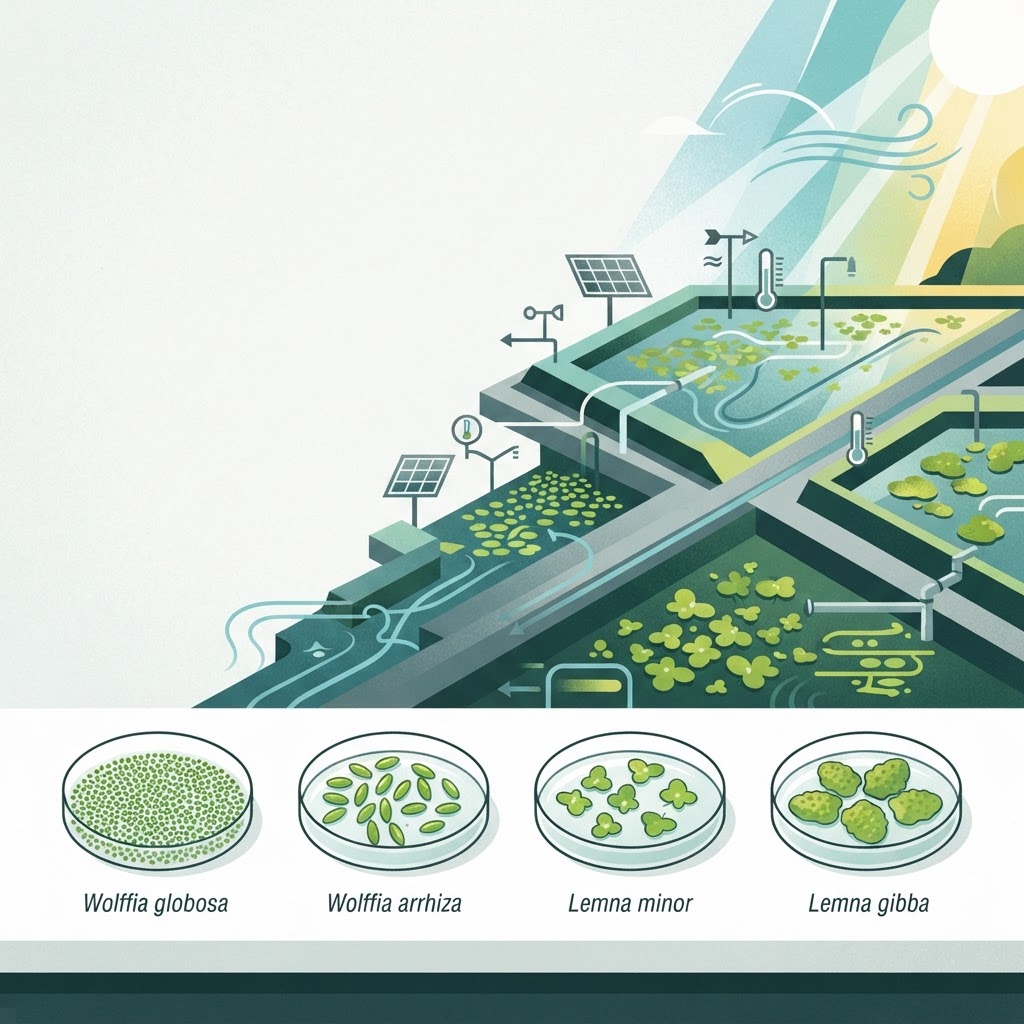
Edible duckweed species, genus by genus: Wolffia globosa and W. arrhiza, Lemna minor and L. gibba, and why the water decides what is food-grade.
Ask which edible duckweed species exist and most pages give one of two answers. Nutrition reviews call nearly every species “promising”. Foraging pages imply that any duckweed on any pond is a salad. Both blur three separate questions: which species people have traditionally eaten, which species a regulator allows on the market, and which species simply look good in a lab analysis.
Kept apart, the answer is short. Two Wolffia species have a long record as food. Two Lemna species have recently joined them as an authorised vegetable in the EU. The rest of the family is studied, not sold. And for all four, the permission attaches to a plant grown in controlled water, never to the species on its own.
The short answer: four species, two genera, one condition
The duckweed family holds 38 species in five genera: Spirodela, Landoltia, Lemna, Wolffiella and Wolffia. Of those, the edible list looks like this.
| Species | Traditionally eaten | EU status for the fresh plant |
|---|---|---|
| Wolffia globosa | Yes, Southeast Asia | Authorised, Reg. 2021/2191 |
| Wolffia arrhiza | Yes, Southeast Asia | Authorised, Reg. 2021/2191 |
| Lemna minor | No European tradition | Authorised, Reg. 2025/153 |
| Lemna gibba | No European tradition | Authorised, Reg. 2025/153 |
| Spirodela, Landoltia, Wolffiella | Reported locally or studied | No entry |
A 2025 review in Nutrients names W. arrhiza and W. globosa as the two main species consumed by humans. The EU list adds the two Lemna species. The condition is the same for all four, and we come back to it below. The dossier-by-dossier history is in our article on duckweed novel food; this one stays with the plants.
Wolffia: the duckweed people actually eat
Wolffia is the rootless genus. It is also the only genus with a long, documented history on the plate.
Wolffia globosa and the khai nam markets
In Thailand, Laos and Myanmar a small green duckweed is sold as khai nam, “water eggs”, and cooked into omelettes, curries and salads. For decades the literature called that plant Wolffia arrhiza. When Appenroth and colleagues identified three market samples from Northern Thailand in 2016, all three were W. globosa, which fits the view that W. arrhiza is rather rare in Thailand.
That correction matters because it shows how easily the species behind a food gets mislabelled, even in peer-reviewed work.
Wolffia arrhiza
W. arrhiza stays on the edible list because it is named, together with W. globosa, in the EU traditional food authorisation. Implementing Regulation (EU) 2021/2191 allows fresh plants of Wolffia arrhiza and/or Wolffia globosa, on the basis of their history of safe use in Southeast Asia, and sets upper limits for heavy metals, microcystins, copper, molybdenum, zinc, boron and manganese.
Note what the regulation covers: the fresh plant. A dried W. globosa powder went through a separate procedure and met a negative EFSA opinion in 2021, a story told in our article on Mankai duckweed protein.
Why Wolffia, chemically
The most complete study of the genus examined all 11 Wolffia species, identified by molecular barcoding. Protein ran from 20 to 30 percent of freeze-dry weight, starch from 10 to 20 percent, fat from 1 to 5 percent. Two findings in that paper bear directly on edibility.
First, unlike Spirodela, Landoltia and Lemna, Wolffia species do not carry their oxalate as calcium oxalate crystals. Second, mineral content depended on the cultivation conditions as well as on the species, and clones within W. globosa and W. arrhiza differed from each other. The authors’ own conclusion was that selecting suitable clones is important.
So even inside the most edible genus, “the species” is not the unit that decides quality. The clone and the water are. Our Wolffia protein article follows that spread through the published figures.
Lemna: from pond weed to an authorised vegetable
Lemna is the duckweed most Europeans and Americans have actually seen. Until 2025 it had no place on an EU plate as a whole plant.
Wageningen Plant Research applied to sell heat-treated Lemna minor and Lemna gibba as a vegetable. EFSA’s 2022 opinion found the plants contained more manganese than other leafy vegetables and concluded that safety could not be established. The applicant then cut manganese in the growing medium, and a 2024 technical report accepted a maximum of 6 mg/kg fresh weight, below the level spinach can reach.
Implementing Regulation (EU) 2025/153 authorised the fresh plants on 29 January 2025, labelled as “Lemna minor and Lemna gibba plants”. The same two species appear in a separate authorisation for a protein concentrate, which is a processed ingredient restricted to one company until 30 April 2029, not a licence to eat the plant.
The genus holds more species than these two; our list of Lemna species covers the rest. None of the others has a food entry.
Spirodela, Landoltia and Wolffiella: studied, not authorised
Here the “promising” literature and the legal map part ways.
Spirodela polyrhiza is reported as eaten raw as a salad or green vegetable in some places, alongside W. arrhiza. Landoltia punctata appears in composition studies. The 2017 Appenroth study, which covered one species from each genus, rated Wolffia microscopica and Wolffiella hyalina as the most desirable for human food on nutritional grounds.
None of those species has an entry among the authorised duckweed products. Under the EU framework a food not consumed to a significant degree in the EU before May 1997 is novel, and the Commission’s novel food status catalogue puts the burden of proof on the business. A good amino acid profile in a lab paper is not that proof.
There is a chemical point too. A systematic review in Agronomy notes that calcium oxalate crystals are present in Spirodela and Lemna and absent in Wolffia. The authorised Lemna product caps oxalates in its specification for that reason. A grower who wants to sell Spirodela would face the same question, with no dossier yet written to answer it.
Edible species is not the same as edible plant
This is the part most edible duckweed lists leave out, and it is the part every regulator wrote into law.
Duckweed is a living filter. The same Agronomy review found that it accumulates minerals several hundred fold relative to the water it grows on, and concluded that duckweed for food cannot be associated with clean-up systems. The 2025 Food Safety and Health review adds that duckweed grown naturally in ponds, lakes and rivers may be contaminated and might not be safe to eat, and treats it as a good food source only as long as the environment is controlled for safe consumption.
Read the authorisations with that in mind. The Wolffia regulation lists contaminant limits. The Lemna regulation was only granted once the growing medium was changed. Both describe a specific production process. A Lemna minor frond on a farm pond is the same species as the authorised vegetable, and legally and chemically a different thing.
The uptake that makes duckweed wastewater treatment work produces remediation-grade biomass, which never enters food or feed. The same uptake is why wild duckweed cannot be assumed edible. That is why SERAPH runs two permanently separated streams. Biomass grown on wastewater, manure or contaminated water is never sold or blended as food or feed, whatever its species, and the production-grade and remediation streams are kept apart from the first sensor reading.
Telling the species apart before you trust a label
If the species matters for the law and the clone matters for composition, identification is the first quality step, not a botanical nicety.
Two facts from the sources above make the case. The Thai market plant was called W. arrhiza in the literature for decades and turned out to be W. globosa. And the full Wolffia study had to use molecular barcoding to be sure what it was measuring. Fronds a millimetre across, with few visible features, do not identify themselves.
Our guide to duckweed species identification walks through the morphological key, where it breaks, and what DNA barcoding adds. For a food application the order is simple: confirm the species, confirm the clone, then confirm the water.
If your question is the broader one, whether duckweed can be eaten at all, our article on is duckweed edible takes it from that end.
Where SERAPH stands
We are early, and we say so. SERAPH is at TRL 3, proof of concept, with outdoor field validation still ahead. We build a cultivation system and the know-how behind it; we do not sell biomass, protein or food.
Our knowledge base indexes 256 duckweed papers across 31 research areas. Reading the food literature against the regulatory files, the lesson for anyone choosing an edible species is that the species is only the first of three choices. The other two, the clone and the water, are where every authorisation was won or lost, and the water is what an adaptive cultivation system exists to control. We publish no yield or composition figures of our own, because none has been validated in the field yet.
Built for the field, not the lab. AI proposes, the bench validates.
FAQ
Can you eat duckweed from a pond?
No authorisation we know of covers wild or pond-grown duckweed. Duckweed concentrates whatever is in its water, including metals and microbial contamination, so a pond plant of an edible species is not a food-grade plant. The authorised products all specify a controlled production process.
Is Spirodela polyrhiza edible?
It is reported as eaten raw in some regions, but it has no EU novel food authorisation, and it carries calcium oxalate crystals that Wolffia does not. Treat it as studied, not approved.
What is khai nam?
Khai nam, “water eggs”, is the Thai market name for the small rootless duckweed eaten in Thailand, Laos and Myanmar. Market samples identified with care turned out to be Wolffia globosa, though older literature calls it Wolffia arrhiza.
Is dried Wolffia powder allowed in the EU?
Not as of the documents we checked. Fresh W. arrhiza and W. globosa plants are authorised, but a dried W. globosa powder received a negative EFSA opinion in 2021 over its contribution to manganese intake. Check the current Union list before labelling any product.