Duckweed Crude Protein Content: What It Does Not Tell You
Duckweed crude protein content averages 27.8 percent of dry matter. Four deductions sit between that figure and the protein an animal actually uses.
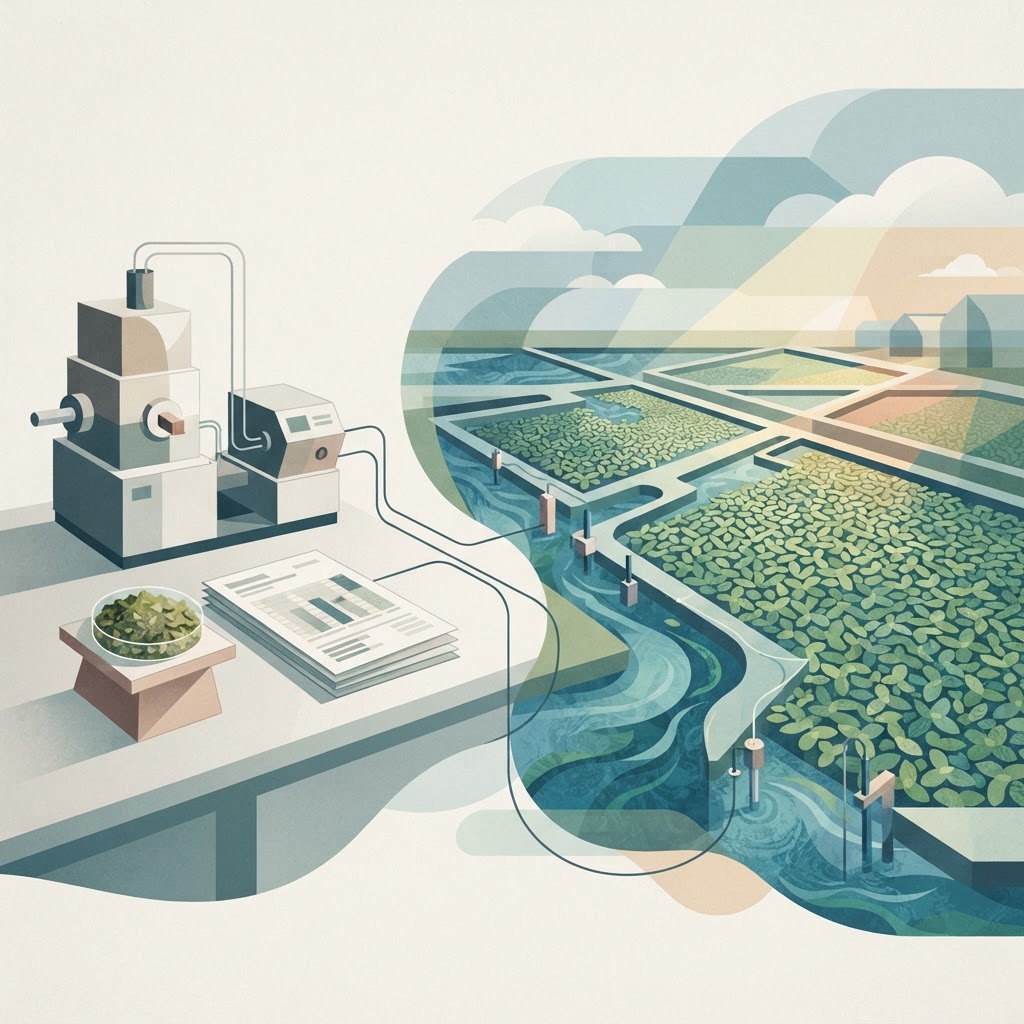
Duckweed crude protein content is the first figure on every supplier sheet and the last one anybody interrogates. The reference tables put dried biomass at 27.8 percent of dry matter across 18 samples, ranging from 15.5 to 35.6 percent. Individual batches go higher.
That number is not wrong. It is just further from the protein an animal deposits than most people buying on it realise, because four separate deductions sit between the assay result and the feed value, and only one of them normally appears on a spec sheet.
This is not an argument that duckweed is oversold. It is an argument about what the measurement is.
Crude protein is a nitrogen assay wearing a protein label
Crude protein is never measured directly. Nitrogen is measured, by Kjeldahl or by combustion, and multiplied by a conversion factor, almost always 6.25.
For duckweed there is a measured alternative: a 2025 study derived 5.78 plus or minus 0.02 from total amino acid analysis, consistent with a proteome dominated by RuBisCO. Applied to that 27.8 percent average, the same nitrogen expresses as roughly 25.7 percent. The assay layer has its own article, on why every source quotes a different duckweed protein figure, and so does the question of which levers actually move duckweed protein content. Neither is the subject here.
The subject here is what happens after the assay.
Deduction one: nitrogen that never became protein
The 6.25 factor carries a second assumption that gets less attention than the 16 percent nitrogen one. It assumes every nitrogen atom in the sample was in a protein.
In duckweed it demonstrably was not. An applied effluent-polishing report states the caveat plainly: duckweed protein data are nitrogen-derived, and it cannot be assumed that all nitrogen goes into protein because non-protein nitrogen compounds are present. That same report bands the plant by water quality, 15 to 25 percent crude protein on nutrient-poor water against 35 to 43 percent under ideal conditions.
The largest identified pool is nitrate. Work on Lemna measured it directly and found more nitrate in roots than in fronds, with frond nitrate 1.4 to 6 fold higher in plants grown at 23.9 degrees C than at 18.3 degrees C. Nitrate nitrogen is nitrogen the plant took up and has not yet reduced. Kjeldahl and combustion both count it. The animal cannot use it as protein.
Which produces an uncomfortable coupling. The conditions that raise crude protein, warm water and abundant nitrogen, are also the conditions that enlarge the pool inflating it.
Deduction two: the gap you can see when both numbers are measured
The argument above is mechanistic. There is a place where the size of the effect was measured directly, and it is sitting unremarked in a pig nutrition paper.
A University of Illinois team characterised Lemna protein concentrate against soybean meal, fish meal and corn in one laboratory, on the same samples, reporting both crude protein and the sum of analysed amino acids. The Lemna concentrate came in at 67.99 percent crude protein and 60.55 percent total amino acids. The soybean meal came in at 48.00 percent crude protein and 47.97 percent total amino acids.
Read those two lines against each other. For the soy, crude protein and measured amino acids agree to within three hundredths of a point. For the Lemna material, crude protein sits about 7.4 points above the amino acids that were actually found, an overstatement of roughly 11 percent in relative terms.
The consequence is specific and it is a formulation error waiting to happen. Substituting duckweed for soybean meal on equal crude protein does not substitute equal protein, because the crude protein overstatement is ingredient-specific rather than a constant that cancels out on both sides of the equation.
Deduction three: digestibility, where the species finally shows up
Now the biggest deduction, and the one that reverses the ranking crude protein gives you.
A study that ran crude protein and standardized ileal digestibility through a single protocol found Lemna at 221.87, Wolffia at 442.65 and Spirodela at 179.64 g/kg of dry matter for crude protein. On digestibility the order changed: Lemna 72 percent, Wolffia 69 percent, Spirodela 39 percent. Wolffia carried twice Lemna’s crude protein and did not convert it into a digestibility advantage. Spirodela, with the highest ash and crude fibre of the three, lost more than half of its already low protein figure.
The reference tables agree on the scale of the loss without naming a species: nitrogen digestibility in the growing pig is listed at 64.0 percent.
Tannins explain most of the within-species spread
Between batches of the same genus the spread is wider still. A broiler trial tested three duckweed batches at 17.5, 24.6 and 37.0 percent crude protein and measured standardized ileal digestibility of methionine running from 49.9 to 90.4 percent across them. Apparent ileal digestibility of phosphorus ran from 50.8 to 78.9 percent.
The variable that tracked it was tannin content: 2943, 2890 and 303 mg/kg for the three batches, in the same order as the digestibility ranking. Anti-nutritional load, not crude protein, decided what the bird got.
Two consignments quoting an identical crude protein figure can therefore differ by tens of points of amino acid availability, and nothing in the crude protein number carries that information. This is why a duckweed spec without a digestibility figure is a description of the plant rather than a description of the ingredient.
Deduction four: the energy ceiling arrives before the protein target does
The fourth deduction is not about protein at all, which is precisely why it gets missed.
Duckweed’s gross energy is unremarkable at 17.1 MJ/kg of dry matter. Its metabolizable energy for poultry is 4.9 MJ/kg DM. Most of the energy in the sample is not available to the bird, so the ingredient dilutes dietary energy every time you raise its inclusion rate.
That ceiling is observable. In the broiler trial, inclusion of the 37.0 percent crude protein batch at 50 and 75 percent of the diet cut feed intake to 109.3 and 74.9 g per day, and the authors concluded the material was usable at up to about 25 percent. High water binding capacity and fibre, not protein quality, were the limiting factors. The pig work points the same way: metabolizable energy of the Lemna concentrate came in at 3804 kcal/kg DM against 4184 for soybean meal.
So the practical answer to “what is the crude protein content” is often irrelevant to the question behind it. Beyond a modest inclusion rate you are constrained by energy and intake, and a richer protein percentage does not buy you room. The applied version of that constraint is worked through for duckweed in chicken feed.
Ruminants read the same number differently
For a ruminant nutritionist the deduction is a different one. Effective nitrogen degradability for duckweed is listed at 66 percent at a passage rate of 4 percent per hour and 60 percent at 6 percent per hour, with condensed tannins at 16.0 g/kg DM.
Two thirds degraded in the rumen makes this a rumen nitrogen source rather than a bypass protein source. That is a legitimate and useful line in a ration. It is a different line from the one a crude protein percentage implies.
What a usable crude protein spec sheet has on it
Six things turn a percentage into something you can formulate against.
Which conversion factor produced it, because 6.25 and 5.78 describe the same biomass in different units.
Dry matter or as fed, and the dry matter percentage alongside, since duckweed leaves the pond at well under 10 percent solids.
Ash on the same sample, because mineral is the part of dry matter that is neither protein nor energy.
An amino acid profile, or at minimum methionine and lysine. Quantity is half a specification and the duckweed amino acid profile is the other half.
A digestibility figure, with the species it was measured in stated. In vitro and in vivo values are not interchangeable.
The water the biomass was grown on. Which is the last deduction, and the one that is not nutritional.
The water that maximises crude protein is often the water that disqualifies the biomass
Nitrogen availability is what raises the percentage, and the cheapest concentrated nitrogen anywhere near a farm is a waste stream. Most of the crude protein literature was generated on exactly that basis and treats the resulting biomass as feed.
The nitrate pool from deduction one returns here wearing a different hat. A doctoral study of duckweed protein production on agricultural effluents measured nitrate content in Lemna minor across six growing media, including the biological effluent of pig manure treatment, and evaluated the results against human and ruminant nitrate limits rather than against a protein target. That is the correct question to ask of high-nitrogen biomass, and a crude protein assay is structurally incapable of asking it, since it counts the nitrate as protein instead of as a limit.
SERAPH takes the harder position on this, as a published operating rule rather than a preference. Biomass grown on wastewater, manure or contaminated water never becomes food or feed here. The production stream and the remediation stream are separated from the first sensor reading, not at the point of sale. The same page states our maturity: TRL 3, proof of concept, with outdoor field validation still ahead.
We do not have field-validated crude protein figures of our own to publish, and we say so rather than borrowing someone else’s. What we have is a mapped view of where the evidence sits, 256 indexed duckweed papers across 31 research areas in 5 domains, each carrying a coverage weight and a maturity band. Reading that map is how the four deductions above became visible as a chain rather than as isolated caveats.
The nutrient-removal case for duckweed wastewater treatment is genuinely strong. It ends somewhere other than duckweed as animal feed, and the crude protein number is not the thing that tells the two apart.
FAQ
What is the crude protein content of duckweed?
Dried duckweed averages 27.8 percent of dry matter across 18 reference samples, from 15.5 to 35.6 percent. Individual commercial batches have been analysed at 37.0 percent and a Wolffia sample at 44.3 percent. Every one of those figures was computed with a 6.25 conversion factor.
Is crude protein the same as true protein in duckweed?
No. Where both were measured on the same samples in one laboratory, a Lemna protein concentrate showed 67.99 percent crude protein against 60.55 percent total amino acids. Soybean meal in the same table showed 48.00 against 47.97.
How much duckweed can you include in a broiler diet?
Up to about 25 percent in the trial that tested it. At 50 and 75 percent inclusion of a 37.0 percent crude protein batch, feed intake fell to 109.3 and 74.9 g per day, limited by fibre and water binding capacity rather than by protein.
Which duckweed genus has the most digestible protein?
Lemna, at 72 percent standardized ileal digestibility of crude protein, ahead of Wolffia at 69 percent and Spirodela at 39 percent, even though Wolffia carried roughly twice Lemna’s crude protein.
Why do two duckweed batches with the same crude protein perform differently?
Anti-nutritional load. Across three batches, tannin contents of 2943, 2890 and 303 mg/kg tracked the digestibility ranking, with standardized ileal digestibility of methionine running from 49.9 to 90.4 percent.