Duckweed as Cattle Feed: What the Rumen Data Shows
Duckweed as cattle feed clears the poultry limits, then meets two the trials rarely mention: rumen-degradable protein and falling metabolizable energy.
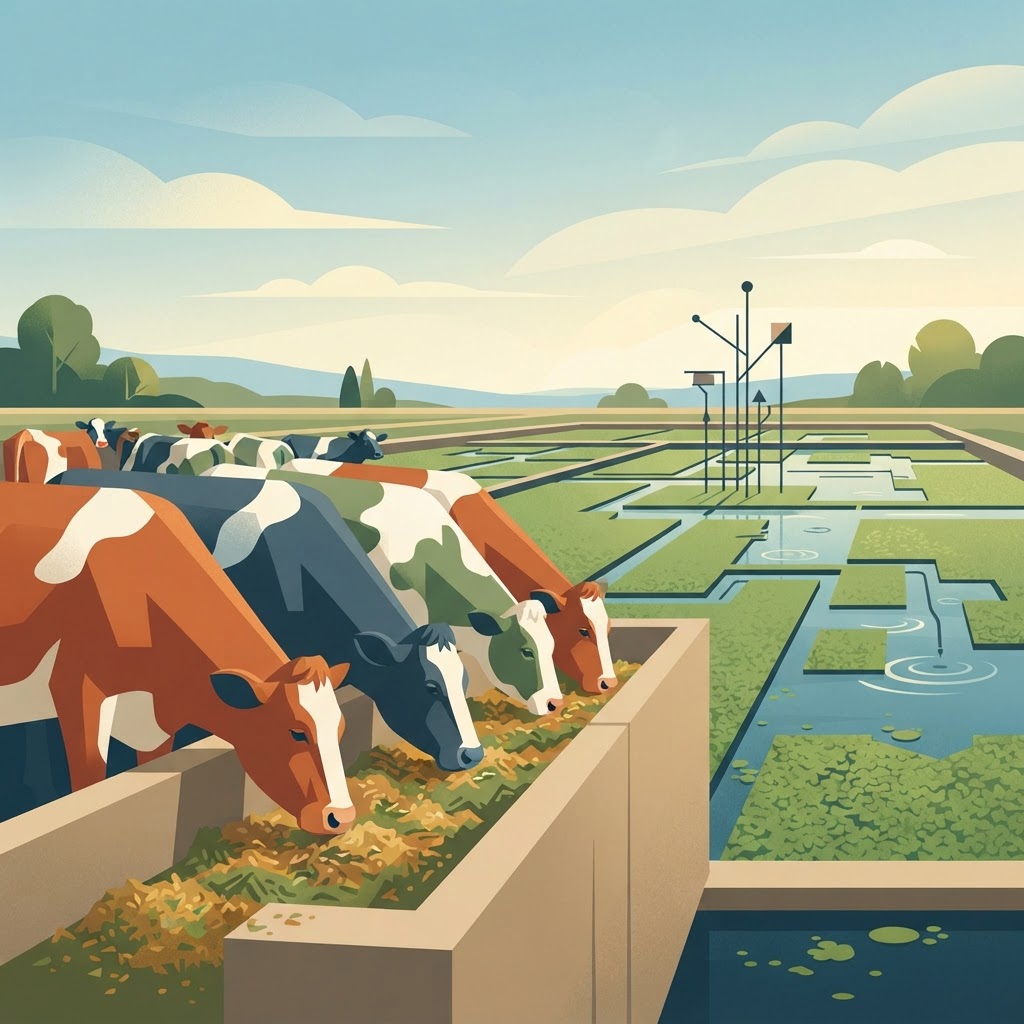
Most of what is written about duckweed cattle feed is poultry advice with the animal swapped out. You can see the seam: the pages quote a protein percentage, argue about an inclusion rate, and finish with a worked example built on 25 laying hens.
The ruminant literature does not support that transfer, and not because it is more cautious. It is less cautious. The four things that cap duckweed in a bird are high ash, high fibre, a water binding problem that stops the bird eating, and a methionine shortfall. A rumen is close to indifferent to all four. So published ruminant inclusion levels start where the poultry ceiling ends, at 10 to 15 percent, and run to 40 percent of the diet.
Which means the inclusion rate is not the interesting question here. Two other things are, and neither of them appears on a page currently ranking for this term.
The starting composition is ordinary enough. A recent Indian in vitro study working with a total mixed ration put its duckweed at 24.5 percent crude protein and 20.07 percent ash, against 4.80 percent ash for the concentrate mixture it was replacing. Hold that ash figure. It comes back.
The real question is what the rumen does with the protein
There is exactly one published study that put duckweed in front of cattle and measured what the rumen did with it. It is from 1996, and almost nobody quotes the sentence it ends on.
Huque and colleagues took the three most available genera and ran them through cannulated cattle. Spirodela, Lemna and Wolffia came in at 284, 399 and 299 g of crude protein per kg of dry matter. Over 24 hours in the rumen, dry matter digestibility ran 410, 570 and 731 g/kg and crude protein digestibility ran 528, 740 and 778 g/kg. The rates of dry matter digestion were 2.22, 3.63 and 5.73 percent per hour, a spread of more than twofold across three plants sold under one common name. Their conclusion was that both dry matter and crude protein were highly degradable in the rumen, that duckweed could be fed to cattle mixed with concentrates, and that the effect on the rumen digestion kinetics of a roughage diet needed careful study.
That last clause has been sitting there for thirty years.
Fast protein is not automatically good protein
Here is why it matters. Protein that degrades quickly in the rumen is only worth what you paid for it if fermentable energy arrives at the same time. The microbes need both to build microbial protein, which is what actually reaches the small intestine. Nitrogen released ahead of the energy is absorbed as ammonia, converted in the liver and excreted as urea. The cow does not grow on it and neither does the milk tank.
Duckweed looks like a fast protein. A more recent degradability study measured the rapidly degradable fraction of Lemna minor at 32.3 percent for dry matter and 27.0 percent for crude protein, against 22.6 and 25.9 percent for alfalfa, while alfalfa was higher on the slowly degradable fraction, the rate constant and effective degradability at every passage rate tested.
The evidence contradicts itself, and the review says so
Except the sheep work points the other way. The standing review of duckweed in animal feed reports Merino trials in which duckweed outperformed urea and matched cottonseed meal on wool growth with no penalty to clean wool yield or fibre diameter, and whose authors suggested on the strength of lower post-feeding rumen ammonia that duckweed might be a good source of rumen undegraded protein. The review notes, plainly, that this conflicts with the cattle findings.
So the field holds two incompatible positions on the single property that decides whether duckweed pays in a ruminant ration, and it has held both for two decades. That is worth knowing before you formulate, and it is not a detail a protein percentage will ever tell you.
What a nitrogen balance actually showed
The closest thing to an answer is a metabolism trial that measured the nitrogen instead of arguing about it. Nineteen Boer goat wethers were fed hay plus supplement at 4 percent of body weight, with one third and then two thirds of the supplemental protein coming from duckweed against a soybean meal control. Nitrogen intake, nitrogen digested and nitrogen retained as a percentage of digested showed no significant differences. Nitrogen retained as a percentage of intake and in grams per day tended slightly lower on the duckweed diets, and serum urea nitrogen showed a linear response at P equals 0.09.
A trend at P equals 0.09 is not a result. It is the direction you would expect if the protein were degrading ahead of the energy, measured once, in goats, at moderate inclusion. Which is roughly the state of the evidence: consistent with the concern, nowhere near sufficient to confirm it.
Energy falls as duckweed rises, and the ash is why
The second question the ranking pages skip is simpler and better evidenced.
In that Indian total mixed ration work, in vitro dry matter and organic matter digestibility peaked at 10 percent duckweed, at 75.0 and 75.8 percent. Metabolizable energy did not peak anywhere. It fell significantly as inclusion rose, bottoming at 5.15 MJ/kg at 30 percent duckweed. The composition table explains it without needing a mechanism: at 20.1 percent total ash against 4.80 for the concentrate being displaced, a fifth of what you are buying is mineral matter that carries no energy at all.
Two independent studies see the same slope. Alfalfa beat Lemna minor on gas production at every incubation time, and on potential and rate of gas production, metabolizable energy and organic matter digestibility. In a Mexican in vitro study, both Lemna gibba samples carried more ash than either lucerne or ryegrass.
The useful part is that ash is not a fixed property of the plant. It tracks the water the plant grew in, which is the same reason the nutritional value of two harvests can differ more than two ingredients would. You are not buying a feed with a spec sheet. You are buying whatever that pond produced that week.
The inclusion numbers, with their conditions attached
With both of those on the table, the published ceilings read differently.
At the conservative end, Lemna gibba at 15 percent of a basal diet left volatile fatty acids, the acetate to propionate ratio and dry matter and organic matter degradability unchanged, with a possible reduction in ruminal methane. The Indian work landed lower, concluding that 10 percent of the concentrate mixture in a 70:30 roughage to concentrate ration could be replaced without adverse effect.
The highest number in circulation comes from fattening lambs, where Lemna gibba replaced 50, 75 and then 100 percent of the alfalfa hay, giving diets at 20, 30 and 40 percent duckweed. Dry matter and NDF digestibility were highest at 40 percent, above the alfalfa control. In the versions where the ration was not rebalanced, up to 30 percent held level with the control.
Three conditions travel with that 40 percent and are usually dropped. It is in vitro. It is lambs. And the best results came only after energy and protein were rebalanced across the whole ration, which the authors say explicitly, along with a request for validation in calves and dairy cows.
The goat trial adds the one reassurance the ruminant record does offer without caveat: rumen pH, ammonium and volatile fatty acids stayed comparable to the soybean meal control, so rumen function itself was not disturbed. Nothing here is a warning about feeding the stuff. It is a warning about the strength of the evidence. Almost all of it is in vitro or small-ruminant work, and the in-cattle record is one study from 1996.
Tonnage is the constraint nobody prices
There is a reason the ruminant evidence is thin, and the 2003 review states it directly: the volume of material needed. A cow is not a scaled-up hen in this respect either. Duckweed is 92 to 96 percent water when harvested, so drying it to a preservable moisture is a serious cost in labour or energy, and the review’s own recommendation is to use it on site rather than dry it. Wet duckweed has been fed at high levels and accepted without complaint.
Set that against supply. Ten to 30 tonnes of dry matter per hectare per year is the honest field range, and a Belgian outdoor pilot found growth ceasing after roughly 100 to 120 days as pH and electrical conductivity in the medium climbed. So the material is bulky, wet, seasonal and best used where it is grown.
That makes a duckweed cattle ration a logistics decision before it is a nutrition one. Plan the harvesting and the season together, and get the cultivation cost per tonne of dry matter, not per tonne of harvest, or the comparison against soymeal is meaningless.
Which water it grew on decides whether it is feed at all
The goat trial above characterised wastewater grown duckweed and evaluated it as a ruminant protein supplement in the same study. That is normal in this literature, and the 2019 review is candid about the exposure: duckweed accumulates considerable amounts of toxic metals and compounds from the aquatic environment, which may limit its use as a feed ingredient, and the risks in the collection and processing chain still need to be established.
SERAPH runs a stricter line than the research does, and states it as a company policy rather than as a rule anyone else is breaking. There are two permanently separated streams. Production-grade biomass for food, feed and high-value products is one. Non-food remediation biomass is the other, and it never crosses. The separation starts at the first sensor reading rather than at the point of sale, because containment and traceability are cheap to design in and impossible to retrofit into a harvest that has already been mixed.
This bites harder for cattle than for poultry, and it is worth being explicit about why. A livestock operation looking at duckweed usually already owns the nutrient-loaded water. The lagoon is right there, the nitrogen is free, and the animals that would eat the biomass produced the effluent it grew on. That is precisely the loop the firewall exists to interrupt. If you are sourcing biomass grown on manure, that belongs in the supplier specification ahead of the protein figure. The same reasoning applies to duckweed as animal feed generally, and it is the one point where our position and the published literature genuinely diverge.
What to measure before you formulate
Four things, and none of them is a protein percentage.
Get the species. Wolffia at 399 g/kg digesting at 5.73 percent per hour and Spirodela at 284 g/kg digesting at 2.22 percent per hour are two purchases, not one.
Get the ash on that batch. It sets how much energy the ration loses per point of inclusion, and it is the number most likely to be missing from whatever you are quoted.
Ask what water it grew on, and treat the answer as a food safety question rather than an agronomic one.
Assume the degradable protein question is still open. Balance fermentable energy alongside the duckweed rather than after it, which is what the lamb work was doing when it got its best digestibility figures.
SERAPH’s own work sits upstream of all four. The system is at TRL 3, proof of concept, with outdoor field validation still ahead, and we state that deliberately rather than softening it. Behind it is a knowledge base of 256 indexed duckweed papers mapped across 31 research areas in 5 domains, which is how a gap like the one in this article, one in-cattle study since 1996, becomes visible rather than assumed.
The measurement side is further along. SERAPH Vision reconstructs a cultivation canopy in 3D from a single capture, using 170,000 surface points drawn from 5.9 million captured, computes canopy volume, and already tells duckweed species apart on a real tray, frame by frame. Growth and stress reading are still in development.
Which is the same argument the ration makes. If species and ash decide whether the duckweed protein in front of you is worth 10 percent of the diet or 40, then knowing what is actually growing in the tray is not a catalogue question. It is a measurement, and it has to be taken continuously, outdoors, in the water the crop is really in.
FAQ
Can cows eat duckweed?
Yes, and the acceptability was measured rather than assumed. Cattle ate mixed duckweed as part of a concentrate mixture in the 1996 trial, and later work found both fresh and dried duckweed readily consumed by cows, sheep and goats. Acceptability has never been the constraint. Supply and ration balance are.
How much duckweed can you feed cattle?
The defensible range from in vitro ruminant work is 10 to 15 percent of the diet, rising to 40 percent in lambs when the ration is rebalanced for energy and protein. Treat the higher figure as conditional on all three of those things, and remember the in-cattle record is a single study from 1996.
Can duckweed replace soybean meal in a cattle ration?
Partially. In the goat metabolism trial one third and two thirds of the supplemental protein came from duckweed with no significant change in intake or fibre digestibility and normal rumen function, but the duckweed was lower in crude protein and higher in minerals than the soybean meal it displaced. It is a partial substitute, not a replacement.
Does duckweed reduce methane from cattle?
In vitro results point that way and no herd has confirmed it. Lemna gibba at 15 percent left fermentation patterns unchanged with a possible methane reduction, and Lemna minor produced less methane than alfalfa in a separate gas production study. That is a signal from a syringe, not a farm result.
Is duckweed better for cattle than for chickens?
On the constraints, yes. The ash, fibre, water binding and methionine limits that set the poultry ceiling are largely absorbed by a rumen, and the amino acid panel that flags histidine and methionine as potentially limiting for cattle matters less when microbes synthesise them. What cattle add is scale, and a protein degradability question monogastrics never raise.
Can you feed cattle duckweed grown on a manure lagoon?
The literature has done exactly that and reports usable feed values from it. SERAPH does not. Remediation-grade biomass never enters food or feed here, and the two streams are separated from the first sensor reading. That is our operating policy rather than a legal rule, and it is deliberately stricter than what the published work permits.