What Is Wolffia globosa? The Smallest Flowering Plant
What is Wolffia globosa? A rootless duckweed under 1 mm long, eaten in Thailand as khai-nam and only partly authorised as food in the EU.
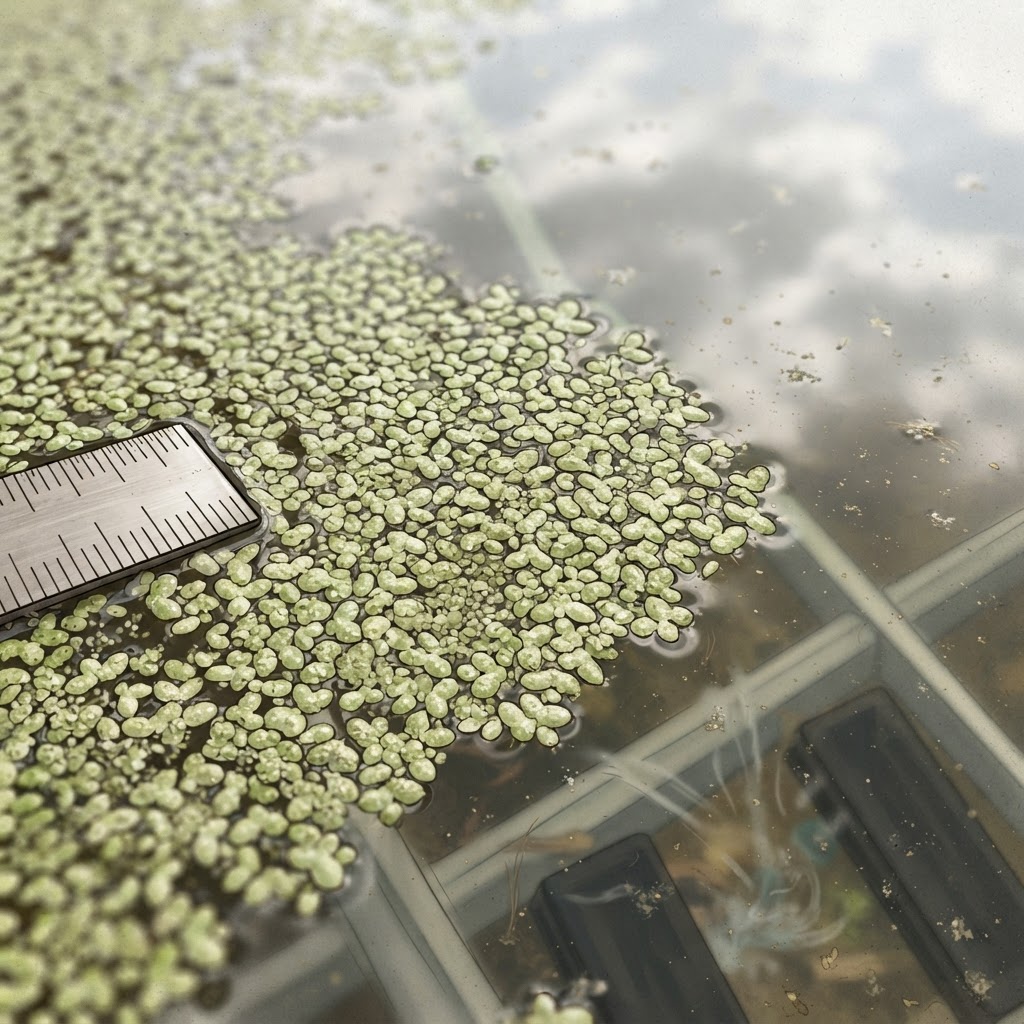
Wolffia globosa is a floating aquatic plant, one species of watermeal, and by most botanical accounts the smallest flowering plant known. It has no roots, no stem and no leaves: just a pale green body less than a millimetre long, drifting at the surface of quiet ponds. In Thailand and Laos it is a traditional vegetable, harvested from natural waterways and cooked in curries. In Europe and the US it is better known through a brand name, Mankai, and through a debate about whether it belongs in food at all.
So what is Wolffia globosa, in one line? It is a duckweed. More precisely, it is one of the 38 species of the water lentil family, which is made up of five genera: Spirodela, Landoltia, Lemna, Wolffiella and Wolffia. This article covers what the plant looks like, how it multiplies, where it grows, why it is eaten, and where it stands under EU food law.
Wolffia globosa in one paragraph
A rootless, ovoid frond between 0.4 and 0.9 mm long. It reproduces mostly by budding and flowers rarely. It is native to tropical Asia, now also found in parts of the Americas and Africa, and grows in dense mats on still fresh water. It is eaten whole, fresh or cooked, under local names such as khai-nam. Its protein content attracts researchers. In the EU, the fresh plant is authorised as a traditional food, while a dried powder failed its 2021 safety assessment.
How small is it, really?
Wayne Armstrong’s botanical description gives a body 0.4 to 0.9 mm long, and calls it the smallest of all known flowering plants, rivaled in minuteness only by the Australian species Wolffia angusta. The Japanese JIRCAS database is close: 0.4 to 0.8 mm long, 1.3 to 2 times as long as wide.
You will also find a much smaller number online. The Wikipedia entry states a diameter of 0.1 to 0.2 mm. That figure does not match the botanical keys above, which measure several times larger. If you are identifying a plant, trust the keys and a millimetre scale.
No roots, no leaves, no stem
The whole plant is one body of undifferentiated tissue, sometimes called a thallus. The NC State Extension toolbox describes the genus as rootless, branchless and leafless, resembling cornmeal on the water. JIRCAS adds detail at species level: the upper surface is barely rounded, it carries 1 to 10 (rarely up to 30) stomata, it is pale and somewhat transparent green, and it lacks the brown pigment cells some relatives have.
Duckweed family or arum family?
Both labels appear, and both are correct depending on the classification you follow. Older texts and most growers place it in Lemnaceae, the duckweed family. Newer treatments fold the duckweeds into the arum family, Araceae, which is how JIRCAS and NC State list it. The plant is the same either way.
How Wolffia globosa reproduces and grows
Nearly all growth is clonal. Each plant has one funnel-shaped budding pouch at its base, and a daughter plant grows out of it, often staying attached so you see plants singly or in pairs. Flowers do occur, inside a small cavity on the upper surface, but JIRCAS notes they are rare.
Budding is fast. A 2022 study on Thai Wolffia globosa cultivation reports that under suitable nutrients, light and temperature the plant sprouts new plants within 16 to 48 hours. That speed is why a few fronds can cover a pond, and why researchers see a crop in it.
At the genus level, watermeal can also survive cold periods: Washington State’s aquatic plant manual records that Wolffia forms winter buds on the lake bottom, produces a tiny seed in a balloon-like fruit, and spreads on wind, birds and animals.
Where it grows, and the species it gets confused with
Wolffia globosa is a tropical and subtropical species. Armstrong lists Africa, India, Southeast Asia, Malaysia, the Philippines and Hawaii, plus hot interior valleys of California and Pinellas County in Florida, where it may have been introduced, possibly via rice fields. It floats on quiet streams and ponds, often mixed with Lemna and other small aquatic plants.
Two practical cautions follow.
First, it is one of 11 species in its genus. A study that grew all 11 Wolffia species under one protocol needed molecular barcoding to identify them, and Washington’s manual notes the North American watermeals can only be told apart under magnification.
Second, the name itself has moved. South African populations once called Wolffia globosa are now recognised as Wolffia cylindracea. The two look alike, but globosa has a translucent margin visible from above. Telling duckweed species apart in the wider family is its own skill; our overview of edible duckweed species covers which ones are eaten, and a planned piece on Wolffia globosa vs Lemna minor will set the two most discussed species side by side.
Khai-nam: a traditional vegetable
In Thailand the plant goes by several names. A 2025 Scientific Reports study lists Khai-nam, Khai-pum, Kai nhae and Pum. Khai-nam translates roughly as “water eggs”, a nod to the tiny round fronds. JIRCAS records it cooked in curries such as kaeng pham, a minced pork or chicken curry, and khua pham, stir-fried northern style, and occasionally sold in local markets in Thailand and Lao PDR. Washington’s manual notes that one watermeal species is cultivated and eaten as a vegetable in Burma, Laos and Thailand, and that watermeal has been fed to cattle and pigs in Africa, India and Southeast Asia.
What does it taste like? The only source we found that says is NC State, which describes the genus as having a taste similar to sweet cabbage.
Notice the word “harvested”. The traditional food comes mostly from natural waterways, not from controlled cultivation. That matters later.
Why researchers grow it for protein
The modern interest is protein. Across published studies, the 2025 Scientific Reports paper summarises Wolffia globosa at 29.6 to 48.2 percent protein on a dry weight basis, alongside carbohydrate, fibre, fat and a large ash fraction. The genus-wide survey, using one protocol for all 11 species, found 20 to 30 percent of freeze dry weight.
Those ranges are wide for real reasons: the growing medium, the clone, and what the percentage is measured against. We unpack them in why Wolffia protein figures run from 20 to 46 percent.
There is also human research, much of it on one cultivated strain. A 2020 study in Nutrients reported bioactive vitamin B12 compounds in Mankai, a cultivated Wolffia globosa strain, and followed 294 participants in the DIRECT-PLUS trial, some of whom drank 100 g of frozen Mankai shake a day. These are findings about one strain in one producer’s system. We report them; we make no health claims from them.
Wolffia globosa, Mankai and the EU rules
Mankai is not a separate plant. It is a strain of Wolffia globosa grown by the Israeli company Hinoman, and figures for it describe that strain, not the species. We cover the brand’s protein figures in our piece on Mankai.
Under EU food law, the form of the product decides its status:
- Fresh plants. Implementing Regulation (EU) 2021/2191 authorises fresh plants of Wolffia arrhiza and Wolffia globosa as a traditional food from a third country.
- Dried powder. Hinoman applied on 24 September 2019 to market Wolffia globosa powder as a novel food. In its 2021 opinion, EFSA’s panel found that an increase in manganese intake from the powder is of safety concern and concluded that the safety of the novel food cannot be established. It also noted that the protein may trigger allergic reactions.
The details of what EFSA did and did not approve, and what that means for a shopper, will be the subject of a separate article on whether Wolffia globosa is safe to eat.
What the water has to do with it
One line in the EFSA opinion matters more than any protein figure. The panel noted that the concentration of trace elements and contaminants in the product is highly dependent on the conditions of cultivation of the plant and the fertiliser composition.
Read that next to how the plant is eaten. Wolffia globosa is consumed whole. There is no husk to remove, no stalk to discard. Whatever it took up from the water is in the food. A plant scooped from a roadside pond and the same species grown in clean, controlled water are, as ingredients, different things.
That is why, at SERAPH, the separation is policy, not preference. Biomass grown for remediation is never sold or blended as food or feed, and the production and remediation streams are separated from the first sensor reading. Duckweed is an excellent nutrient scavenger, and that is exactly the reason a food crop and a cleaning crop cannot share water.
Species identity is the other half of the problem, and the one most easily lost in an open system: watermeals look alike to the eye. Our computer vision work already tells duckweed species apart on a real tray, frame by frame. Growth and stress reading are still in development.
We are early, and we say so: TRL 3, proof of concept, with outdoor field validation still ahead. We have no field figures of our own for Wolffia globosa. What we can say with confidence is the definition this page set out to give: a tiny, rootless, fast-budding duckweed, eaten for generations in Southeast Asia, whose value as food depends first on knowing exactly which plant it is and what water it grew in.
FAQ
Is Wolffia globosa the same as duckweed?
Yes, it is one of the duckweeds. It belongs to Wolffia, one of the five genera of the water lentil family, alongside Spirodela, Landoltia, Lemna and Wolffiella. “Duckweed” is the common name for the whole family, so it covers many species besides this one.
Does Wolffia globosa have roots?
No. Botanical descriptions of the genus list no roots, no stem and no true leaves: the whole plant is a single floating body, which is part of why it looks like grains of meal on the water.
Can you buy Wolffia globosa in Europe?
As fresh plants, it is authorised in the EU as a traditional food from a third country under Regulation (EU) 2021/2191. A dried powder is a different product: EFSA’s 2021 assessment could not establish its safety because of manganese intake.
Is Wolffia globosa the same as Wolffia arrhiza?
No. Both are Wolffia species and both are named in the EU fresh plant authorisation, but they are distinct species within a genus of 11, and products made from one say nothing about the other.