What Is a Turion? Duckweed Dormancy in Plain Terms
What is a turion in duckweed? A starch-filled resting frond that sinks through winter. Plus turion duckweed, the species, and how to spot it.
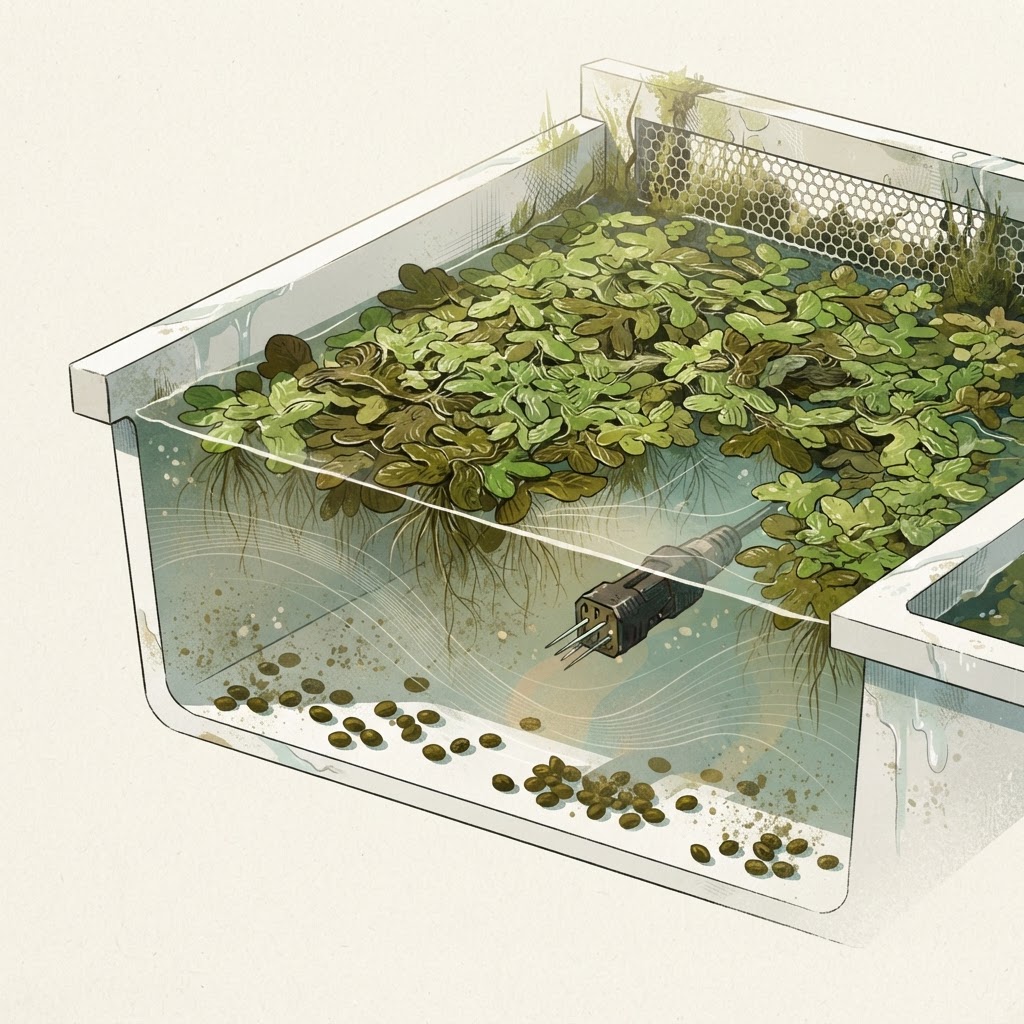
Ask what is a turion in duckweed and you can get two different answers. One is an organ: a small, starch-packed resting frond that some duckweeds make in late summer, drop to the bottom of the pond and leave there until spring. The other is a plant: turion duckweed, the common name of the species Lemna turionifera. Half the pages that rank for the question describe the first, half describe the second, and almost none say so. This page covers both, in plain terms.
What is a turion in duckweed
The short answer
A turion is a dormant bud. The word comes from the Latin turio, meaning shoot, and many aquatic plants make them. In duckweed, a turion is a resting frond that grows out of the same pocket where a normal daughter frond would bud. It separates from the mother frond and sinks to the bottom because of its density. Then it waits.
What makes it a true turion, rather than just a tough frond, is that it is innately dormant. When it forms, it does not and cannot grow, even though it still respires and can photosynthesise. Only a long spell of cold switches it back on.
How a turion differs from a normal frond
Put a turion next to the frond that made it and the difference is obvious. The turion is smaller, with thicker cell walls, much smaller air spaces and much more starch. It has only rudimentary roots, closed stomata and a high anthocyanin content, which gives many turions their dark or reddish colour. In Spirodela polyrhiza and Lemna turionifera the turions are flat and rounded; in Wolffia they are tiny spheres.
Under the microscope, the 1978 study of Spirodela turions described a broad, kidney-shaped outline and mesophyll cells packed with starch grains, and a single clean abscission layer at the base that lets the turion snap free and fall to the bottom of the flask. The starch does two jobs. It is food for the restart in spring, and it is ballast. Less air and more starch means the turion is denser than water, so it sinks.
What a turion does over one year
The full physiology, including what triggers the switch in a real pond, is in our longer piece on duckweed turions in an outdoor pond. The plain version runs in three steps.
Autumn: form and sink
Late in the season, the frond pockets stop making daughter fronds and start making turions. In Spirodela polyrhiza the main trigger is phosphate running out in the water, with cold taking over where phosphate stays high. That story is told in duckweed and phosphorus. Turions are not only a winter tool, either. The 2023 survival review notes they can also form under cadmium exposure, overcrowding and even summer heat.
Sinking is the real survival trick. Water is densest at about 4 degrees, so in a frozen pond the warmest water sits at the bottom, under the ice. Turions cannot survive severe frost, but they can withstand long periods of cold just above freezing. On the bottom, that is what they get.
Winter: the cold unlock
A fresh turion cannot germinate even in perfect conditions. That lock exists because turions form while the water is still warm and bright. If they sprouted straight away, the new fronds would have no time to make fresh turions before the surface froze. For Spirodela polyrhiza, the review puts the unlock at least two weeks at water temperatures of 0 to 5 degrees. After that, the turion is ready and simply waits for the water to warm.
Spring: the bubble ride up
When conditions turn, a gas bubble forms in the turion’s pocket and carries it to the surface. Once there, a new frond pushes out within two to three days and the colony starts growing again. Duckweed rarely flowers, so this is how it gets through winter. As one review puts it, a turion functions like a seed except that the resulting plant is genetically identical to the parent.
Which duckweeds make turions
Fewer than most people assume. True turions are recorded in Spirodela polyrhiza, Lemna turionifera, some clones of Lemna aequinoctialis and many Wolffia species. Making the organ is not the same as being protected by it: Wolffia arrhiza turions are as sensitive to cold as its ordinary fronds.
Lemna minor does not
Lemna minor is the duckweed most people picture, and it does not make turions. The Montana Natural Heritage key lists turions as absent in Lemna minor, Lemna gibba, Lemna trisulca and Lemna valdiviana. L. minor overwinters as resting fronds that stay able to grow instead.
The mix-up is easy to pick up. The US Forest Service’s clear, plain paragraph on turions sits on its common duckweed (Lemna minor) page, where it reads as if the species on the page makes them. It says “some duckweed”, which is accurate, but L. minor is not one of them.
Turion duckweed, the species
The second meaning of the question is a plant. Lemna turionifera is called turion duckweed because it is the Lemna that makes turions. It is native and widespread, recorded from Alaska to California, east across much of North America, and in Eurasia. Not every botanist even treats it as separate: the Montana guide notes that Lesica (2012) folds it into Lemna minor.
How to tell turion duckweed from Lemna minor
On the water the two look almost identical. The field guides agree on a short list of tells:
- Turions. The surest sign. In autumn L. turionifera produces small rootless disks, 0.8 to 1.6 mm wide, that sink. Minnesota Wildflowers describes them as round to kidney-shaped, green at first and turning olive to reddish-brown.
- Bumps on top. A row of small raised papillae along the midvein of the upper surface, which can catch the light as a ridge. L. minor is mostly flat.
- Red underneath. Red or purple spotting or tinge on the underside, often starting where the root attaches. Wayne’s Word describes blotches of reddish anthocyanin near the root base and a generally darker green upper surface.
- Size. Fronds of 1 to 4 mm. L. minor can be somewhat larger.
Wayne’s Word sums it up: the dense, starch-filled turions separate L. turionifera from every other Lemna species in North America. Without them, telling the two apart can be very hard.
Why the confusion matters
Here is the line that should give anyone pause. A retired curator at the Bell Herbarium noted that most specimens filed as L. minor had been misidentified and were really L. turionifera, and the Minnesota Wildflowers authors say they cannot confidently place L. minor at more than one of the dozens of sites they photographed. If herbarium specimens get it wrong, a pond operator, or a lab ordering a “Lemna minor” culture, can too.
It matters because the two behave differently. One species leaves the surface in autumn and the other stays. Any growth figure, any seasonal plan and any comparison between sites quietly assumes you know which one is in the water. That is why duckweed species identification comes first in any serious measurement setup.
Why SERAPH cares about a 2 mm frond
We are early, and we say so. SERAPH is at TRL 3, proof of concept, with outdoor field validation still ahead. We have no turion dataset, and none of the figures on this page are our measurements.
What we do have is a reason to care. SERAPH Vision already distinguishes duckweed species on a real tray, frame by frame, with growth and stress reading still in development. The L. minor versus L. turionifera problem is exactly the kind of confusion that a camera reading the canopy every day should help with. The turion itself leaves visible signs: reddening fronds, then surface cover thinning as turions sink out of frame. Reading that onset is a target for us, not a capability, and we will say when it becomes one.
One note on the starch, because people ask. Turions are starch stores, and starch from duckweed is a real research topic, covered in duckweed starch content. At SERAPH, any biomass grown on wastewater or contaminated water stays in the remediation stream. It never becomes food or feed.
FAQ
Is a duckweed turion a seed?
No. A seed comes from flowering and carries new genetic combinations. A turion is a vegetative bud, a clone of the parent frond, made without flowers. It plays a seed’s role, surviving a bad season and restarting the colony, but the plant that grows from it is genetically identical to the one that made it.
What colour are duckweed turions?
In Lemna turionifera they start green and turn olive to reddish-brown, or dark green to brownish. Spirodela polyrhiza turions are also dark, with anthocyanin pigment. Colour alone is not a reliable identification, so look for the disk shape and the fact that they sink.
Can you see duckweed turions without a microscope?
Yes, just. Lemna turionifera turions are about 0.8 to 1.6 mm across, roughly the size of a pinhead. In autumn they gather on the bottom of a shallow container or pond edge, where a hand lens makes them easy to spot.