Lemna Growth Inhibition Test (OECD 221), Explained
The Lemna growth inhibition test (OECD 221) in plain terms: species, 7-day design, frond endpoints, ErC50 vs EyC50, validity rules and its limits.
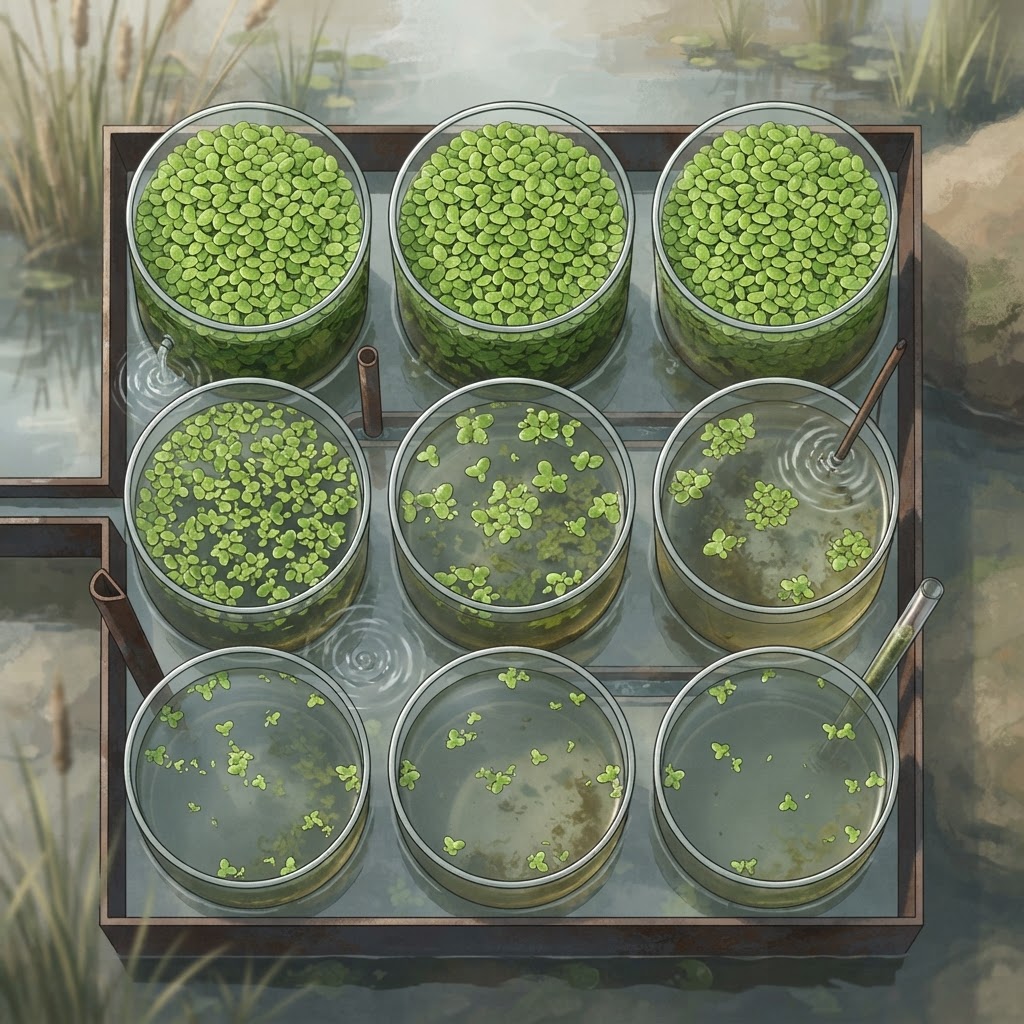
The Lemna growth inhibition test is the standard way regulators ask one question of a chemical or an effluent: does it slow down a floating aquatic plant? It appears in pesticide dossiers, in REACH registrations and in some discharge permits, and the document that defines it, OECD Test Guideline 221, was written for laboratory staff. Everything that ranks for the term is either that guideline or a contract lab offering to run it.
This article explains what the test measures, how it is built, what the numbers mean, and where its answer stops. That last part matters to us. SERAPH designs duckweed cultivation for real outdoor water, and OECD 221 is the most carefully standardised indoor duckweed experiment there is. Knowing exactly what it proves is the first step to knowing what it does not.
What the Lemna growth inhibition test measures
The OECD describes the test in one sentence: exponentially growing cultures of Lemna are grown as monocultures in at least five concentrations of the test substance over seven days, and the effect on vegetative growth is compared with untreated controls. Frond number is counted, at least one other variable (total frond area, dry weight or fresh weight) is measured, and from the growth curves the laboratory calculates the concentration that causes a chosen percentage of inhibition. A simplified version, the limit test, uses a single dose of 100 mg/L to show a substance has no effect up to that level.
That is a hazard assessment tool. It tells you how toxic something is to a representative aquatic plant under defined conditions. It is not a performance test for duckweed as a treatment step, and it does not claim to be.
Why duckweed became the standard aquatic plant
The reasoning is practical and it is written down in the report of the international ring test that produced the guideline. Frond number can be determined without expensive apparatus and is non-destructive, so the same vessel can be counted several times through the run. Counting fronds also folds three effects into one number: whether existing fronds survive, how fast new ones appear, and how much budding occurs. The same report explains the seven-day duration. Lemna grows fast enough that a week shows a clear response, and a short static test avoids the nutrient depletion that creeps into longer ones.
Anyone who has watched a culture tray understands why a week is enough. Under good conditions the population doubles every couple of days, which is the same property that makes the plant interesting as a crop. We have written separately about duckweed growth rate and why lab doubling times are an upper bound rather than a forecast.
The two species, and why there are two
OECD 221 accepts two species, Lemna gibba and Lemna minor, both extensively studied. The guideline is candid about its own limits. Lemna taxonomy is complicated by a wide range of phenotypes, there are not enough data on clone-to-clone variability to recommend one clone, and the test is not conducted axenically, so laboratories take steps to keep contamination by other organisms low rather than eliminating it.
Lemna minor
The ring-test steering group noted that L. minor suits cold-water environments. The US EPA guideline that mirrors OECD 221 adds that L. minor has been used more frequently for testing environmental samples and in Europe. If you meet the test in a European wastewater context, this is almost certainly the plant. Our profile of Lemna minor covers the species outside the test vessel.
Lemna gibba
L. gibba, specifically the G3 clone, has been the workhorse of pesticide testing in the United States and is positioned as the warm-water species. The two are easy to confuse by eye, which is one reason the guideline insists the source, species and clone be reported, and one reason duckweed species identification is a field problem before it is a lab one.
How the test is set up
The guideline reads as a protocol. Here is the logic behind it.
Starting material and acclimation
Plants may come from a culture collection, another laboratory or the field. Field-collected material must be kept in the test medium for at least eight weeks before use, and material from another laboratory for at least three weeks. The point is to start from a population already growing exponentially in the medium, so that any slowdown can be attributed to the substance rather than to the move.
Media and pH
The two species get different media. The guideline recommends a modified Swedish Standard (SIS) medium for L. minor and 20X AAP medium for L. gibba, and accepts Steinberg medium if the validity criteria are met. Buffers (MOPS for L. minor, sodium bicarbonate for L. gibba) are considered carefully because a buffer can react with the test substance and change its apparent toxicity. The ring-test criteria for a medium were that it supports exponential growth for seven days without renewal, holds pH between 5 and 9, and does not drift more than about 1.5 pH units across the week.
Concentrations and replicates
Each test vessel starts with colonies of two to four fronds, nine to twelve fronds in total, with the same number of fronds and colonies in every vessel. Ring-test data showed that three replicates per treatment are enough to detect a difference of roughly 4 to 7 percent inhibition when calculated by growth rate, or 10 to 15 percent when calculated by yield. The US guideline is a little more demanding, asking for 12 to 16 fronds per vessel and a minimum of four replicates. Environment Canada’s version, written for effluent testing, runs a daily mean temperature of 25 ± 2 °C and asks for at least seven concentrations in a geometric series where each step is half the previous one.
Static or semi-static
If a preliminary stability check shows that the substance concentration falls below 80 percent of the starting value over seven days, the test switches to a semi-static regime in which plants are moved to freshly prepared solutions at least twice, typically on days 3 and 5. Highly unstable or volatile substances may need flow-through. This matters for anyone reading a result for a degradable compound: the exposure the plant actually saw depends on which regime was used.
What gets counted: endpoints and the ErC50 versus EyC50 split
Frond number, the primary variable
Fronds are counted at the start, at least once every three days, and at termination on day 7. The guideline also asks the operator to record changes that a count alone would miss: frond size, chlorosis, necrosis, gibbosity (the swollen appearance that gives L. gibba its name), colonies breaking apart, loss of buoyancy, and root length. Algal growth or undissolved material in the vessel are noted too.
The second variable: frond area, dry weight or fresh weight
Frond number can miss effects that act on frond size rather than frond count, so the guideline requires one more measurement. Total frond area has the advantage of being measurable in every vessel at every count. Dry weight is destructive, so it is taken from a representative sample of the inoculum at the start and from every vessel at the end. The method is specific: rinse, blot, dry at 60 °C to constant weight, include root fragments, report to 0.1 mg. Environment Canada allows 100 °C for six hours as an alternative. If frond area is not measured, dry weight is preferred over fresh weight.
Growth rate versus yield
This is the part that confuses people reading a certificate. The same data produce two families of result. Average specific growth rate is the logarithmic increase in the measured variable per day, and the concentration that reduces it by x percent is the ErCx. Yield is the simple increase in the variable from start to finish, and the concentration that reduces it by x percent is the EyCx. The guideline asks for both, each calculated on frond number and on the second variable, which gives four ECx values for every inhibition level. A report that quotes a single “EC50 for Lemna” has chosen one of the four, and the growth-rate and yield numbers for the same substance are usually not the same.
NOEC and LOEC
Alongside the ECx values, laboratories may statistically determine the no observed effect concentration and the lowest observed effect concentration. Environment Canada expresses its endpoints as ICp values, the inhibiting concentration for a given percent effect, with 95 percent confidence limits, one for frond number and one for dry weight.
The one rule that makes or breaks a run: the validity criterion
OECD 221 has a single hard validity criterion. The doubling time of frond number in the controls must be less than 2.5 days (60 hours), which corresponds to roughly a seven-fold increase over seven days and an average specific growth rate of 0.275 per day. If the controls grow slower than that, the run is invalid regardless of what the treated vessels did, because the test cannot distinguish a toxic effect from a sick culture. Environment Canada phrases its rule as an eight-fold increase: a vessel that starts with two three-frond plants must hold at least 48 fronds on day 7.
The ring test also fixed two reference toxicants, potassium dichromate and 3,5-dichlorophenol, so that laboratories can prove their culture responds normally before they trust it with an unknown.
We like this criterion because it is the test’s own version of a line we use often: AI proposes, the bench validates. Nothing in the protocol is accepted on assumption. The controls have to earn the result.
What OECD 221 cannot tell you about an outdoor pond
Now the part the guideline does not write, because it is not the guideline’s job.
Every design choice above points the same way. Constant temperature. Defined medium. A monoculture of one species, one clone where possible, acclimated for weeks. Contamination suppressed. Seven days. Light and pH held steady. These choices are what make the test repeatable across laboratories, and they are precisely the conditions an open pond on real effluent never has.
So a Lemna growth inhibition result answers a narrow question well: under standard conditions, at what concentration does this substance slow Lemna down? It does not say how a mixed duckweed cover will behave on a lagoon at 14 °C in November, whether a population will recover after a pulse, how competing species or grazers change the outcome, or what removal an operator will see. Those are field questions, and nearly all of the published duckweed literature, the test included, is indoor.
That gap is the reason SERAPH exists. The company states its own position as TRL 3, proof of concept, with outdoor field validation still ahead, and it designs its cultivation system for real weather and water rather than for the vessel. One more point from the same source applies here. Biomass grown on wastewater, manure or contaminated water is remediation biomass. It is never food or feed, and the plants from a toxicity test are not either. The separation is absolute, and it holds from the first sensor reading. Our overview of duckweed for wastewater treatment explains how that firewall is engineered rather than declared.
Counting fronds by eye, and what comes after
There is a quiet irony in the protocol. The guideline prefers frond number and frond area because they are non-destructive and can be measured repeatedly, yet in most laboratories they are still gathered by a person with a hand lens, counting every visible bud. Dry weight, the destructive alternative, is used because imaging has historically been harder than weighing.
Non-destructive canopy measurement is the problem SERAPH Vision works on. From a single capture, the system reconstructs the canopy in 3D with 170,000 surface points drawn from 5.9 million captured, computes canopy volume, and already tells duckweed species apart in frame on a real tray. Reading growth and stress from the image is still in development, and we say so. The system is not an OECD 221 instrument and we make no claim about regulatory use. The point is narrower: the measurement the test wishes it had, continuous and non-destructive, is now a research question with working prototypes, and the literature that defines what to measure, including the 256 indexed duckweed papers in our knowledge base, is where that work starts.
For readers who arrived here from a permit or a dossier, two sibling pieces go deeper: the OECD Lemna test from the regulator’s side, and a closer look at Lemna toxicity testing endpoints and what each one is sensitive to.
FAQ
How long does the Lemna growth inhibition test take?
Exposure lasts seven days, with frond counts at the start, at least every three days and at termination. Before that, cultures need three weeks of acclimation in the test medium if they come from another laboratory and eight weeks if they were collected in the field, so a run realistically spans a month or more from culture to report.
What is the difference between ErC50 and EyC50?
ErC50 is the concentration that halves the average specific growth rate, the logarithmic increase per day. EyC50 is the concentration that halves yield, the plain increase in the measured variable over seven days. OECD 221 asks for both, each on frond number and on one other variable, so a complete report carries four EC50 values.
Which duckweed species is used in OECD 221?
Either Lemna gibba or Lemna minor. The G3 clone of L. gibba dominates pesticide testing in the United States, while L. minor is the usual choice for environmental samples and for European laboratories. The guideline requires the species, clone and source to be reported because it does not prescribe one.
What is the limit test in OECD 221?
A single-concentration test at 100 mg/L. If growth at that dose is not significantly inhibited relative to the controls, the laboratory can report that the EC50 lies above 100 mg/L without running a full concentration series.
Can the Lemna test be run on wastewater rather than a pure chemical?
Yes. Environment Canada publishes a Lemna minor growth inhibition method written explicitly for chemicals, wastewater and receiving water, in which the effluent itself is diluted in a geometric series and tested against a 100 percent medium control.