How a Duckweed Pond Is Used in Water Treatment: 5 Steps
How a duckweed pond is used in water treatment, step by step: pretreatment, the mat, three oxygen zones, uptake, harvest and what leaves in the effluent.
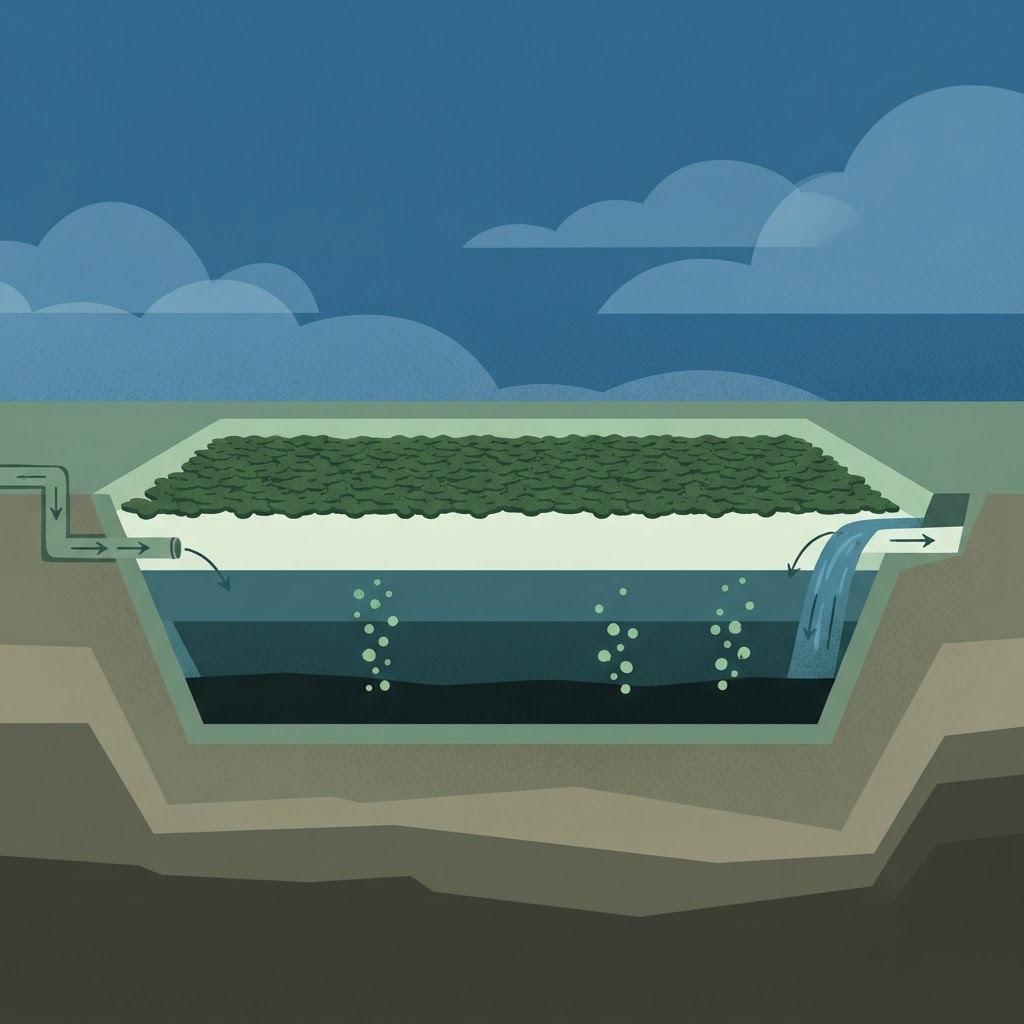
Ask how a duckweed pond is used in water treatment and most answers describe the plant. This one follows the water instead. A volume of effluent enters at one end, spends days under a green mat, and leaves at the other end with less nitrogen, less phosphorus and fewer solids. Five things happen to it in between, in a fixed order, and the order is the part the design guidelines bury in their appendices.
One caution before the first step. The question usually arrives from someone looking at a garden pond. A treatment pond is a different object: engineered depth, a controlled inflow and outflow, a retention time measured in days, and a harvest schedule. In the Queensland government’s review of duckweed-based treatment, these systems sit in the same family as conventional lagoons, with one inversion: a lagoon encourages planktonic algae, a duckweed pond is run so that they cannot grow. Everything below follows from that inversion.
A treatment pond is not a garden pond with duckweed on it
The garden version is passive. Fronds drift in, cover part of the surface, shade the water, and get eaten or skimmed. Nothing is measured and nothing is scheduled.
The treatment version is a unit process inside a train. Water arrives from a pretreatment stage, moves through the pond at a set rate, and the plant cover is deliberately kept complete and deliberately thinned on a schedule. The guide to the full treatment train and pond geometry covers the arrangement of the ponds. This article covers what the water goes through inside one of them.
Step 1: pretreatment, because the plant eats minerals, not sewage
Duckweed does not consume sewage. It takes up ammonium and orthophosphate, the mineral forms of nitrogen and phosphorus. Raw wastewater carries most of its nutrients bound in organic matter, so something has to break them loose first.
The SuSanA duckweed guide calls adequate primary treatment indispensable before a duckweed stage. Its recommended option is anaerobic pretreatment in a clay-lined earthen sedimentation pond or a closed settlement tank. The point is not only to drop solids. Anaerobic conditions promote the release of organically bound ammonium and orthophosphate, the forms duckweed prefers, and the same guide notes that the availability of those two ions was suggested as the limiting step for fast growth.
That pretreatment pond fills with sludge over time, and the sludge is a disposal question of its own. The gasification side of the group has written up what happens to sewage sludge after treatment, which is where that question goes.
So the first thing that happens to the water is that bacteria, not plants, convert its nitrogen into a form a plant can use. Skip this and the duckweed pond receives a feed it cannot take.
Step 2: the mat closes the surface and changes the whole pond
The water now flows under a continuous layer of fronds. That cover is the single design feature that makes a duckweed pond behave differently from an open lagoon, and it acts in two ways.
Shade: algae lose
A full mat cuts light at the surface, and planktonic algae, including blue-green cyanobacteria, cannot grow without it. The Queensland review draws the consequence that matters for treatment: nutrients locked in phytoplankton are hard to harvest and are generally released back into the water when the cells die, whereas duckweed is easily lifted out, which removes the nutrients from the stream outright. The same shading suppresses the large day-to-night pH swings of an algal lagoon and reduces evaporation from the surface.
Three zones under the mat
The mat also stops oxygen diffusing in from the air. The DWWT design guidelines describe the result as three vertical zones. The top roughly 10 centimetres stays aerobic, fed by oxygen that the duckweed roots transfer down from the atmosphere, and this is where aerobic bacteria oxidise organic matter and nitrification happens. Below that the mid-water goes anoxic, which is where denitrification runs. The bottom turns anaerobic, and bacteria there break down settled organic matter, releasing carbon dioxide, hydrogen sulphide and methane.
Those three zones are the reason a duckweed pond can do nitrification and denitrification in the same basin without aeration. They exist only while the mat is intact, which is why harvest, in Step 5, is never allowed to open the surface.
Step 3: bacteria do the first job, the plant does the second
By now the water carries mineral nitrogen and phosphorus, an intact cover above it and three oxygen regimes stacked below. The treatment itself is a division of labour. Microbes living on the roots, in the water column and in the sediment do the chemistry. The plant takes up the mineral products and stores them in tissue.
Where each pollutant goes
The DWWT guidelines list the pathways per pollutant, and the list is worth reading slowly because the plant is only one line in each. Suspended solids drop out by sedimentation, by biodegradation of organic matter, by minor absorption on the roots, and by the absence of algae that would otherwise add new solids. Nitrogen leaves by duckweed uptake of ammonium, by sedimentation of organic nitrogen, by ammonia volatilisation, and by nitrification followed by denitrification. Phosphorus leaves by plant uptake, by adsorption onto clay and organic matter, by chemical precipitation, and by sludge removal.
How fast the plant line runs has been measured. In a pilot study that built an integrated kinetic model for a duckweed-based system, Lemna gibba ponds operated at 30 to 36 degrees Celsius took up nitrogen at 0.62 grams per square metre per day at the optimum operating point. That figure is tropical and pilot-scale, and it says nothing about a temperate winter.
The question of how much of the removal is actually the plant, as opposed to the bacteria and the sediment, decides whether a project should expect its result to show up in the harvest or in the sludge. Phosphorus is the awkward case, because the plant saturates and the sediment does not, and a separate piece on duckweed and phosphorus takes that up.
Step 4: retention time sets what the water has time to lose
Every pathway in Step 3 has a rate, so the number that decides which pollutants the water actually sheds is how many days it stays in the pond.
The DWWT guidelines give 10 to 20 days of hydraulic retention as the range needed to bring BOD down to 30 or 20 milligrams per litre, depending on the influent strength. The SuSanA guide, writing for plug-flow systems, asks for at least 20 days at an optimum depth of 0.4 to 1 metre and a length to width ratio of 1:10 or more, the narrow shape being chosen so that operators can work the pond from its edge.
The kinetic study found its optimum at 10 days, with an organic loading of 50 kilograms of COD per hectare per day and a stocking density of 0.5 kilograms of duckweed per square metre. At that point it reported removals of 84 percent COD, 88 percent BOD5, 68 percent ammonia nitrogen, 58 percent total nitrogen and 87 percent suspended solids. Note the gap between ammonia and total nitrogen: the plant and the nitrifiers handle ammonium well, and organic nitrogen that has not yet been mineralised passes through.
A longer-running comparison makes the same point about time. In a twelve-month pilot at Birzeit University, four duckweed ponds ran in series at 7 days each and 0.9 metres depth, started at 600 grams fresh weight per square metre. Effluent from the third pond, after 21 days, met the WHO criteria for unrestricted irrigation in summer. In winter it took the fourth pond, 28 days, to get there.
Retention time also governs what a pond can do with contaminants it was never designed for. A baffled duckweed pond treating agricultural drainage water lifted removal of acetaminophen from 69 to 87 percent, amoxicillin from 53 to 83 percent and ampicillin from 55 to 91 percent when retention rose from 6 to 8 days, then gained little more at 12. Diclofenac did not follow, staying between 28 and 57 percent across the three settings. One study on one water, but it shows that the retention curve is not the same for every molecule. The wider evidence on duckweed and antibiotics is thin enough to deserve its own article.
Step 5: harvest is the removal step
This is the step the guidelines treat as maintenance and the step that actually completes the treatment. Up to this point, the nitrogen and phosphorus the plant has taken up are still in the pond. They have moved from the water into the fronds, and a frond that dies sinks and gives them back. Nothing has left the site.
Harvest is what changes that. Lifting biomass out of the pond is the only moment in the whole sequence when nutrients physically cross the boundary, which is why the Queensland review contrasts duckweed, easily harvested, with phytoplankton, which releases its nutrients back on death.
The SuSanA guide puts a number on the stake. Nutrient removal by the plant is reported to vary around 50 plus or minus 20 percent, so the share of total nitrogen and phosphorus input that is recovered in the harvested biomass sits in that same band. The rest of the removal happened by the bacterial and sediment pathways in Step 3, which is the practical reason the two halves of the job cannot be separated.
The same guide is blunt about what harvest costs in labour. Operating a duckweed treatment system requires a high input of skilled work, with almost daily attention needed to keep growth conditions and treatment efficiency where they should be. Biomass has to come out at regular intervals, and the amount taken each time has to leave a more or less dense cover behind, because an opened surface invites algae, odour and mosquito breeding.
Harvest rate is also a moving target. The Queensland review observes that duckweed grows faster at higher nutrient concentrations, up to a tolerance limit, but that as the pond reduces those concentrations, high growth can no longer be maintained. A pond doing its job well therefore grows less plant per day at the outlet end than at the inlet end, and the harvest schedule has to follow the water rather than the calendar.
What comes out the far end
The water that leaves has lost solids, organic matter and a large share of its mineral nutrients. What it has not reliably lost is pathogens.
The Birzeit comparison found that duckweed ponds beat open algae ponds on BOD and suspended solids but that the algae ponds reduced faecal coliforms further. The DWWT guidelines explain why: under a mat there is less light, no antibacterial substances from algae, less oxygen and none of the very alkaline conditions that kill bacteria in an open lagoon. Long retention can make up some of the gap, and the Birzeit effluent did reach the WHO irrigation criteria, but a duckweed pond should be planned as a nutrient and solids step with disinfection treated as a separate question.
Whether the influent suits the plant at all is decided before any of this. The piece on the four lab numbers that decide whether your water suits duckweed covers ammonia, pH, conductivity and temperature, the four readings that can kill the mat before Step 2 ever happens.
The biomass from a treatment pond never becomes feed
Several of the sources above, SuSanA among them, present duckweed treatment as a way to grow aquaculture feed. That framing has to be rejected explicitly for biomass grown on wastewater, manure or drainage water.
SERAPH’s published accuracy guide states the policy: remediation biomass is never sold or blended as food or feed, and the production stream and the remediation stream are separated from the first sensor reading. A treatment pond harvest is a waste stream to be characterised and disposed of under the rules that apply to it. It is not a by-product.
Where SERAPH is on this
Everything in this article is a reading of the published literature, not a report from a SERAPH pond. The company states its own maturity as TRL 3, proof of concept, with outdoor field validation still ahead, and it does not publish performance figures. Its working rule is that AI proposes and the bench validates.
What SERAPH does hold is the map of what has been measured. Its knowledge base indexes 256 duckweed papers across 31 research areas in 5 domains, each area weighted by how much evidence it carries. The five steps above are the areas where the evidence is deep. The steps that stay uncertain, winter performance and the transfer of indoor results to real outdoor water, are the ones the system is being built to test.
FAQ
Does duckweed clean a pond on its own, without harvesting?
Not in treatment terms. The plant moves nutrients out of the water and into its own tissue, and they stay there only while the frond is alive. Dead fronds sink and return what they held. A pond cleans itself only when the biomass is physically removed, which is why a treatment pond has a harvest schedule and a garden pond does not. The separate question of whether duckweed cleans ponds in the backyard sense has a different answer.
How deep is a duckweed treatment pond?
Shallow by lagoon standards. The SuSanA guide reports optimum depths between 0.4 and 1 metre, and the Birzeit pilot ran at 0.9 metres. The plant works at the surface and the aerobic layer under the mat is only about 10 centimetres deep, so extra depth adds anaerobic volume rather than treatment.
Does a duckweed pond remove pathogens?
Less reliably than an open algae pond. The mat removes the light, oxygen and high pH that kill bacteria in a conventional lagoon. In the Birzeit trial the algae ponds cut faecal coliforms further, although the duckweed train still reached WHO unrestricted irrigation criteria after 21 days in summer and 28 in winter. Plan disinfection as a separate step.
Can a duckweed pond remove pharmaceuticals or antibiotics?
One baffled pond study on agricultural drainage water removed 83 to 91 percent of acetaminophen, amoxicillin and ampicillin at an 8 day retention time, while diclofenac stayed below 60 percent at every setting. That is a single study on a single water and not a general claim.
Why does the duckweed mat have to cover the whole surface?
Because open water undoes Step 2. Light reaching the water lets algae grow and raises the pH swing, oxygen diffusing in collapses the anoxic zone where denitrification runs, evaporation rises, and still open patches give mosquitoes a place to breed. The harvest rule in the SuSanA guide, to leave a dense cover after every cut, exists to protect the mechanism rather than the plant.