Fastest Growing Duckweed Species: Lab Rank vs the Pond
The fastest growing duckweed species is a Wolffia clone that doubles in 29.3 hours. Why that lab ranking fails to predict growth in your own water.
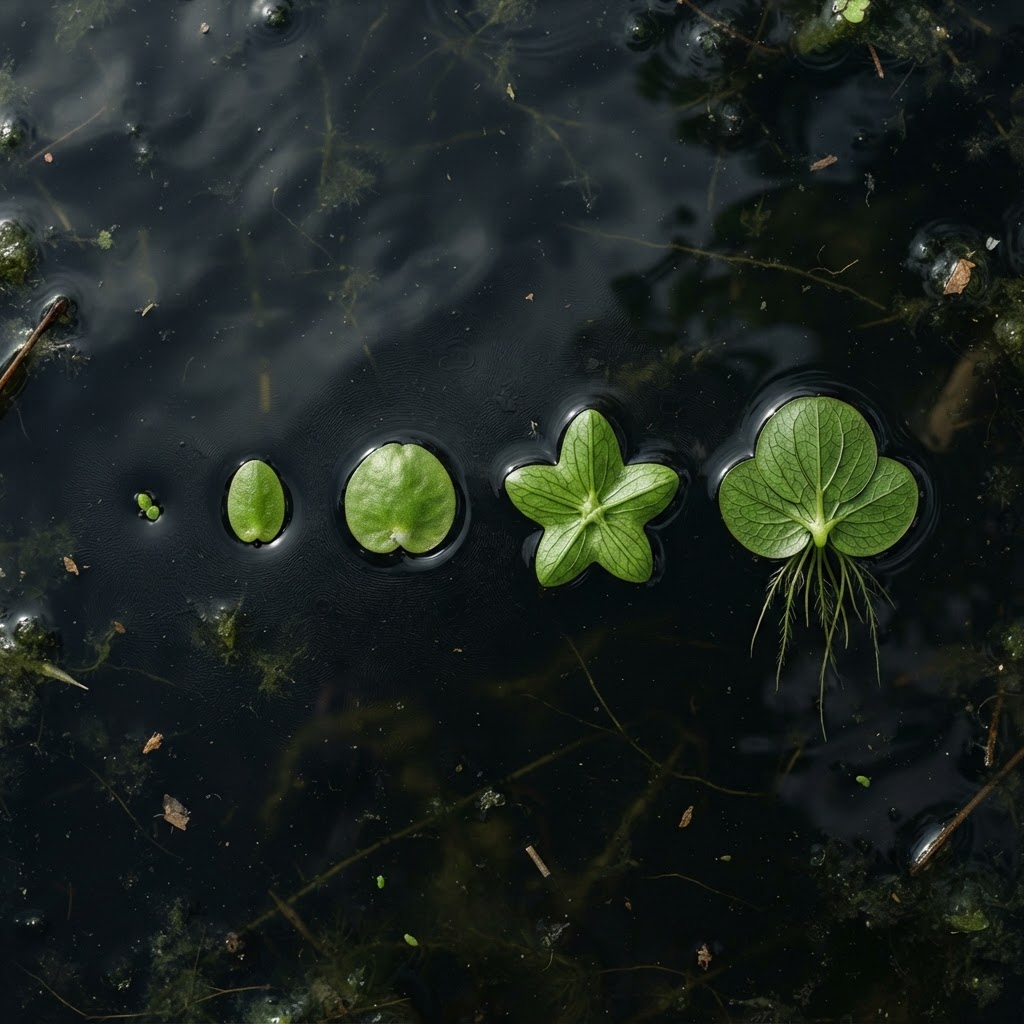
The fastest growing duckweed species has a name, a clone number and a stopwatch time. A clone of Wolffia microscopica doubled in 29.3 hours under standardised laboratory conditions, which made it the fastest growing flowering plant known. That is the headline, and it is correct.
It is also the least useful thing in the paper that produced it. The same screen of 25 clones across all 11 Wolffia species found that differences between clones of one species were much larger than differences between species, and that this record clone’s growth rate depended strongly on which nutrient medium it sat in. Anyone choosing a species for a pond, a tray or a treatment step needs the second finding more than the first.
So this article does both. It gives the ranking as the comparative studies actually report it, then shows why every one of those studies ends up saying the same uncomfortable thing: species is not the variable that decides how fast your duckweed will grow.
The short answer, with its conditions attached
Four large screens have compared duckweed growth under controlled conditions, and their ranges overlap more than their rankings agree.
The reference comparison spans the whole family. Across 39 clones from 13 species in all five genera, relative growth rates ran from 0.153 to 0.519 per day and doubling times from 1.34 to 4.54 days, with relative weekly yields from 2.9 to 37.8. The authors’ own conclusion was that growth rate does not vary primarily at the level of genus or species. It reflects the adaptation of individual clones to their own local conditions.
Read against that, the Wolffia record is a fast clone, not a fast genus. Both findings are true. Only one of them helps you choose.
What the four big comparisons actually found
Across all five genera
The 39-clone study is the one everything else cites, and it set the pattern: wide range, species a weak predictor. A later summary of its means put Spirodela clones at around 0.304 per day and Lemna clones at around 0.396 per day, which looks like a ranking until you notice that the within-genus spread is wider than the gap between the two.
Inside the genus Wolffia
The Wolffia screen is where the record comes from, and it is more careful than its headline. Large differences showed up between clones of a single species, Wolffia globosa among them. Photosynthesis rate, measured as oxygen production in light, correlated positively with growth rate across clones, which points to the mechanism behind a fast clone rather than to a property of the genus.
Forty clones from Iran
A 2022 screen of 40 native Iranian clones in the genera Lemna and Spirodela reported dry-weight growth rates from 0.149 to more than 0.600 per day and doubling times from 1.12 to 9 days. By frond doubling, Lemna gibba was the fastest species, with a mean of 2.26 days, significantly below the others. The single fastest clones were L. gibba 6LA at 2.14 days, S. polyrhiza 4AM at 2.33 days and L. minor 11C at 2.96 days. Yet the highest fresh-weight growth rate in the whole set, 0.472 per day, belonged to a Spirodela clone, the genus that ranked slowest by other measures.
Four species under changing conditions
The most recent comparison, published in September 2026, grew four native Korean species, Spirodela polyrhiza, Landoltia punctata, Lemna minor and Wolffia globosa, alongside Wolffia australiana as a reference, and then varied photoperiod, temperature and light source. Under standard conditions, Wolffia species generally doubled faster than the Lemna tribe, and W. australiana was the fastest of the five. Lemna minor, despite much larger fronds, doubled at a rate comparable to the two Wolffia species, which is why it reached the highest surface coverage.
Then the conditions changed, and so did the story. Lemna minor held relatively stable growth across every regime, including fluctuating low temperature. Landoltia punctata turned out to be sensitive to light stress, with anthocyanin and transparency appearing in new fronds under continuous illumination and LED sources. Wolffia globosa shifted toward turion formation under fluctuating cold. The fastest species under standard conditions was not the most robust one under changing ones.
Why the ranking keeps changing
Clone beats species
Every one of the four studies, run on different continents with different isolates, arrived at this. The 39-clone study says growth rate reflects clone adaptation rather than species. The Wolffia screen says intraspecific differences are much higher than interspecific ones. The Iranian study found clones of a slow genus outgrowing clones of a fast one. The Korean study found rankings that reorder with the light source.
The practical reading is that “fastest growing duckweed species” is the wrong unit. The question that has an answer is “fastest growing clone in this water under these conditions”, and nobody can look that up.
Medium and light move the rate
The record Wolffia clone’s growth rate depended strongly on its nutrient medium, more so than the other species in its screen. Light does the same to the ranking. In a head to head of Lemna minor and Spirodela polyrhiza across three light intensities, both species grew fastest at the middle intensity of 236 micromoles of photons per square metre per second. Spirodela grew slower than Lemna minor throughout, and slowed further at the highest intensity, while Lemna minor held its rate. Spirodela answered poor light by enlarging its fronds. The authors describe it as a trade-off between size and number: the plant that multiplies fastest is not the plant that captures most light.
Frond count, fresh weight and dry weight are different races
A doubling time is a doubling of something, and the choice of something changes the winner. In the Iranian set, the mean fresh-weight growth rate across all 40 clones was 0.301 per day while the mean dry-weight rate for the same clones was 0.435 per day. In the Korean study, Landoltia under one light regime gained fresh weight while its doubling time lengthened, so biomass accumulation and clonal propagation partly uncoupled. A species can win on frond count and lose on dry matter in the same tray, in the same week.
This is also why the published figures disagree so much. They are not contradicting each other. They are measuring different things, and a comparison that does not name its metric is not a comparison. The sibling article on duckweed growth rate walks through the six questions to ask of any single figure.
What happens to the fastest species outdoors
All four comparisons are indoor. That is not a weakness of the work. It is the only way to compare clones against each other at all. It does mean the ranking answers “how fast can this clone grow when nothing is in its way”, which is a different question from “how fast will it grow here”.
The closest thing to a direct outdoor test is a two-year run of open-air microcosms in the Netherlands. The rates measured there without density dependence, 0.29 per day by frond number, 0.43 by fresh weight and 0.39 by dry weight, sit inside the laboratory range rather than below it. The variable that best explained them was not species. It was water temperature. And in the first winter, roughly four weeks of ice cover collapsed the populations entirely, while the same populations held through the following ice-free winter.
The Korean study adds the species-level twist. Under fluctuating cold, Wolffia globosa diverted toward turion-based survival while Lemna minor kept growing. A species that tops the summer ranking can be the one that disappears from the surface first when the water cools, which is a selection criterion no indoor doubling time contains. What turions do to a season is its own subject.
One more trap. The literature contains pilot-scale yield reports per species, and they are easy to misread as a field ranking. The Iranian paper collects them: about 8 tonnes of dry weight per hectare per year reported for Wolffia arrhiza, 36 for Spirodela polyrhiza and up to 104 for Lemna minor. Those come from different sites, different water, different years and different systems. They say that the authors’ Lemna minor system outperformed the authors’ Wolffia system, each in its own place. They do not say Lemna minor outgrows Wolffia.
How to choose a species for your water
Given all of that, a species decision is a shortlist, not an answer. A procedure that respects the evidence looks like this.
- Start from the output, not the speed. Rootless Wolffia simplifies whole-plant biomass handling. Large-fronded Spirodela captures light under shade. Lemna minor was the most stable performer across changing conditions in the only study that changed them. Those are reasons to shortlist a genus. Doubling time is not.
- Screen clones, not species. Several isolates of each shortlisted species, grown in your own water at your own light, will spread more widely than the species ranking predicts. The Iranian study found a Spirodela clone beating every Lemna clone on fresh weight. Expect that.
- Fix the metric before you measure. Frond count, fresh weight, dry weight and surface coverage rank clones differently. Pick the one that matches the thing you are selling, and do not switch halfway.
- Test the bad week, not the good one. A cold snap, a light spike, a medium change. The species that keeps growing through that is worth more than the one that wins a standard-condition race.
This is the part of the problem SERAPH works on. Our scope covers about 37 duckweed species across the five genera, and the clone screening the literature keeps calling for only works if growth is measured continuously rather than sampled occasionally. Our vision system already distinguishes duckweed species in a live tray frame and reconstructs the canopy in 3D from a single capture, with growth and stress reading still in development. We are at TRL 3, proof of concept, with outdoor field validation ahead of us. We do not have a field ranking of species to offer, and we are suspicious of anyone who says they do.
If you want the botany behind the names, duckweed species identification covers how the genera are told apart by eye and by camera, Lemna minor covers the most studied species on its own, and the largest duckweed species is the opposite end of the same family.
FAQ
Is Wolffia the fastest growing duckweed?
A clone of Wolffia microscopica holds the record at a 29.3 hour doubling time, and in the 2026 five-species comparison Wolffia species generally doubled faster than the Lemna tribe. But the same Wolffia screen found larger differences between clones of one species than between species, and the record clone’s rate depended strongly on its medium. Wolffia as a genus is fast. A specific Wolffia clone in your water may not be.
Is Lemna minor or Spirodela polyrhiza faster?
Head to head across three light intensities, Spirodela polyrhiza grew slower than Lemna minor and slowed further in high light, while Lemna minor held its rate. Spirodela compensates with larger fronds, so under shade it can gain the advantage on light capture rather than on multiplication.
What is the doubling time of Lemna gibba?
Among 40 Iranian clones, Lemna gibba had a mean frond doubling time of 2.26 days, significantly lower than the other species tested, and its fastest clone reached 2.14 days. Lemna gibba also loses its characteristic gibbous frond under unsuitable culture conditions, at which point it looks like Lemna minor.
Does the fastest species in the lab give the most biomass outdoors?
No published comparison supports that leap. In the only two-year outdoor dataset, water temperature explained growth rate better than anything else, and species respond to cold in opposite ways: Wolffia globosa shifted to turion formation under fluctuating low temperature while Lemna minor kept growing.