Duckweed Species Identification: Keys, Barcodes, Vision
How to identify duckweed species by roots, frond size and veins, where morphology fails, and what DNA barcoding and computer vision add to a field key.
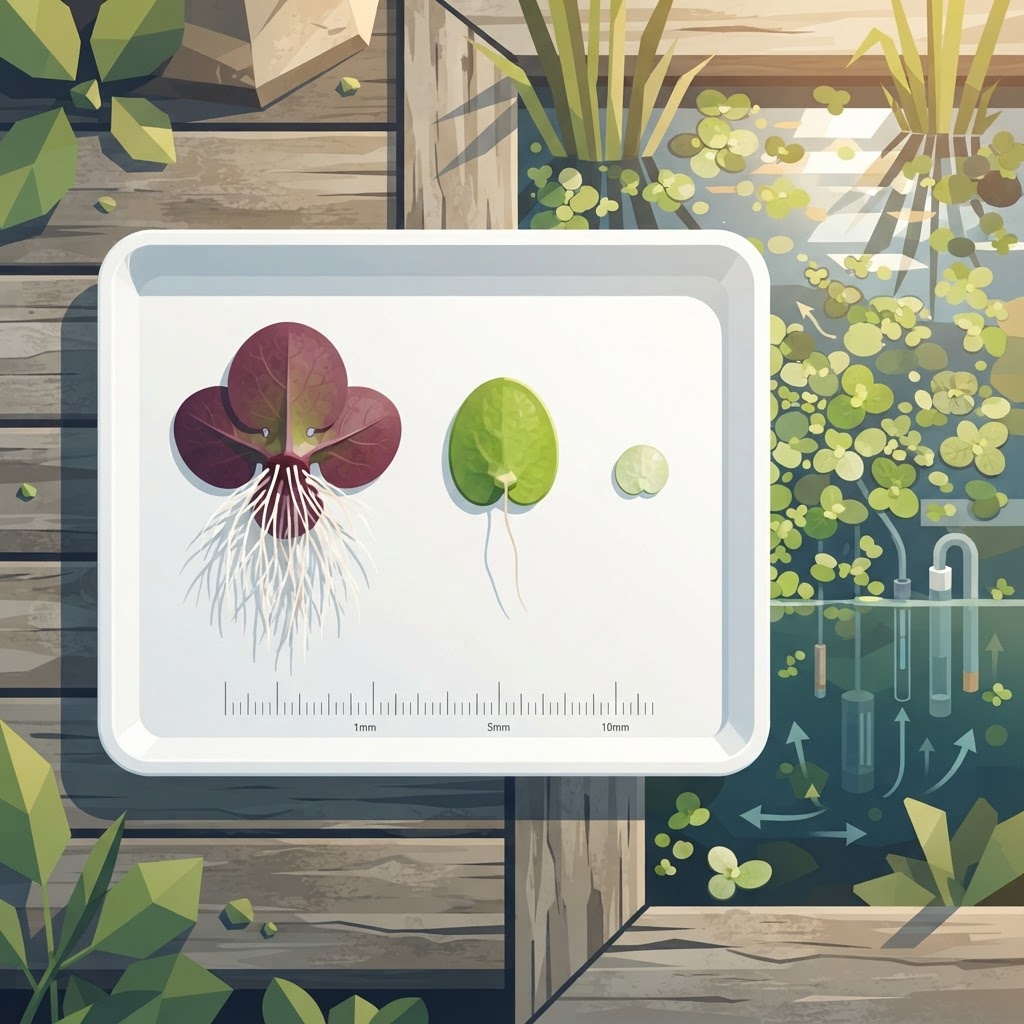
Duckweed species identification has three layers, and most guides stop at the first. The first layer is what a hand lens can see: roots, frond size, veins, colour. It gets you to genus every time and to species most of the time. The second layer is where morphology provably fails, which is inside the genus Lemna, where culture collections have been mislabelling clones for decades. The third layer is instrumented identification: plastid barcodes, nuclear markers and, more recently, cameras that read a canopy continuously.
This guide walks through all three. It matters because the species decides what you can expect from a pond or a tray. A growth rate, a protein figure or a removal efficiency quoted for “duckweed” is only as good as the identification behind it.
Why identifying duckweed species is harder than it looks
The family Lemnaceae has 36 currently accepted species, according to the updated morphological key that replaced Landolt’s 1986 monograph. SERAPH works with a scope of about 37 species across five genera: Spirodela, Landoltia, Lemna, Wolffiella and Wolffia. The one-species gap between those counts is itself a taxonomy argument, which tells you something about the family.
Three things make the job hard. The plants are tiny and reduced to a floating body with no stem or true leaf. Flowers are rare, so identification is almost entirely vegetative, and the authors of the main online key recommend a 30X dissecting microscope with backlighting for anything beyond genus. And ponds rarely hold one species: the FAO notes that floating mats commonly consist of more than one species, Lemna mixed with Wolffia being a typical pairing.
So treat identification as a procedure, not a glance.
Step one: count the roots to get the genus
Every good field guide starts in the same place. The OPAL water survey guide, written for volunteers, is explicit: group duckweeds by how many roots they have, then use size, shape and colour. Turn a frond over. The underside tells you the genus.
No roots: Wolffia and Wolffiella
If there are no roots at all, you are in Wolffia or Wolffiella. Wolffia, the watermeal, is a globose or ovoid body of 0.6 to 1.2 mm. Wolffiella is flattened and ribbon-like at 3 to 10 mm, often with the free ends curving down into the water. Texas extension staff put it bluntly: Wolffia fronds are the size of a pinhead and a high-magnification microscope is needed to tell Wolffia species apart. British botanists are still unsure whether their historical “Wolffia arrhiza” records were in fact W. columbiana.
One root: Lemna
One root per frond means Lemna, the largest and most confusing genus. Landolt’s key gives Lemna 1 root and 1 to 5, occasionally 7, nerves, with no basal scale. Fronds are typically 6 to 8 mm across according to the FAO summary, though the smallest Lemna species are under 2 mm.
Several roots: Landoltia and Spirodela
More than one root means Spirodela or Landoltia, and this is where the first common mistake happens. Spirodela polyrhiza, the giant or greater duckweed, has 7 to 12 or more roots on a frond of around 10 mm, up to 20 mm in the FAO figures, with a dark green upper surface, a red to purple underside and a basal scale called a prophyllum. Landoltia punctata, the dotted duckweed, has only 2 to 5 roots on a frond of 3 to 6 mm. Its name misleads: the dots are a surface texture, not the pigment cells that mark Spirodela. If you are counting roots and get two to five, it is Landoltia, not a young Spirodela.
Step two: frond size, shape, veins and colour to get the species
With the genus fixed, the species call rests on measurements. Here is how the common European and North American species separate, using the OPAL and Somerset numbers.
The common Lemna species side by side
| Species | Frond length | Shape and ratio | Colour and markers |
|---|---|---|---|
| Spirodela polyrhiza | 4 to 12 mm | Nearly round or tear-shaped | Dark green above, purplish red below, many roots |
| Lemna gibba | 2 to 6 mm | Domed, widest near apex, ratio 1 to 1.5 | Dull green or reddish, large bubble-like air cells below |
| Lemna minor | 2 to 7 mm | Ovate, widest near middle, ratio 1.2 to 2.0 | Bright yellow-green above, paler below, 3 or more veins, no red |
| Lemna turionifera | similar to minor | Ovate, widest in apical half, ratio 1 to 1.5 | Strong red pigment from the node, 3 veins, rootless turions |
| Lemna minuta | 1 to 2.5 mm | Flat, delicate | Pale grey-green both sides, almost translucent, one vein |
| Lemna trisulca | 5 to 10 mm | Pointed, stalked, in chains of three | Submerged, see-through, never more than one root |
| Wolffia arrhiza | 0.5 to 2 mm | Oval, fat, like tiny grapes | Bright green, never any roots |
The ratios and vein counts come from the Somerset Rare Plants Group, whose field notes give Lemna minor a length to width ratio of 1.2 to 2.0 with three or more veins, against 1 to 1.5 for both L. gibba and L. turionifera. Those two then split on air cells versus red pigment and turions.
Why backlighting matters
Veins, called nerves in duckweed because the body is not a true leaf, are invisible under ordinary top lighting. Hold the frond against the sky with a 10x hand lens, or use substage illumination on a scope. The nerve count separates one-veined Lemna minuta from three-veined Lemna minor, and in Wolffiella the position of a tract of elongated cells inside the budding pouch is the only reliable way to separate two of the species.
Where the morphological key breaks
Everything above works on the pond. It works less well in a culture collection, and the reason is the genus Lemna, section Lemna, where several species look alike and, it turns out, interbreed.
Cryptic species and hybrids in section Lemna
Lemna minor and Lemna turionifera are cryptic species: morphologically similar, genetically distinct, with overlapping ranges in which they are easily mistaken for one another. An Alberta survey had to develop species-specific DNA primers before it could say which of the two was actually present in the province.
Their hybrid is the real problem. Lemna japonica, long suspected to be a cross between the two, was confirmed in 2025 by chromosome-level genomes to be a set of L. minor by L. turionifera hybrids that form both as diploids and as reciprocal triploids. The same study found that an accession labelled L. japonica for years lacked any L. turionifera genome and was simply L. minor, and that none of the L. minor or L. japonica accessions tested formed turions while L. turionifera readily did. Turion formation, in other words, is a diagnostic trait, but only if you are willing to wait weeks under inducing conditions.
The numbers from the culture collections
An Italian group went through the Landolt collection with a nuclear marker method, Tubulin Based Polymorphism, and quantified how often morphology had got it wrong. Across five taxa in section Lemna the overall misidentification rate by morphology was 28.6 percent. Nearly half of the L. x japonica clones, 48 percent, had been filed as L. minor, L. gibba or L. turionifera. Thirty-six percent of clones labelled L. minor were in fact L. x japonica. And 55 percent of supposed L. gibba clones were hybrids of one kind or another, including a previously undescribed L. minor by L. gibba cross.
Those are the collections that supply the clones behind published growth rates and regulatory tests. The article on Lemna minor in this series takes that thread further. The short version: when a paper says L. minor, there is a material chance the flask held something else.
Molecular identification: what DNA barcoding can and cannot resolve
DNA barcoding fixed most of this, with two caveats. The foundational study tested seven plastid markers on 97 accessions representing 31 species and found the noncoding atpF-atpH spacer the best single marker, with 92.85 percent correct identifications, ahead of psbK-psbI at 84.7 percent. A later two-barcode protocol compared more than 100 strains and could identify 30 of the 37 known species with varying confidence, and in doing so confirmed two cases where species had been mis-assigned.
Caveat one: even atpF-atpH could not separate the sister pairs L. minuta from L. valdiviana or Wolffiella gladiata from W. oblonga. Caveat two is bigger. Plastids are inherited from the mother. A hybrid carrying L. minor plastids returns an L. minor barcode. That is exactly why the L. x japonica misidentifications survived the barcoding era and needed a nuclear method to surface. If your question is “which Lemna is this, and is it a hybrid”, a plastid barcode alone will not answer it.
Instrumented identification: what computer vision adds, and what it does not yet
The third layer is reading the canopy with a camera instead of a hand lens. SERAPH’s working vision system takes a single capture of a cultivation tray and reconstructs the canopy in 3D from 170,000 surface points drawn from 5.9 million captured, computes canopy volume, and already distinguishes duckweed species on a real tray frame by frame. Growth and stress reading from the same images are still in development.
Be clear about what that does and does not mean. A camera resolves what a trained eye resolves: frond size, shape, colour, root presence, the proportion of a mixed mat that is Lemna versus Wolffia. It does so continuously and without pulling fronds out of the water, which is the piece a destructive sample can never give you. It cannot see a genome. A camera will not tell L. minor from L. x japonica any more than a hand lens will, and nobody should claim otherwise. The honest position, which SERAPH states on its own site, is TRL 3, proof of concept, with outdoor field validation still ahead. The system proposes, the bench validates.
A practical identification workflow
Putting the three layers together gives a procedure that fits most situations.
- Hand lens first, roots first. Turn fronds over, count roots, fix the genus. Measure frond length against a scale and check the ratio, veins and underside colour against the table above. Expect a mixed mat and sample from several points.
- Barcode anything that will carry a number. If a clone is going to generate a growth rate, a protein figure, a removal efficiency or a regulatory test result, sequence atpF-atpH, and if it sits in Lemna section Lemna, add a nuclear marker. A 28.6 percent error rate is too high to publish on.
- Image continuously if the culture is mixed or outdoors. Species proportions in an open pond shift with season and nutrients. A canopy camera tracks that drift without harvesting, which is the measurement gap outdoor cultivation has always had.
Two companion pieces are planned: a comparison of the main duckweed species compared for cultivation, and a look at the fastest growing duckweed species and why lab doubling times do not transfer outdoors. Both depend on the identification being right.
FAQ
How many species of duckweed are there?
The 2018 updated identification key recognises 36 species. Older references, and SERAPH’s own working scope, count about 37, spread across five genera: Spirodela, Landoltia, Lemna, Wolffiella and Wolffia. The difference reflects ongoing taxonomic revision rather than discovery.
What is the difference between duckweed and watermeal?
Watermeal is the common name for Wolffia. It has no roots, is pinhead-sized at roughly 1 mm or less, and needs high magnification to separate species. Duckweeds in the narrower sense, Lemna, Landoltia and Spirodela, all carry at least one root per frond and are several millimetres across.
Can you identify duckweed species from a photo?
To genus, yes, if the photo shows the underside with roots and includes a scale. To species, usually, for the common ones with distinct size and colour. For cryptic pairs such as Lemna minor and Lemna turionifera, or any suspected hybrid, no photo or camera resolves it; a DNA marker is required.
Which DNA barcode is used for duckweed?
The plastid intergenic spacer atpF-atpH is the standard single marker, often paired with psbK-psbI. Because plastids are maternally inherited, hybrids need a nuclear marker as well, such as Tubulin Based Polymorphism or genotyping by sequencing.