Does Duckweed Clean Ponds? Only If It Leaves the Pond
Does duckweed clean ponds? It takes up nitrogen and phosphorus and shades out algae, but the pond only gets cleaner when you skim it out. Here is why.
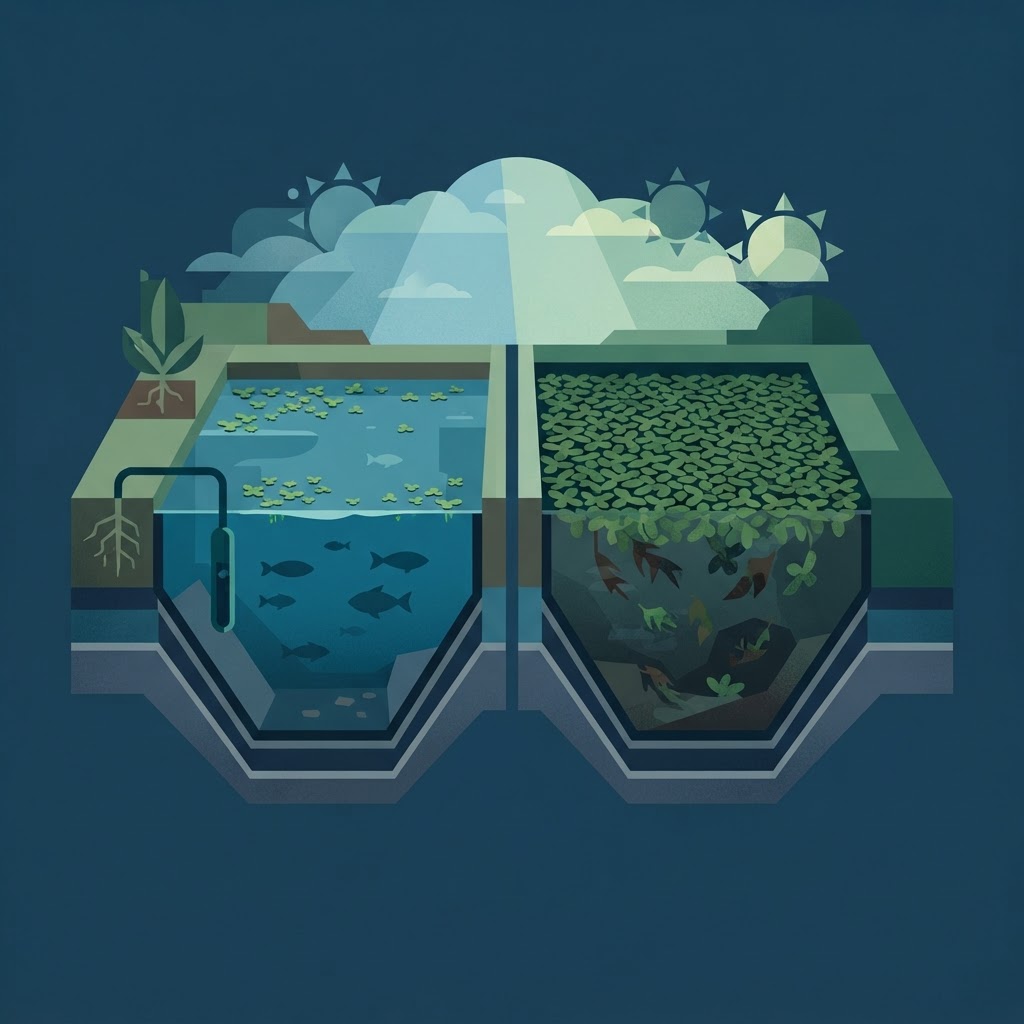
Does duckweed clean ponds? Partly, and only under one condition. The plant pulls nitrogen and phosphorus out of the water and into its own fronds, and its cover shades out the algae that turn a pond green. That is a transfer, not a removal. The nutrients leave the pond only when the duckweed does. Leave the mat in place to die and sink, and most of what it took up goes back into the water.
That one condition explains why the advice online seems to contradict itself. One county page tells residents to relax because the green cover means the pond is self-cleaning. Extension services warn that the same cover can starve the water of oxygen and kill fish. Both are describing real effects. They are describing different stages of the same mat.
The short answer: it takes nutrients in, it does not take them out
A duckweed frond is a small floating sponge for the two nutrients that drive pond problems. It grows fast because it absorbs them directly from the water, not from soil. While it lives, those nutrients are locked in tissue instead of feeding algae.
The UK charity Freshwater Habitats Trust puts the practical consequence plainly in its pond FAQ on algae and duckweed: scraping duckweed off the surface removes the plants and also removes the nutrients locked in their tissues, and by repeatedly removing floating plants you can gradually reduce nutrient concentrations in the pond. The verb that matters there is removing. The plant does the collecting. You do the cleaning.
What duckweed actually pulls out of pond water
Nitrogen and phosphorus
Duckweed takes up ammonium, nitrate and phosphate. These are the same nutrients that arrive from lawn fertiliser, livestock, leaves and fish food, and they are the reason a pond grows anything green in excess. The mat does not work alone. Bacteria living on its roots and in the water underneath convert nitrogen, and the shade changes which microbes thrive. Phosphorus is the harder of the two to get out of a pond, and it gets its own piece in duckweed and phosphorus.
What the numbers look like in a pond, not a lab
Measured results come from controlled ponds and pilot systems, not from garden ponds, so treat them as what the plant can do under good conditions rather than what yours will do.
- In a comparison of duckweed ponds and algae ponds treating simulated storm water, the duckweed ponds removed 90 percent of ammonium nitrogen, 94 percent of nitrate nitrogen and 47 percent of orthophosphate. The algae ponds managed 77, 85 and 21 percent. The phosphate gap is the striking one.
- A pilot-scale study of three duckweed species on eutrophic water brought total nitrogen from 6.0 to below 0.5 mg per litre and total phosphorus from 0.56 to below 0.1 mg per litre in 16 days. The authors attribute more than 70 percent of the removal in such systems to duckweed uptake.
- A review of duckweed’s capacity to treat wastewater found that in very shallow systems the mat, with its attached bacteria and algae, was responsible for three quarters of the total nitrogen and phosphorus loss. It also stresses that the harvest schedule, not the plant alone, keeps the system working.
Notice what all three share. Shallow water, a controlled inflow, and plants that were measured and harvested. Those are the conditions a garden pond usually lacks.
Why a duckweed pond often looks clearer
The visible effect is shade. A dense layer of fronds cuts light at the surface, and planktonic algae cannot grow without it. The Aquatic Plant Management Society’s best management practice chapter on duckweed and watermeal notes that the mat’s ability to decrease light and consume nutrients can actually inhibit algal growth. The RHS says the same in gardening terms: duckweed helps reduce algae and has been found to improve water quality by absorbing pollutants.
So the water under a duckweed cover is often less green. It is not necessarily cleaner. The nutrient load has moved from one organism to another, and the pond still holds it. The Freshwater Habitats Trust describes village ponds where barley straw cleared the algae one year and the surface was a sheet of duckweed the next. Same nutrients, new tenant.
Where it stops cleaning and starts fouling
Oxygen under a full mat
A complete cover blocks the surface, and the surface is where a still pond gets its oxygen. The BMP chapter reports that dissolved oxygen below duckweed mats is often low. The storm-water study measured a daily swing of 0.9 to 3.9 mg per litre in its duckweed ponds, against an average of 5.5 in the open algae ponds. In an engineered pond that low-oxygen zone is useful, because it drives bacterial nitrogen removal. In a garden pond with fish, it is a stress.
When fronds die, the nutrients come back
Penn State Extension explains that a full cover can block sunlight, inhibit oxygen exchange and reduce dissolved oxygen when the plants die and decay. Decay is the reverse of uptake. Bacteria break the dead tissue down, consume oxygen doing it, and release the nitrogen and phosphorus back into the water and sediment. The same thing happens at scale after herbicide: Texas A&M AgriLife’s AquaPlant guide warns that decomposing dead plant material can deplete oxygen and kill fish.
This is the step the “it cleans the water, leave it” advice skips. An unharvested mat is a seasonal loan of nutrients, repaid in autumn.
The harvest is the cleaning step
If you want duckweed to clean a pond, it has to leave the pond. Three rules from the extension literature cover most of it.
- Keep cover partial. The Missouri Department of Conservation suggests that ideally 10 to 20 percent of a pond’s surface and bottom carries aquatic plants, and that above 20 percent some control is worth considering. It also notes these plants can cover a one-acre pond in two months.
- Skim often. The Freshwater Habitats Trust notes duckweed can double in area every 3 days in summer, so one clearance is never the end of it. The detail on how quickly a mat rebuilds is in duckweed growth rate, and the tools for lifting it out are in duckweed harvesting.
- Take it far away. Skimmings dumped on the bank rot and wash straight back in. Put them in a compost bin away from the pond.
If you do use herbicide, Missouri’s guidance is to treat no more than one third of the plants at a time, at 10 day to two week intervals, so the decay does not strip the water of oxygen all at once.
One firm line from us, not from the extension sheets. Some advice, including an Ask Extension reply, mentions duckweed as feed for poultry. SERAPH’s published policy is that biomass grown on wastewater, manure or contaminated water is never food or feed. A pond loaded with runoff, livestock waste or unknown inputs is exactly that kind of water. Treat what you skim as compost.
Duckweed is the signal; the nutrient source is upstream
A thick duckweed cover is a reading on the pond’s nutrient budget, not a fault in the plant. Penn State calls overabundant plant growth a symptom of excessive phosphorus and nitrogen, coming from barnyards, crop fields, septic systems, lawns and golf courses. The Freshwater Habitats Trust adds tap water top-ups, soil in the pond bottom, fish food, and bottom-feeding fish and ducks stirring up sediment.
Skimming takes nutrients out. Cutting the inflow stops them coming back. Missouri recommends a buffer strip of grass and trees 100 feet or wider around the pond’s edge to filter runoff. Without some fix at the source, harvesting becomes a permanent chore rather than a cure.
Garden pond versus treatment pond
When people read that duckweed cleans water, the evidence usually comes from treatment ponds. Those are a different object: engineered depth, a controlled flow, a full cover kept on purpose, and a harvest on a schedule. We walk through how a duckweed treatment pond is engineered separately.
One finding from that world is worth carrying back to the garden. The Queensland government review of duckweed treatment notes that once nitrogen and phosphorus run low, starved plants scavenge other elements and can absorb toxins and heavy metals if they are present. If your pond takes road or industrial runoff, the fronds may be carrying more than nutrients. That is covered in duckweed and heavy metals.
Where SERAPH sits on this
SERAPH builds a cultivation system for duckweed meant for outdoor water rather than lab trays. We are early, and we say so: our own maturity is TRL 3, proof of concept, with outdoor field validation still ahead. The gap this article keeps returning to, between what duckweed does in a controlled pond and what it does in a real one, is the gap we work on. We publish what the literature measures, not performance figures of our own.
FAQ
Is duckweed good or bad for a pond?
Both, and coverage decides which. A partial cover feeds waterfowl, shelters invertebrates, shades the water and soaks up nutrients. A complete mat blocks light to submerged plants and cuts oxygen exchange. Missouri’s guide puts the healthy range at 10 to 20 percent plant coverage.
Does duckweed kill fish?
Not directly. Fish kills come from low oxygen, which follows a full mat on still water or the decay of a large mass of dead plants, for example after a single herbicide treatment of the whole pond. Treating in thirds and aerating at night reduce the risk.
Will duckweed get rid of green water?
Often, because the mat shades out the microscopic algae that cause pea-soup water. The nutrients stay in the pond, though, now inside the duckweed. Unless you also skim it and cut the nutrient inflow, you have swapped one symptom for another.
Can I feed pond duckweed to my chickens or fish?
We advise against it. SERAPH’s policy is that biomass from wastewater, manure or contaminated water is never food or feed, and an uncontrolled pond fed by runoff or livestock waste falls into that category. Compost the skimmings away from the pond instead.