Lemna minor: The Duckweed Most Research Is Built On
Lemna minor is the default duckweed of labs and regulators. Genotyping found 36 percent of clones labelled L. minor were a hybrid. What that changes.
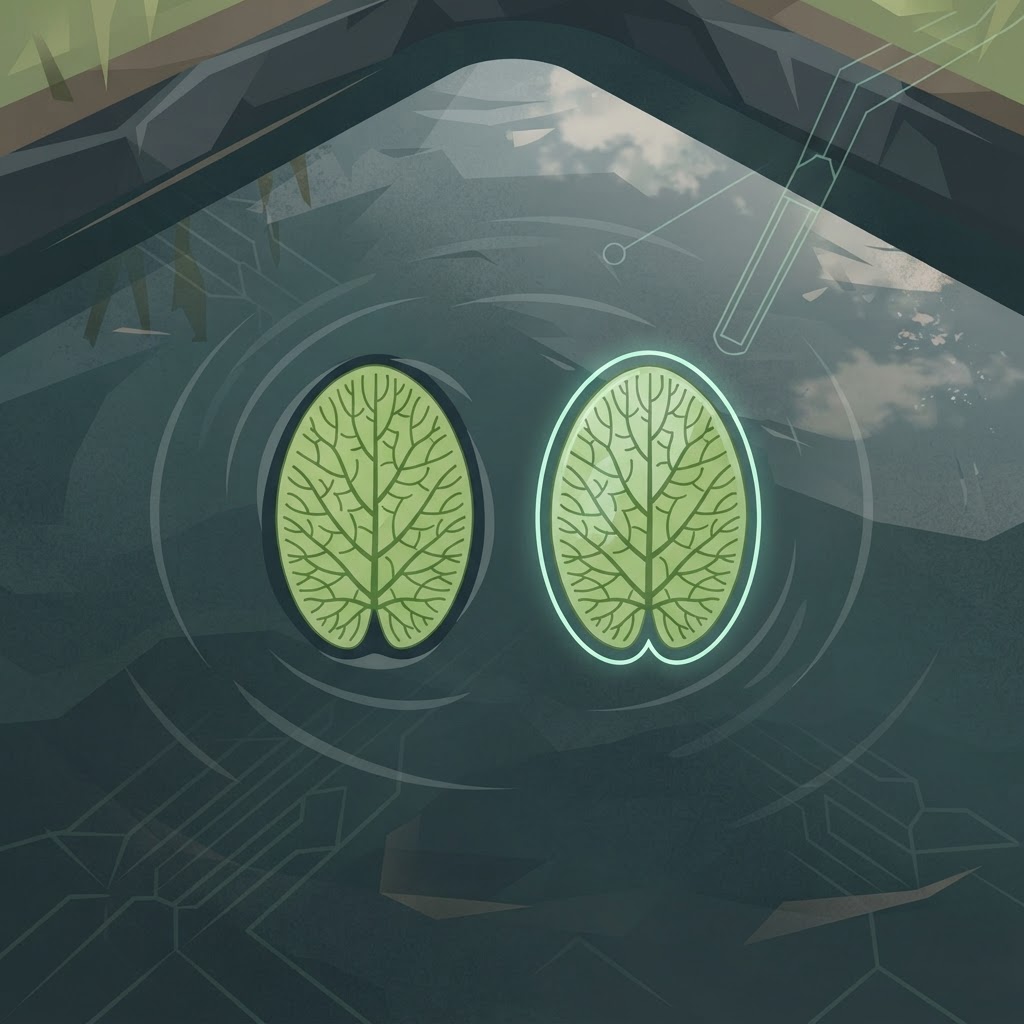
Lemna minor is the duckweed you have read about, whether or not the paper said so. It is the plant in the regulatory test method, the plant in the culture collection, and the plant behind a large share of the growth rates, removal efficiencies and protein figures quoted for duckweed generally.
It is also, according to the molecular work of the last five years, frequently not the plant that was actually in the flask. That is the part of this species worth your attention, and it is the part no identification page tells you.
What Lemna minor is
A single frond 2 to 6 mm long, roughly 1.3 to 2 times as long as it is wide, flat on both surfaces, with three veins and one unbranched root up to 15 cm long. Fronds sit in small groups of one to eight, joined by a thin white stipe. It does not form turions. It flowers rarely, and reproduces by budding daughter fronds from two lateral pouches. It is near-cosmopolitan in still and slow-moving fresh water.
That description places it inside a family of 36 currently accepted duckweed species spread across five genera: Spirodela, Landoltia, Lemna, Wolffiella and Wolffia. The genus Lemna alone holds twelve species in four sections, and L. minor sits in the section that taxonomists find hardest to resolve.
Everything above is the standard answer. Now the useful part.
Why this one species carries the literature
Duckweed did not become a research organism gradually and democratically. One or two species were written into the standard methods, and the evidence base grew where the methods pointed.
The clearest case is OECD Test No. 221, the Lemna growth inhibition test. It specifies Lemna gibba and Lemna minor, grown as monocultures across at least five concentrations of a test substance for seven days, with frond number as the primary measurement variable and at least one other variable alongside it. From those growth rates the test derives an ErCx or EyCx, the concentration producing a stated percentage inhibition.
That guideline sits inside a much older habit. Duckweeds have been used to assess contaminants since the 1930s, L. minor was proposed as a representative aquatic macrophyte in 1979, and test methods built on it were subsequently adopted by ISO, the OECD, the USEPA and ASTM. Canada went further still: its national biological test method states that L. minor is the species that must be used, not one option among several.
The consequence is worth stating plainly, because it is usually left implicit. Lemna minor dominates the literature because it is the standard, not because anyone demonstrated it was the best duckweed for treating water, producing protein or accumulating starch. It is the reference organism. A reference organism is chosen for comparability, which is a different property from performance.
A large share of published Lemna minor is not Lemna minor
Here is the finding that should change how you read all of it.
Researchers applied a genetic fingerprinting method called tubulin-based polymorphism to clones held in the Landolt Duckweed Collection, the most important historical duckweed collection in the world, and compared the genetic result with the morphological classification each clone had carried for decades. Across five species, the overall misidentification rate by morphology was 28.6 percent. Thirty-six percent of clones labelled L. minor were reclassified as Lemna x japonica. Fifty-five percent of supposed L. gibba turned out to be either L. x japonica or a previously undescribed L. minor by L. gibba hybrid.
Lemna x japonica is not an unrelated plant that got the wrong sticker. It is a natural interspecific hybrid whose parents are L. minor and Lemna turionifera, which is exactly why it looks like L. minor. Its similarity to the parent species is the cause of the misclassification, not an accident of sloppy curation.
Why morphology could not catch it
The obvious objection is that the collection was classified by eye, and molecular tools have been available for years. They have, and they did not solve this either. Plastid barcoding, the combination of markers usually treated as the gold standard for duckweed identification, cannot separate L. minor from L. japonica because the two share too little genetic distance at those loci. Duckweed identification is difficult even for specialists, and the specialists say so.
Nor is this confined to old collection material. A whole-genome survey of 23 natural Lemna populations in Switzerland found two clean species-level clusters: one of genuine L. minor, and one of the cryptic species L. japonica, which the authors concluded is more widespread than previously thought. Someone sampling a pond and identifying the catch as common duckweed has a real chance of being wrong, in the field, today.
The clone matters more than the species
Follow the thread one step further and the species name starts to look like a weak descriptor of the material.
The Canadian standard method does not just name the species. It recommends specific Landolt clones, 8434 and 7730, and it states the reason directly: different clones of the same species have been shown to have different sensitivities. The method is telling you that the binomial is not sufficient to reproduce the test.
Two published statements are then worth setting beside each other, and it is worth being precise about what they do and do not mean. The Canadian method recommends clone 8434. In the reclassification table from the tubulin-based genotyping, clone 8434, collected in Canada and held as L. minor, is listed as L. x japonica. That is not a claim that the test method is invalid. It is a demonstration of how deep the identity question runs: it reaches into the material that standard methods name explicitly.
The performance evidence points the same way. Across 39 clones spanning 13 species and all five genera under standardised conditions, relative growth rates ran from 0.153 to 0.519 per day and doubling times from 1.34 to 4.54 days. The fastest clone doubled more than three times faster than the slowest, and the variation tracked each clone’s adaptation to its own local conditions more than it tracked genus or species. Which is to say: two cultures can both be genuine L. minor and behave differently enough that quoting one to predict the other is a mistake.
What this changes if you are choosing duckweed for a system
Three practical consequences, in the order they usually bite.
A published figure inherits the identity uncertainty of the clone it was measured on. If a removal efficiency or a duckweed growth rate was measured on a collection clone whose identity was assigned morphologically, the number is real and the label carries a known error rate. That does not make the study wrong. It makes the extrapolation to your material weaker than it looks.
Choosing the species is a smaller decision than choosing the isolate. Teams spend a long time deciding between L. minor and another species and almost no time on which isolate suits the water they actually have. The evidence says the second question carries more of the variance.
Identity is part of the measurement, not a property of the label. If it matters which plant produced your result, it has to be established and recorded, with the method stated, the same way you would record temperature or nutrient concentration.
This is the part of the problem SERAPH is built around, and it is worth being exact about where our own capability stops. Our vision system reads a cultivation surface continuously and already tells duckweed species apart in a live frame, reconstructing the canopy in 3D from a single capture. What it cannot do, and what no camera can do, is separate L. minor from L. x japonica, because that difference is not visible. It defeated trained taxonomists with the plants in front of them and it defeats plastid barcoding. Resolving it takes genotyping.
We would rather say that than imply otherwise. SERAPH is at TRL 3, proof of concept, with outdoor field validation still ahead, and a measurement layer that knows its own boundaries is more useful than one that claims not to have any.
How to read a Lemna minor result
Six questions to put to the next figure attributed to this species, from a paper or a supplier.
- Which clone, and from which collection or which site.
- Was the identity confirmed molecularly, and with which marker. Plastid barcoding alone does not settle L. minor against L. x japonica.
- Indoor or outdoor, and over what period.
- What medium or what water, with its nutrient concentrations.
- Which measurement variable: frond number, frond area, fresh weight or dry weight.
- What conditions, particularly temperature and light.
A result that survives those questions is transferable. A result that does not is still a result, it just belongs to a specific plant under specific conditions, and the species name on it is doing less work than it appears to. That is the same reason duckweed cultivation is designed around a defined material rather than started with whatever grows, and the same reason a duckweed wastewater treatment design has to state what it was validated on.
FAQ
Is Lemna minor the same as common duckweed?
Common duckweed, lesser duckweed and least duckweed are all accepted common names for Lemna minor. In practice the common name is used loosely for several look-alike species in the same section of the genus, so it identifies an appearance rather than a taxon.
What is Lemna x japonica?
A natural interspecific hybrid between Lemna minor and Lemna turionifera. It resembles L. minor closely enough that it is the taxon most L. minor misidentifications turn out to be, and it is now recognised as a cryptic species with a wider distribution than was previously assumed.
Can you identify Lemna minor by eye?
Provisionally. The absence of turions, a smooth upper surface, a symmetrical apex and a flat rather than swollen frond separate it from its closest look-alikes. But morphology misassigned 28.6 percent of clones in the reference collection, so a visual identification is a working hypothesis rather than a fact.
Why is Lemna minor used in toxicity testing?
Its small size, simple structure, asexual reproduction and short generation time make it convenient for standardised laboratory work, which is why it was written into international test methods rather than selected fresh for each study.
Does duckweed species choice matter for a cultivation system?
It matters less than the choice of isolate. Growth rate varied more than threefold across clones and followed each clone’s adaptation to local conditions rather than its species, so the isolate and the conditions carry more predictive information than the binomial.