Duckweed for Wastewater Treatment: Is Your Water a Fit?
Duckweed for wastewater treatment works on some effluents and dies on others. The four lab numbers that decide it: ammonia, pH, conductivity, temperature.
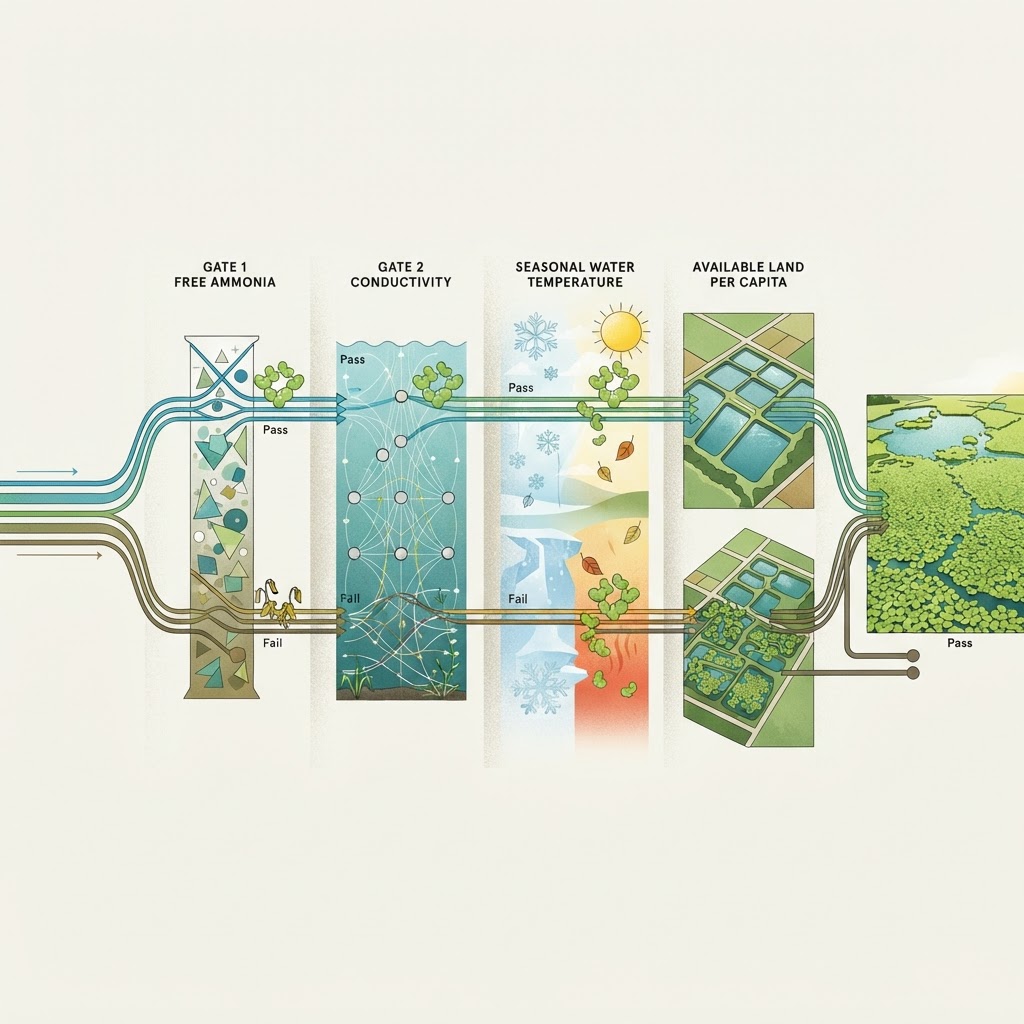
Most articles about duckweed for wastewater treatment answer the wrong question first. They explain what the plant removes. The question that comes before it is whether the plant will survive in the water you actually have, and that one is answered by four numbers you already hold on a routine lab sheet.
Duckweed (Lemnaceae) is a free floating macrophyte. It is a nutrient sink, not a treatment process. Nitrogen and phosphorus go into biomass, and you remove that biomass physically. The mat, together with the bacteria and algae attached to it, accounts for three quarters of the total nitrogen and phosphorus loss in very shallow systems, independent of loading rate. So the whole case rests on whether a mat can live on your effluent. If it cannot, nothing downstream matters.
This article is the screening test. For what a duckweed system actually removes once it is running, and for how the ponds are configured and sequenced, the siblings go deeper.
The four numbers that decide it
Total ammonia nitrogen and pH, read together
This is the one operators get wrong, and it is not a subtle error. Ammonia sits in equilibrium between the ammonium ion and un-ionised NH3, and pH decides the ratio. Duckweed prefers ammonium. Free ammonia kills it.
In controlled work on settled domestic wastewater across pH 6.8 to 8.7 and total ammonia of 10 to 300 mg N/L, the maximum tolerance was around 8 mg NH3-N/L, above which Lemna gibba died. Above 1 mg/L NH3-N, the toxic contribution of the ionised form can be disregarded entirely. Treatment becomes impossible above roughly pH 9.8.
Translate that into an operating rule and you get the familiar guidance: hold total ammonia below 50 mg/L and pH below 8, with maximum growth between 3.5 and 20 mg/L N. That rule is safe. It is also why plenty of viable water gets screened out by mistake, because at a different pH the same total ammonia is harmless.
The clearest demonstration is recent. At pH 8.2, Lemna minor grew best at 10 mg/L ammoniacal nitrogen and worse as it rose. At pH 6.5, growth was unaffected all the way to 250 mg/L. On unamended cattle digestate at pH 8.2 the plant would not grow even at 5 percent dilution; acidified to pH 6.5 it grew at 20 percent dilution, 239.3 mg/L ammoniacal N. Same nitrogen. Different answer.
Species matters too. Landoltia punctata has been reported growing at 240 mg/L NH4-N in swine wastewater, which looks like a contradiction of the 50 mg/L rule until you notice the pond was neutral to slightly acidic. The literature is not inconsistent. It is reporting total ammonia when the variable that matters is free ammonia.
Practical version: take your total ammonia nitrogen and your pH together, work out the NH3-N fraction, and compare that to 8 mg/L. Not the headline number.
Electrical conductivity
The variable most screening exercises forget. Growth peaks near 1200 microsiemens per centimetre, holds up between 600 and 1400, and is inhibited above 2000 uS/cm, which corresponds to roughly 1517 mg/L of dissolved salts. Conductivity is a one minute measurement and it eliminates most saline and brackish industrial streams before anyone spends money on a pilot.
Temperature and season
Optimum growth sits around 26 C, and sunlight and temperature drive it more strongly than nutrient concentration does. Duckweed is nonetheless the cold climate option among floating plants: the EPA design manual lists lower sensitivity to cold as its main advantage over water hyacinth, and shallow roots plus wind sensitivity as its main disadvantages. A wind exposed site is a real disqualifier, because the mat is the treatment and wind piles it into one corner.
Land and site
Land is where the arithmetic usually breaks. Budget 2 to 3 square metres per inhabitant, excluding primary treatment, on flat or gently sloping ground with slowly permeable soil. A tighter design guideline puts it at 1.5 to 1.8 square metres per capita with 15 to 18 days retention. Against a conventional plant of the same duty, Bangladesh experience puts capital at roughly one tenth and land at roughly three times. That trade is the whole commercial question. It works where land is cheap and a nitrogen or phosphorus consent is expensive, and nowhere else.
Which effluents pass, and which do not
Passes with normal pre-treatment
Anaerobically pre-treated domestic sewage and secondary effluent are the straightforward cases. Municipal ammonia typically runs 10 to 50 mg/L N at a pH near neutral, which sits inside the window on both axes. Constructed wetland effluent is the other good fit: a 2026 screen of full scale wetland plants selected those with effluent total nitrogen above 10 mg/L and noted that below pH 8 practically all ammonia is in the ionised form, with nitrogen loading above 50 kg/ha/day the point where inhibition risk starts.
Passes only after dilution or acidification
Livestock effluent, digestate and biogas slurry all carry too much ammonia raw, and all of them can be brought into range. On pig farm biogas slurry the optimum was 4 percent slurry, equal to 29.56 mg/L NH3-N, while the plants died outright at 10 percent. Acidification does the same job without the water cost, as the cattle digestate work above shows. If your problem is manure lagoons in particular, that is the stream where the pH lever earns the most.
Usually fails the screen
Abattoir effluent is the cautionary case. Unmodified, it was toxic to duckweed even at 3:1 dilution, with ammonia making up over 95 percent of total nitrogen, and only grew vigorously at 1:4 dilution once acidified to pH 7 with bentonite added. Saline industrial water fails on conductivity. And raw sewage fails for a different reason: the efficiency gains are in secondary and tertiary treatment once solids have been removed, and the mat cannot absorb a shock load on its own.
What a lab sheet cannot tell you
Here is the honest limit, and it is the reason this article is a screen rather than a decision.
Almost every threshold above came out of a small indoor vessel. The ammonia and pH work used batch reactors 6 cm deep with 64 square centimetres of surface. The conductivity work used 1.5 litre containers over ten days. Those are the right experiments for isolating one variable, and the wrong experiments for predicting a pond in November.
The most useful counterweight is a 175 day outdoor pilot in Flanders running three streams side by side. Diluted pig manure gave the highest productivity at 6.1 g dry weight per square metre per day, and then the system died in August for reasons the influent monitoring did not catch. pH, electrical conductivity and ammonium all crossed their limits in the same window, and the authors concluded that all three have to be monitored continuously and the influent diluted in response, not screened once at the start.
So use the four numbers the way they work best. A lab sheet can screen water out with confidence. It cannot screen water in. Built for the field, not the lab, is a stance about exactly this gap.
If your water passes
What you are committing to is an operating discipline, not an installation. Full mat coverage maintained continuously, with a harvesting schedule matched to a doubling time of 2 to 3.5 days and plug flow conditions. Long, narrow ponds. Recirculation to dilute the head of the train when BOD5 runs above 80 mg/L in the first lagoon.
Those choices belong to the design article rather than this one. So does the money: harvesting is the operating cost that decides whether the system stays inside its budget, and what a duckweed system costs to build and run is a separate calculation from whether it can run at all. The species question, starting with Lemna minor, and the growth rate under real conditions both change the sizing.
The line the harvested biomass does not cross
One thing to carry out of the sources rather than into them. Several of the standard references assume the harvested duckweed becomes feed, fish food or a revenue line. A remediation stream cannot inherit that assumption.
Biomass grown on wastewater, manure or contaminated water is remediation biomass. It is never sold or blended as food or feed, and the two streams are separated from the first sensor reading. The mechanism makes this sharper than a policy statement: in the polishing zone at the tail of a plug flow train, nutrient starved duckweed scavenges, and that is precisely where it can take up metals and other contaminants. The cleanest water in the system produces the biomass with the most uncertainty attached to it. Design the containment and the traceability at the same time as the ponds, or do not design them at all.
Where SERAPH is on this
SERAPH states its own maturity as TRL 3, proof of concept, with outdoor field validation still ahead. Nothing here is a performance claim and nothing here describes a deployed system.
What the company does have is the two halves of the problem this article describes. A knowledge base of 256 indexed duckweed papers mapped across 31 research areas in 5 domains, which is where thresholds like the ones above come from and where their coverage gaps are visible rather than hidden. And measurement: computer vision that reconstructs a cultivation canopy in 3D from 170,000 surface points and tells duckweed species apart on a real tray.
The point of pairing them is the Flanders problem. A screening test is a snapshot, and the failures that matter happen over a season, between samples. Continuous canopy measurement is what turns a snapshot into a trend. AI proposes, the bench validates.
FAQ
What ammonia level is too high for duckweed?
There is no single number, because pH decides it. The ceiling is around 8 mg/L of un-ionised NH3-N. The total ammonia that corresponds to is roughly 50 mg/L at pH 8 and several hundred mg/L at pH 6.5, which is why two studies can report a kill at 65 mg/L and healthy growth at 240 mg/L without contradicting each other.
Is raw sewage suitable without pre-treatment?
No. Efficiency gains sit in secondary and tertiary treatment after solids removal, and the mat gives poor pathogen removal and cannot receive a shock load on its own.
How much land does a duckweed treatment system need?
Between 1.5 and 3 square metres per person depending on which design guideline you follow, and roughly three times a conventional plant of the same duty, against capital cost of about one tenth.
Does duckweed work in cold climates?
Better than the alternatives among floating plants, which is why it is the standard substitute for water hyacinth where frost occurs. But the optimum is near 26 C, so winter performance has to be designed for explicitly rather than assumed.
Can duckweed handle salty or brackish wastewater?
Poorly. The growth optimum is near 1200 microsiemens per centimetre and conductivity above 2000 inhibits growth, so most saline industrial streams fail this check before any other.