Duckweed as Chicken Feed: Inclusion Rates and Limits
Duckweed as chicken feed works to roughly 10 to 25 percent of the ration, but only once you know the species, the growing medium and the batch.
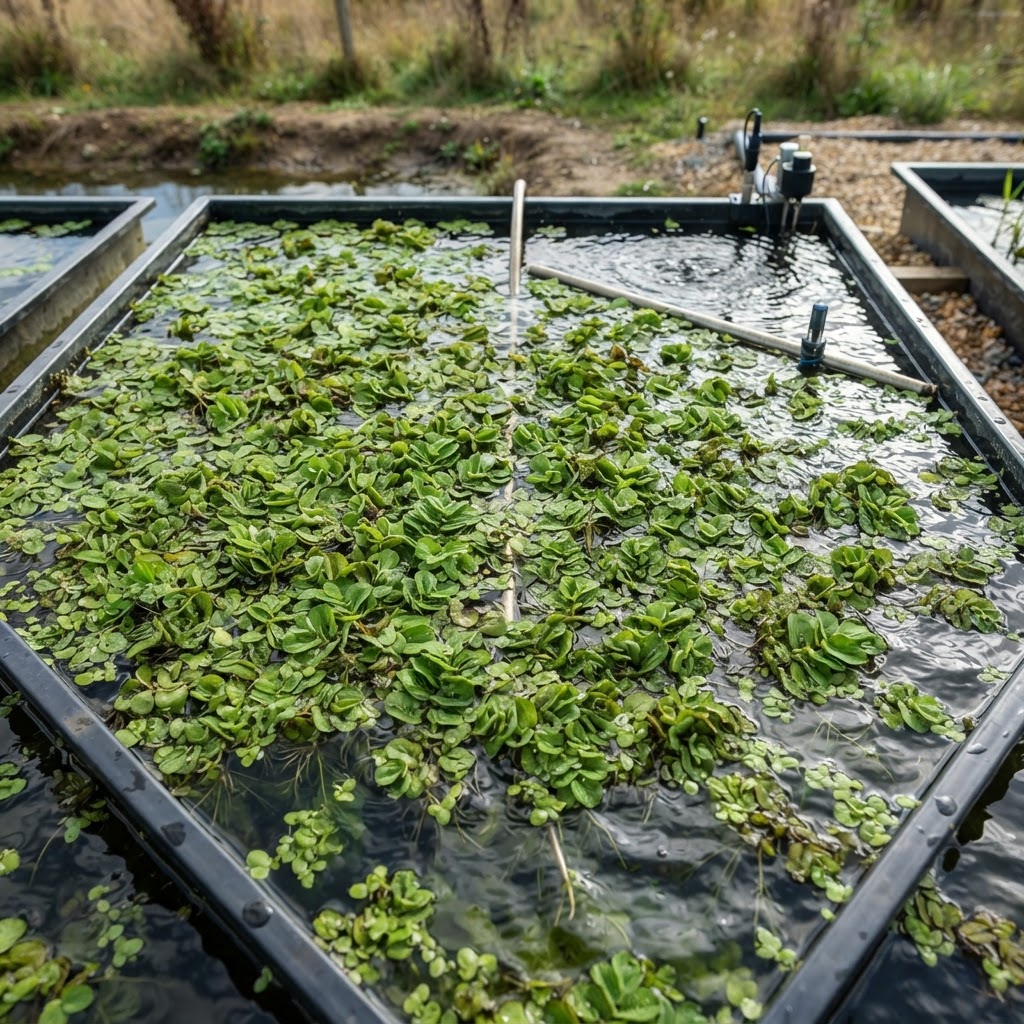
Published broiler trials have fed duckweed at 3 percent of the diet and at 25 percent of the diet, and both results held up. That looks like a contradiction. It is not. It is what happens when six research groups each test a different batch of something they all call duckweed.
So the useful question about duckweed chicken feed is not how much you can feed. It is what you are holding. Once you know the species, the water it grew on and the crude protein of that specific harvest, the inclusion rate mostly answers itself.
The reviews give you the headline numbers to start from. The Indian Journal of Animal Sciences review reports crude protein anywhere from 7 to 40 percent of dry matter depending on the growing medium and the species, an essential amino acid profile similar to animal protein with the exception of methionine, and 4 g lysine per 100 g protein. It puts inclusion at up to 15 percent in broiler rations and up to 40 percent in layer diets. Note that the same source that gives you the ceiling also gives you a protein range with a fivefold spread. Those two facts are connected.
Two duckweed batches are not the same ingredient
The clearest evidence on this comes from a study that did the obvious thing and tested three real batches side by side in Ross 308 broilers.
Batch A was a mix of Lemna minuta and Lemna minor at 17.5 percent crude protein. Batch B was Spirodela polyrhiza at 24.6 percent. Batch C was Lemna obscura at 37.0 percent. Same genus family, same common name, and the protein content more than doubles across them.
The differences do not stop at protein. Tannins came in at 2943, 2890 and 303 mg per kg for batches A, B and C in that order, roughly a tenfold gap. Standardised ileal digestibility of methionine ranged from 49.9 percent in batch A to 90.4 percent in batch C. Phosphorus digestibility ran from 50.8 to 78.9 percent. A formulator working from a table of average values would get every one of these wrong.
The bird stops eating before the protein matters
The most practical finding in that study has nothing to do with amino acids. Duckweed holds water. Water binding capacity of the control diet was 119.6 percent. At the highest duckweed share it reached 364.9 percent. Average daily feed intake fell from 154.2 g per day on the control to 74.9 g per day at that inclusion level.
A ration the bird will not eat has no nutritional value at all. High fibre and high ash push in the same direction. That is the real ceiling on duckweed protein in a monogastric diet, and it is a physical property of the biomass rather than a limit on the protein itself. The study’s own conclusion is that a defined and stable biomass composition, optimised for the bird, is the precondition for using duckweed at all.
What the broiler trials found
Read in that light, the trial record stops looking inconsistent.
At the conservative end, work at the University of Zimbabwe fed 160 male broilers finisher diets at 0, 10, 20 and 30 percent duckweed. Intake, weight gain and feed conversion all declined as inclusion rose, and 10 percent was the level that matched the control on both performance and carcass composition.
Higher rates have worked with a better batch. Feeding Lemna gibba at 0, 10, 15 and 25 percent, Haustein and colleagues at the Universidad Agraria in Lima found weight gain at 15 percent equal to controls, while 25 percent significantly cut feed consumption and gain. In a separate commercial-conditions run at 5 percent, female birds reached higher final weights, and pigmentation increased significantly in every duckweed-fed group.
At the low end, a 2026 study fed 150 Ross 308 birds Lemna minor at 3 and 4 percent across starter, grower and finisher phases and found no negative effect on production performance, with improved blood and antioxidant parameters. It also found something a feed buyer should know: the smell of the breast meat changed, increasing with the duckweed percentage. That is a commercial fact, not a benefit or a defect, and the authors state plainly that the results need validation under commercial farm conditions before broad recommendations.
Two limits recur across the record. Duckweed is a partial substitution, not a replacement: complete replacement of dietary fish meal by duckweed plus soybean meal reduced gain and raised production cost in a 1997 Bangladeshi trial. And young birds are the constraint. The standing review of duckweed as an animal feed notes that growth of very young broilers was retarded at increasing Lemna gibba levels while layers and older broilers did well, and advises being conservative with young birds specifically.
Methionine is the amino acid that decides the ration
Every source above converges on the same gap. The duckweed amino acid profile resembles animal protein except for methionine.
The Belgian pilot below ran a full essential amino acid panel against published requirements and rated the total profile suitable for broilers, while flagging histidine and methionine as potentially limiting for pigs or cattle. Broilers are the better fit among the monogastrics, then, but only because the premix is expected to carry the methionine that the plant does not. Any duckweed amino acid profile you are quoted should be read next to the digestibility figure for that same batch, because a high total methionine content at 49.9 percent digestibility is not the same ingredient as a lower total at 90.4 percent.
Which water it grew on decides whether it is feed at all
The best outdoor evidence available on duckweed as a feed crop comes from a pilot at a pig farm in Pittem, Flanders, run over a full Belgian growing season. Three 10.18 square metre systems, Lemna x japonica clone 6580, growing medium made of the diluted liquid fraction of pig manure plus nitrification and denitrification effluent. It produced 8 tonnes of dry biomass and 2.8 tonnes of protein per hectare per year while removing 1.2 g of nitrogen and 0.13 g of phosphorus per square metre per day, and the harvested biomass was then assessed as a feed ingredient.
That is a real result and the paper is careful with it. It is also the point where SERAPH’s own operating policy diverges, and the divergence is worth stating explicitly rather than blurring.
SERAPH runs two permanently separated streams. Production-grade biomass for food, feed and high-value products is one. Non-food remediation biomass is the other, and it never crosses. The separation starts at the first sensor reading, not at the point of sale, because containment and traceability are cheap to design in and impossible to retrofit into a harvest that has already been mixed. That is a company policy, not a regulation, and it is a stricter line than the research literature draws.
The reason to hold it is in the literature anyway. Duckweed concentrates what is in its water. The standing review notes that harvested crop may need decontamination before feeding where heavy metals are present, precisely because the plant is efficient at taking them up. If you are sourcing biomass grown on manure or effluent, that question belongs in your supplier specification before the protein figure does.
The number nobody publishes: how long the pond actually runs
A trial result becomes a feed contract only if the supply is there in week 30.
The Belgian pilot is one of the few sources that reports this honestly. Growth ceased after roughly 100 to 120 days, which the authors attribute to rising pH and electrical conductivity in the medium, pointing at ammonia toxicity and salt stress. Not a yield problem. A system stability problem, visible only because somebody ran it outdoors for a whole season.
Set that against the yield figures in circulation. Field yields for well-managed systems land at 10 to 30 tonnes of dry matter per hectare per year, while extrapolated experimental rates run several times higher. The gap between those two numbers is the entire lab-to-field problem in one line, and it applies to duckweed growth rate claims generally. Plan the harvesting equipment and the season length together, or the ration you formulated in July has no ingredient in November.
How to buy or grow duckweed for a flock without guessing
Four questions do most of the work.
Ask for the species, not the common name. Lemna obscura and Lemna minuta are both duckweed and they are not the same purchase.
Ask for crude protein on that batch, from that harvest. A range quoted from a review tells you what the genus can do, not what is in the sack.
Ask what the growing medium was, and treat the answer as a food safety question rather than an agronomic one.
Assume methionine has to come from somewhere else, and start young birds low.
SERAPH’s own work sits upstream of all four. The system is at TRL 3, proof of concept, with outdoor field validation still ahead, and that is stated deliberately rather than softened. Behind it is a knowledge base of 256 indexed duckweed papers mapped across 31 research areas in 5 domains, which is how the coverage gaps in this field become visible instead of assumed.
The measurement side is further along. SERAPH Vision reconstructs a cultivation canopy in 3D from a single capture, using 170,000 surface points drawn from 5.9 million captured, computes canopy volume, and already tells duckweed species apart on a real tray, frame by frame. Growth and stress reading are still in development.
Which returns to where this article started. If the batch is the variable that decides whether duckweed is a 5 percent ingredient or a 25 percent one, then knowing what is actually growing in the tray is not a nice-to-have. It is the measurement the whole feed question rests on.
FAQ
How much duckweed can you feed a chicken?
Published broiler ceilings cluster at 10 to 15 percent of the diet. Twenty-five percent has worked, but only with a high-protein low-tannin batch such as Lemna obscura, and layer diets tolerate considerably more than broiler diets at up to 40 percent. Treat any single number as conditional on the batch.
Can chickens eat duckweed straight from a pond?
Birds will eat it fresh, and smallholders have fed it that way for a long time. The caution is that duckweed takes up what is in its water, including heavy metals, and biomass from a contaminated source may need decontamination before feeding. For poultry specifically the reviews prefer dried duckweed of known origin.
Is duckweed better than soybean meal for chickens?
Not as a straight swap. It is a partial protein substitute with more ash and fibre than soymeal and a methionine shortfall, and full replacement trials have gone badly. Its case is local supply and nutrient recovery, not superiority per kilogram.
Does duckweed change the meat or the eggs?
Yes, measurably. Pigmentation increased significantly in duckweed-fed broilers in the Lima trials, and breast meat smell shifted with dose in the 2026 Ross 308 study. Whether that matters depends on your market.
Can you feed chickens duckweed grown on wastewater or manure?
The research literature has evaluated exactly that and reports usable feed values from manure-grown biomass. SERAPH does not do it. Remediation-grade biomass never enters food or feed here, and the two streams are separated from the first sensor reading. That is our operating policy rather than a legal rule, and it is deliberately stricter than what the published work permits.